

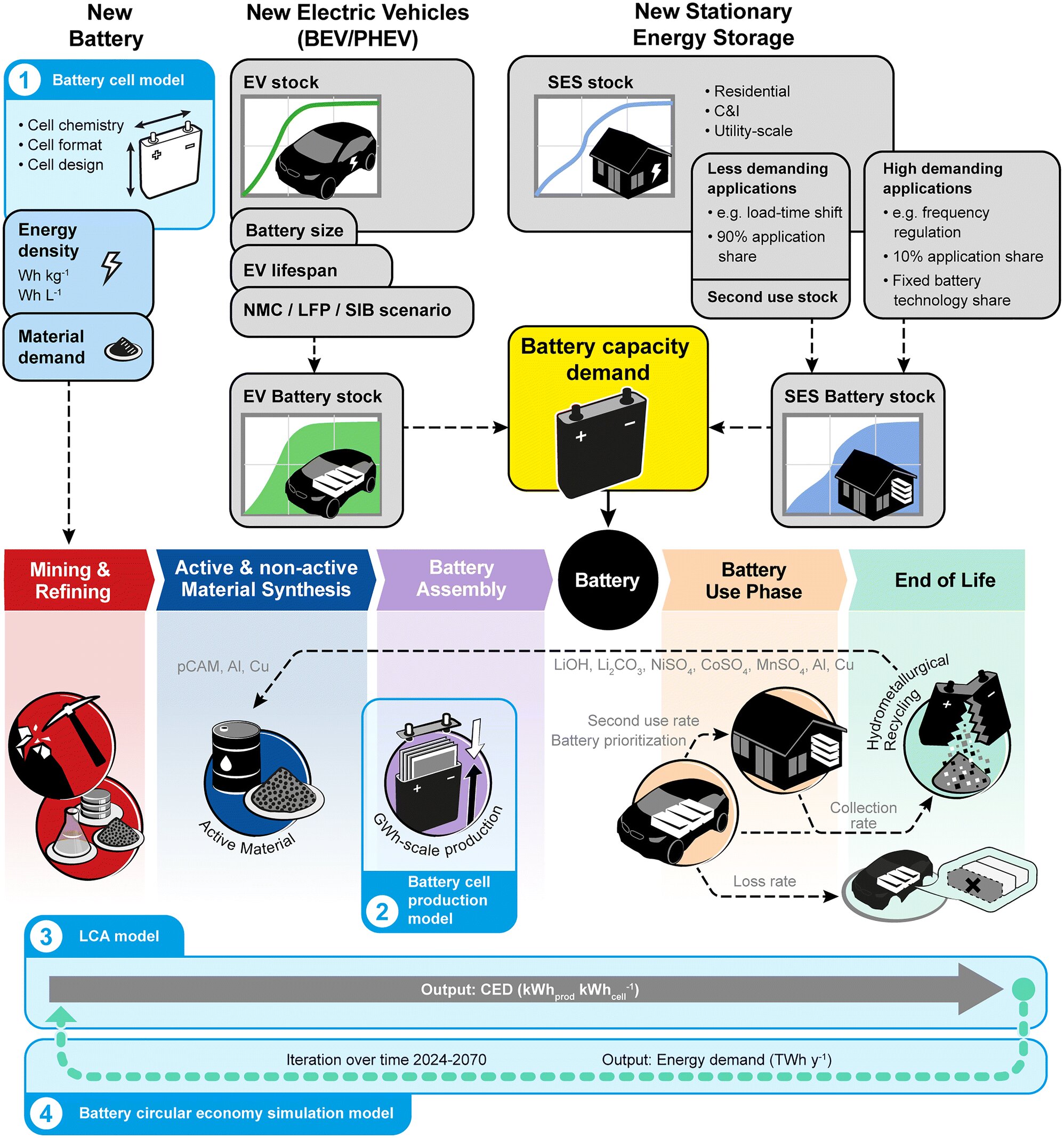

(1) A modeling framework for battery cell models, (2) a battery cell production model, (3) a life cycle evaluation model, and (4) a circular economy simulation model to determine energy consumption across the entire European battery value chain until 2070. Credits: Energy & Environmental Science (2025). doi:10.1039/d5ee02287h
Europe accounts for around 25% of the world’s electric vehicle sales. Despite high demand, Europe currently only supplies around 6.8% of the energy required for cell production. Most energy is imported in the form of materials and battery cells.
A team led by Professor Simon Lux (University of Munster and Fraunhofer Research Institute for Battery Cell Production) has now analyzed future energy requirements related to the European Union’s goal of strengthening the battery supply chain in Europe. This study has been published in the Journal Energy & Environmental Science.
To achieve self-sufficiency by 2050, researchers predict that the EU will need to meet annual growth in energy demand for local battery cell production from current levels of approximately 3.5 terawatt hours (TWH) per year to 250 TWH per year. This is only possible if well-developed recycling infrastructure has been introduced in the past.
Additionally, Europe requires 200-250 TWH to compensate for losses of efficiency when charging electric vehicles and draining batteries in electric vehicles and fixed storage systems. Nevertheless, the increase in energy demand for lithium and sodium ion batteries is offset by 90 TWH of upstream fossil fuel energy.
“Strengthening the local battery supply chain is important to reduce energy dependence,” says Lux. “However, Europe requires a significant amount of energy supply.” Battery-based electricity demand is increasing disproportionately compared to total electricity demand, requiring large investments in renewable generation and corresponding infrastructure.
It is also important that Europe maximizes battery recycling rates and recycling efficiency, reducing import dependence and future energy demand. Researchers assume there is a significant recycled capacity in Europe (a battery capacity of approximately 800 gigawatt hours is expected to be recycled annually from 2050). This could reduce the energy required for battery production in Europe by 33-46%.
However, current recycling infrastructure is in the early stages of development. Therefore, researchers conclude that European policymakers need to implement effective regulations that enable businesses to develop viable and sustainable recycling capabilities.
This study is based on recent research studies and life cycle assessment analysis using data from the Ecoinvent database. Additionally, the research team conducted energy demand analysis using simulation models developed by the Institute of Chemistry and Pharmacy Management at Munester University.
Details: Future energy demand for automobile and fixed lithium and sodium ion battery production for Lukas Ihlbrock et al., European Economics, Energy and Environmental Sciences (2025). doi:10.1039/d5ee02287h
Provided by the University of Munster
Citation: Researchers analyze future European energy demand for battery cell production obtained on September 16, 2025 from https://techxplore.com/news/2025-09–09- european-energy-demand-battery.html (September 16, 2025)
This document is subject to copyright. Apart from fair transactions for private research or research purposes, there is no part that is reproduced without written permission. Content is provided with information only.
