

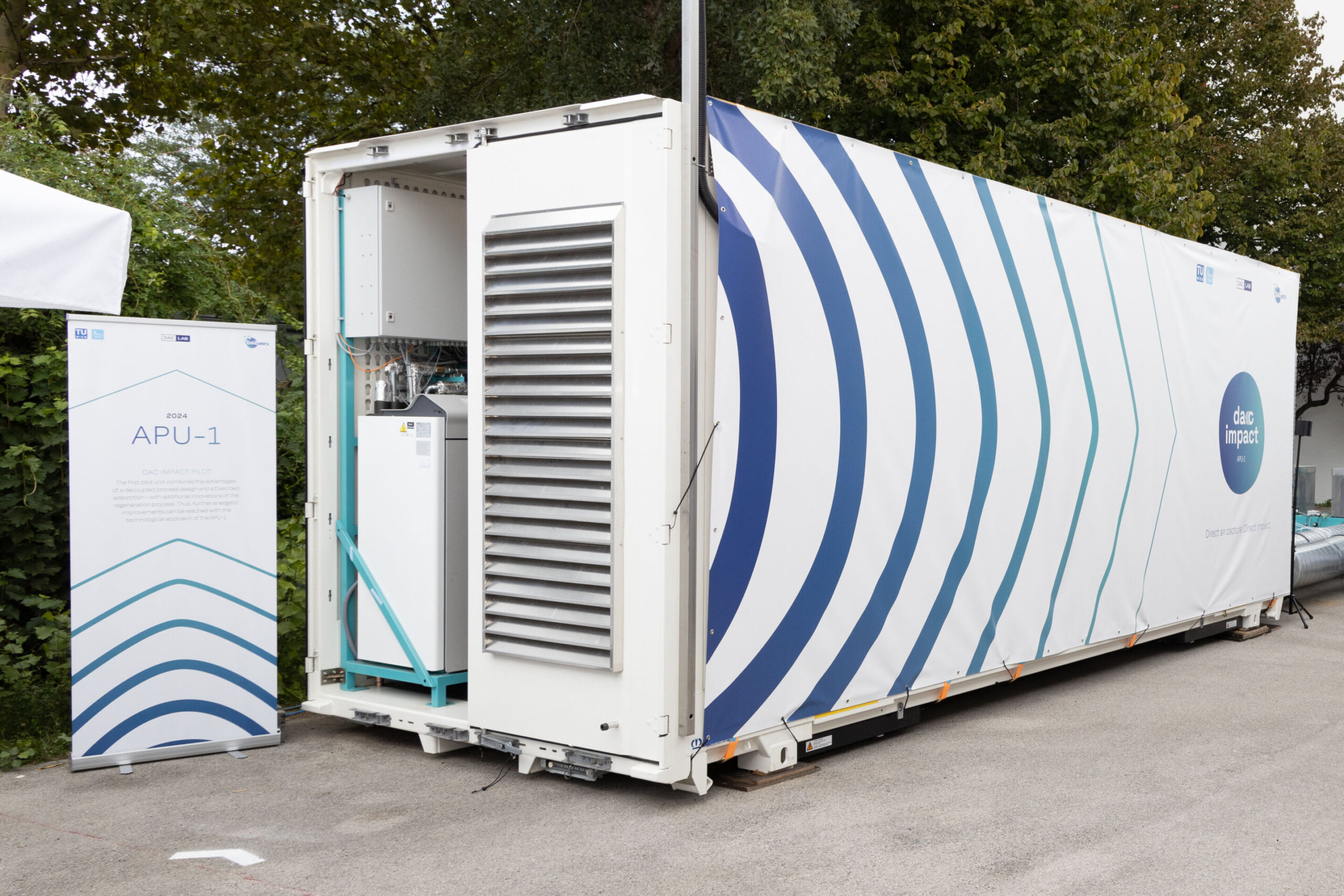

The CO2 capture system fits into a standard shipping container. Credit: Vienna University of Technology
This will be a game-changer for CO2 capture. The newly developed pilot plant, which is about the size of a truck container, will extract 50 tonnes of CO2 per year from the atmosphere and do so with record-low energy demands of less than 2,000 kilowatt-hours per tonne. Austrian Pilot Unit 1 (APU1) was recently commissioned and is currently undergoing continued development and scaling.
The idea of filtering harmful CO2 from the surrounding air is not new. However, this new technological approach to extracting CO2 directly from the air focuses on minimizing the factory’s energy consumption. A compact module has been created that can be used flexibly in the future. Small businesses and private initiatives can use individual units, while larger companies can combine multiple modules to build large plants. The next step is to establish a 1,000-ton facility that can be developed into commercial-scale modules.
Important questions about the future of the climate
It is clear that capturing CO2 does not mean that we will be able to inadvertently release it into the atmosphere in the future. Reducing CO2 emissions is inevitable. But it’s still not enough. In addition, we also need to capture the CO2 already released into the atmosphere.
Current climate models already factor in this CO2 capture, even though the technology is not yet available on the market. Without the ability to remove CO2 from the atmosphere on a large scale over the next few decades, climate change will become much more negative than previously predicted. This makes CO2 capture central to our climate future.

Andreas Walmüller and Peter Steinschaden. Credit: Vienna University of Technology
Fine-grained filter material binds CO2
Let me briefly explain the idea behind the process. Certain substances, such as amines, can combine with CO2 in the air. The material is used in the form of microparticles bound to a solid, through which air is pumped to almost completely remove CO2. At some point, the filter material becomes saturated and the bound CO2 must be removed from the filter material and stored elsewhere.
To do this, the filter material must be heated. A significant portion of the plant’s total energy requirements is allocated to this step. At high temperatures, the bound CO2 is released from the material, and the regenerated material can then filter CO2 from the air again.
Currently, both filtration and regeneration steps take place in the same location, but energy losses occur because not only the filter material but also the surrounding containers and technical equipment are heated in each cycle and then have to be cooled again. To prevent this energy loss, technology has been developed to automatically transport filter material between hot and cold containers.
Two-zone process saves energy
The vessel in which the actual filtration process takes place does not need to reach high temperatures. Once the material is saturated, it is transported to the regeneration equipment via a specially developed transport system. All that is required is heating. Additionally, highly energy-efficient filter media regeneration can be achieved by highly deploying multiple regenerators. The filter media is then returned. This trick provides a better energy balance than other systems. Capturing 1 ton of CO2 requires less than 2,000 kWh of electricity.
The efficiency of APU1 will naturally increase further if heat is supplied from other low-grade heat sources below 100°C. Ideal for coupling with energy plants that generate heat. Currently, the low-temperature waste heat required by such systems is often not utilized and is simply released into the environment as waste heat.
This is exactly how the research team and investors believe this technology will become economically viable. The idea is not necessarily to build large, centralized CO2 capture facilities, but rather to provide a compact, scalable technology that can be installed based on individual needs, similar to how customized solar power systems are installed today.
Provided by Vienna University of Technology
Citation: New technology extracts CO₂ from the atmosphere (November 17, 2025) Retrieved November 18, 2025 from https://techxplore.com/news/2025-11-technology-atmosphere.html
This document is subject to copyright. No part may be reproduced without written permission, except in fair dealing for personal study or research purposes. Content is provided for informational purposes only.
