

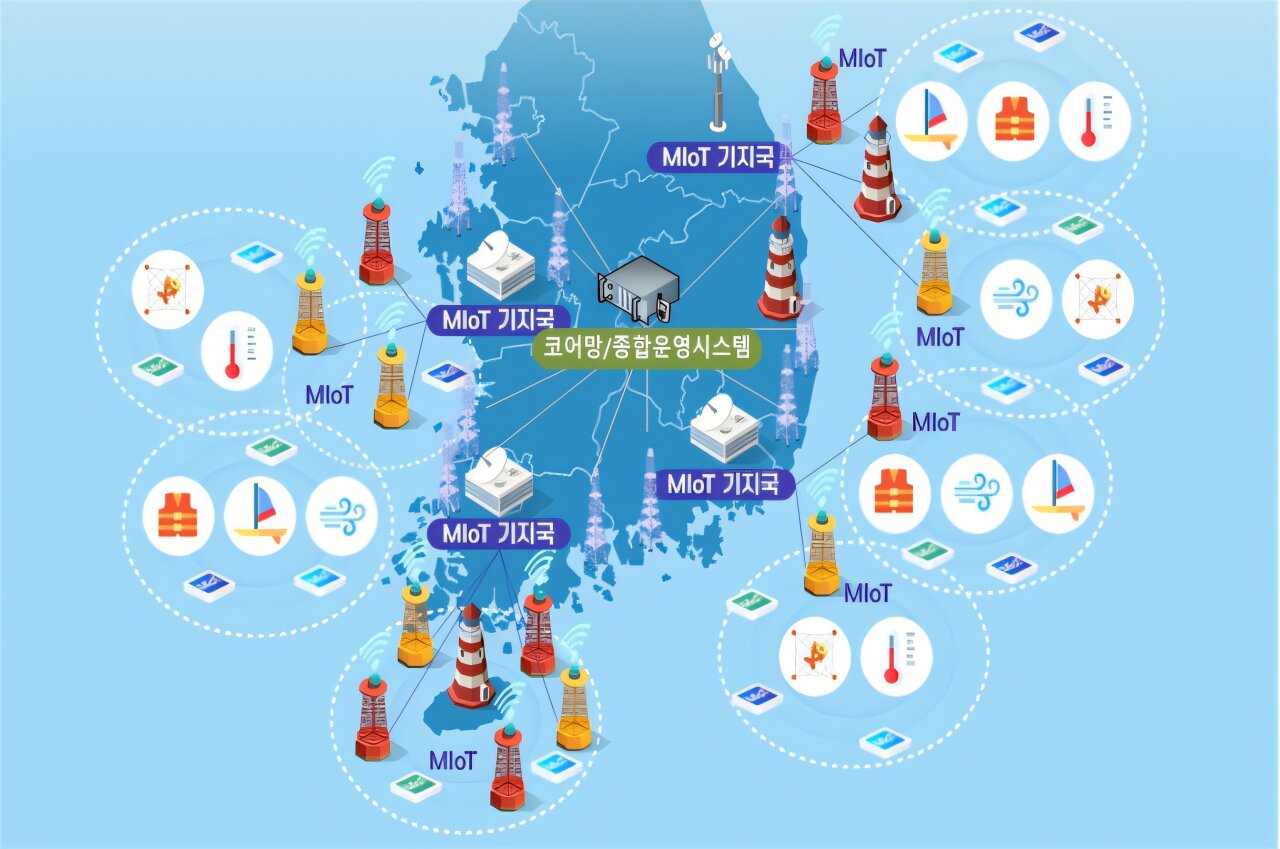

Conceptual diagram of a marine internet of things (MIoT) network. Credit: Electronics and Telecommunications Research Institute (ETRI)
South Korean researchers have successfully verified the world’s first real-world maritime Internet of Things (MIoT) communication network, which can be used for safety management and environmental monitoring by installing sensors and communication devices on ships, ports, and marine facilities to collect oceanographic data.
The Electronics Telecommunications Research Institute (ETRI) has built an MIoT communication network in the Western Sea and Southern Ocean, achieving a communication range of up to 35 km and simultaneous connection of 30 devices. This achievement is significant because it is the first time that the IoT international standard technology defined by the 3rd Generation Partnership Project (3GPP) has been tested and validated in a real marine environment.
The developed MIoT communication network can be used to build a big data system that collects marine weather, ecological, and environmental data and shares it with public institutions. It also contributes to the efficient operation of marine facilities such as AtoN (beacons of navigation), fishing gear, aquaculture facilities, and uninhabited island management. It can also be used for public safety management, such as tracking small ships, life jackets, and floating objects in the ocean, and has a wide range of applications.
Network deployment and successful demonstration
Researchers developed an independent network that connects base stations, terminals, core networks, and application services by utilizing the 450MHz public frequency band secured by the Ministry of Maritime Affairs and Fisheries in 2023.
In June, a base station was installed at the Godongdo Lighthouse in Yeosu City, and 30 terminals were installed at six locations, including the test light buoy, and the company succeeded in transmitting and receiving actual data.
In August, a base station was installed at Maldo Lighthouse in Gunsan, and terminals were installed at lighthouses at Gunsan Port, Biun Port, Janghang Port, and Gakpo Port to continue communication demonstrations.
As a result, communication was successfully established over a distance of 27 km between the Wudong Island base station and the Namdo Port terminal, and a distance of 35 km between the Maro base station and the Janghang Port terminal.
Once connected to the network, the deployed devices worked reliably, transmitting their GPS location, lighting status, impact detection, and battery level every three minutes. Additionally, 30 terminals installed at AtoNs (navigation aids) in Yeosu City and Gunsan were successfully connected simultaneously, and it was verified that up to 1,000 terminals can be connected simultaneously using commercial test equipment.
Future plans and international impact
Based on these results, ETRI plans to build an MIoT pilot network in the three regions of East, West, and Nankai starting in 2026, and expanding nationwide from 2030 onwards.
Unlike existing land-based narrowband Internet of Things (NB-IoT), the MIoT system developed by ETRI is built as an independent network and applies low-power transmission and reception techniques optimized for the marine environment and message prioritization for safety services.
Unlike LTE-M (LTE-Maritime), which specializes in large-capacity data transmission, it is a communication network that specializes in low-power, low-cost equipment, and is differentiated in that it can create a high-density maritime network similar to that on land by complementing existing maritime communication networks.
The International Agency for Marine Navigation (IALA) has already begun efforts to standardize maritime IoT technology internationally, and the government has also formulated the “Third Aids to Navigation Basic Plan (2025-2029)” and the “Maritime Navigation Information System Innovation Strategy (April 2025)” to promote the construction of a nationwide maritime IoT communication network.
ETRI’s recent results are expected to contribute not only to international standardization, but also to attracting an International Cooperation Center for Aids to Navigation to South Korea and exporting technology overseas.
Expert perspective and future prospects
Dr. Sung-cheol Cho, the project leader for this research, said, “The world’s first demonstration of an MIoT communication network at sea is not just a technology demonstration, but will serve as the basis for creating new industries based on marine big data and expanding the national maritime safety infrastructure.”
“We will strive to lead Korea’s global maritime digital transformation by building pilot networks in the East, West and South Seas and further advancing our technology in line with international standards.”
Lee Moon-sik, deputy director of the Satellite Communications Research Department, said, “Securing a public frequency for implementing a standalone maritime IoT network in the actual ocean and demonstrating a maritime IoT communication network based on smart navigational aids is a first in South Korea and an unprecedented achievement internationally. We hope that South Korea’s maritime safety management and climate crisis response capabilities will be further strengthened.”
ETRI plans to continue to advance and commercialize the system through further research.
This achievement is expected to lay the foundation for South Korea to lead the global maritime IoT market while securing ocean big data and strengthening maritime safety at the same time.
Provided by National Science and Technology Research Council
Citation: Researchers Complete First Real-World Verification of Marine IoT Communication Network (November 17, 2025) Retrieved November 18, 2025 from https://techxplore.com/news/2025-11-real-world-verification-maritime-iot.html
This document is subject to copyright. No part may be reproduced without written permission, except in fair dealing for personal study or research purposes. Content is provided for informational purposes only.
