

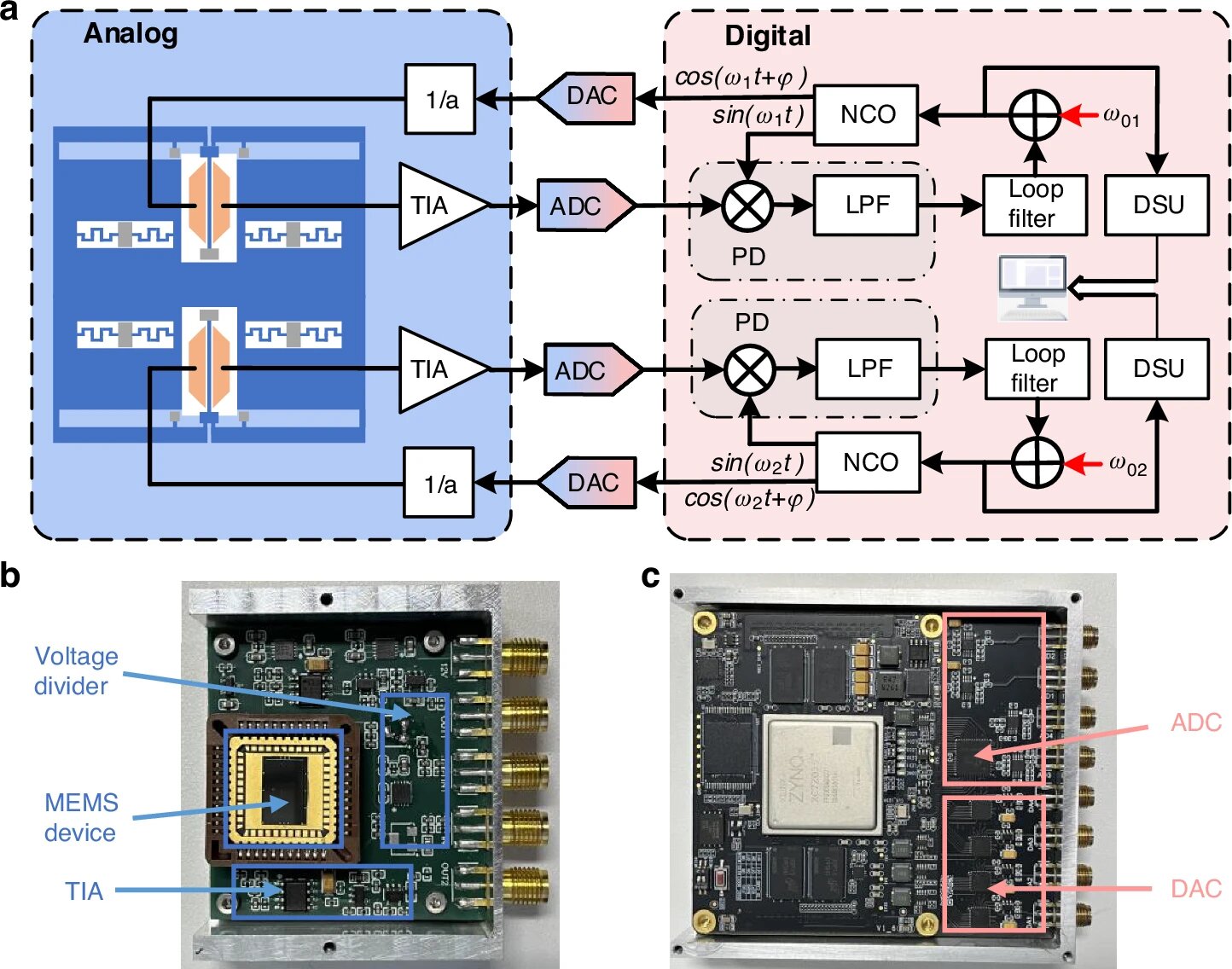

DMCS working principle and experimental setup. Credit: Microsystems and Nanoengineering (2025). DOI: 10.1038/s41378-025-01022-1
A research team led by Professor Zou Xudong of the Institute of Aerospace Information, Chinese Academy of Sciences (AIRCAS) has proposed a new solution to address two long-standing challenges in microelectromechanical systems (MEMS) resonant accelerometers: temperature drift and measurement deadband.
By implementing a dual-mode operating scheme that effectively separates the operating frequencies of the device’s differential beams, the team achieved improved sensor accuracy and performance. Their findings were recently published in Microsystems & Nanoengineering.
This study reveals that driving one beam in a first resonant mode and operating the other beam in a second resonant mode enhances temperature compensation and reduces mode localization effects that typically cause measurement dead bands. The dual-mode design also preserves the geometric symmetry of the beam. This is important to minimize temperature-induced errors and maintain stable sensor performance.
Experimental data supports the effectiveness of the solution, where the dual-mode method reduces temperature-induced drift by more than 280 times compared to traditional approaches. Specifically, after differential compensation, the temperature drift was reduced from approximately 342 mg to 1.19 mg. In addition, Allan deviation and power spectral density (PSD) analysis revealed a significant reduction in low-frequency noise, improving accelerometer accuracy and long-term stability.
Additionally, this design eliminates frequency overlap between the two differential beams, solving the dead zone problem that commonly occurs when the operating frequencies of the beams intersect.
The researchers emphasized that this dual-mode technology provides a cost-effective way to improve the performance of MEMS accelerometers, making them valuable for applications such as inertial navigation and vibration monitoring.
More information: Bingchen Zhu et al., Temperature Drift Suppression and Measurement Dead Zone Elimination in Differential MEMS Resonant Accelerometers Using Dual-Mode Operation Method, Microsystems & Nanoengineering (2025). DOI: 10.1038/s41378-025-01022-1
Provided by Chinese Academy of Sciences
Citation: Dual-mode design improves accuracy in MEMS accelerometers, study reveals (November 17, 2025) Retrieved November 18, 2025 from https://techxplore.com/news/2025-11-dual-mode-boosts-mems-accelerometer.html
This document is subject to copyright. No part may be reproduced without written permission, except in fair dealing for personal study or research purposes. Content is provided for informational purposes only.
