
Close Menu
  • Home
  • Aerospace & Defense
    • Automation & Process Control
      • Automotive & Transportation
  • Banking & Finance
    • Chemicals & Materials
    • Consumer Goods & Services
  • Economy
    • Electronics & Semiconductor
  • Energy & Resources
    • Food & Beverage
    • Hospitality & Tourism
    • Information Technology
  • Agriculture
What's Hot

Counter-terrorism chiefs urge farmers to review fertilizer safety

Saks’ acquisition of Neiman Marcus led to bankruptcy

Five US lawmakers investigated for warning troops about illegal orders | Donald Trump News

Facebook X (Twitter) Instagram
USA Business Watch – Insightful News on Economy, Finance, Politics & Industry
  • Home
  • Aerospace & Defense
    • Automation & Process Control
      • Automotive & Transportation
  • Banking & Finance
    • Chemicals & Materials
    • Consumer Goods & Services
  • Economy
    • Electronics & Semiconductor
  • Energy & Resources
    • Food & Beverage
    • Hospitality & Tourism
    • Information Technology
  • Agriculture
  • Home
  • About Us
  • Market Research Reports and Company
  • Contact us
  • DMCA
  • Privacy Policy
  • Terms & Conditions
USA Business Watch – Insightful News on Economy, Finance, Politics & Industry
Home » New study finds that parasitic wasps remain effective against crop pests
Agriculture

New study finds that parasitic wasps remain effective against crop pests

Bussiness InsightsBy Bussiness InsightsDecember 23, 2025No Comments3 Mins Read
Share Facebook Twitter Pinterest Copy Link Telegram LinkedIn Tumblr Email
Share
Facebook Twitter LinkedIn Pinterest Email


Despite growing concerns about resistance, parasitic wasps remain an effective and resilient alternative to chemical pesticides for controlling crop pests, according to new research.

The University of Stirling research results show that biological pest control continues to work well even when pests begin to adapt, which should reassure farmers and producers who are under increasing pressure to reduce chemical inputs.

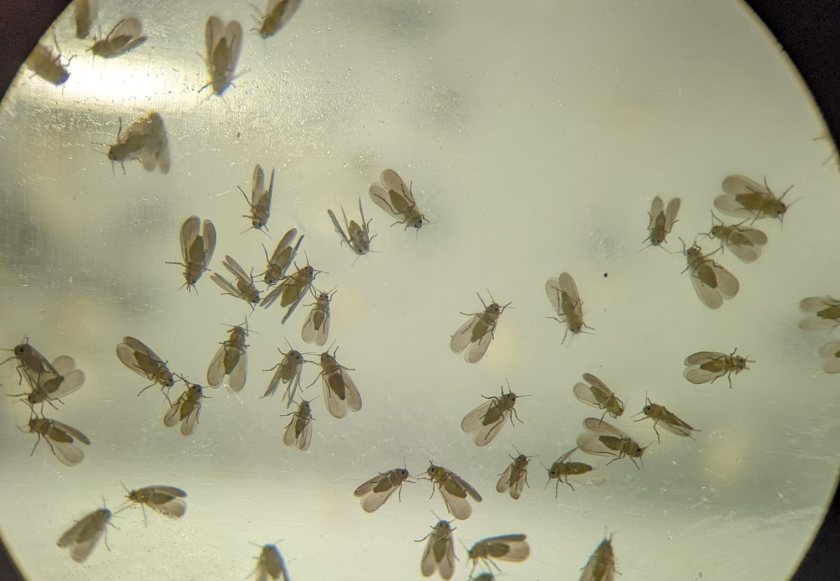
The researchers focused on the glasshouse whitefly, a sap-sucking pest that is widespread in protected crops, and Encarsia formosa, a parasitic wasp commonly used to control it.

The study, led by Dr Mia McGowan, found that while some whiteflies may develop genetic resistance to parasitism, those that survive pay a significant biological cost. The reproductive success of surviving individuals was found to be low, and the spread of resistance throughout the pest population is unlikely.

The use of predators and parasitic insects to control pests is widely considered to be safer and more environmentally sustainable than chemical pesticides, to which pests are known to rapidly adapt. In the case of Encarsia formosa, the wasps lay their eggs inside whitefly larvae, preventing them from becoming adults and naturally reducing the pest population.

Importantly, researchers have discovered that biological control agents can evolve along with the pests they target. This coevolution reduces the risk of rapid resistance development that often undermines the effectiveness of chemical insecticides.

Although reports of pests showing resistance to biological control agents have increased in recent years, this study suggests that such resistance is far less likely to be widespread.

Dr McGowan said concerns about bacterial resistance should always be kept in mind. “In recent years, there have been increasing reports of resistance to biological control agents becoming a problem,” she says.

“Our study shows that although this is possible, complex evolutionary interactions between host and parasite limit its potential and that biological control is evolutionarily resilient when compared to chemical control.”

This study included two controlled experiments conducted in a university controlled environment facility. In one, known closely related whiteflies were exposed to parasitism to assess whether survival was genetically inherited. In a second experiment, whiteflies that survived parasitism were monitored to assess lifetime reproductive success.

The results showed that whiteflies that were able to resist the parasitism laid fewer eggs and produced fewer viable offspring than unexposed insects, confirming that resistance comes at a significant adaptive cost.

Dr Rebecca Boulton, lecturer in evolutionary ecology at the University of Stirling, said the findings strengthened confidence in biological pest control as a long-term strategy.

“Our results add to a small but growing number of case studies demonstrating that resistance to biological control by parasites can evolve under certain circumstances,” she said.

“However, these findings strengthen the view that biological control is an evolutionarily stable and resilient strategy to the evolution of resistance compared to chemical pesticides.”

The researchers said the study supports the continued use of biological control as part of integrated pest management, especially as agricultural systems adapt to stricter pesticide regulations and environmental goals.

They added that biological control provides a durable, science-backed solution for managing pests while reducing reliance on chemical sprays.

Are you enjoying British farming?

Get the weekly agriculture roundup – the essential UK agriculture newsletter


Source link

Follow on Google News Follow on Flipboard
Share. Facebook Twitter Pinterest LinkedIn Tumblr Email Copy Link
Previous ArticleInside Uzbekistan’s nationwide license plate monitoring system
Next Article Lemon Slice gets $10.5 million from YC and Matrix to build digital avatar technology
Bussiness Insights
  • Website

Related Posts

Counter-terrorism chiefs urge farmers to review fertilizer safety

January 15, 2026

NFU warns that gene editing must not be sacrificed in UK-EU trade talks

January 15, 2026

Government says environmental targets affecting farms are ‘significantly off track’

January 15, 2026
Leave A Reply Cancel Reply

Latest Posts

Counter-terrorism chiefs urge farmers to review fertilizer safety

NFU warns that gene editing must not be sacrificed in UK-EU trade talks

Government says environmental targets affecting farms are ‘significantly off track’

‘Hardest year’ for British arable farming, with Frontier profits more than halved

Latest Posts

Boeing will surpass Airbus’ sales in 2025 for the first time since 2018

January 13, 2026

Delta Air Lines (DAL) 2025 Q4 Earnings

January 13, 2026

Greenland and Venezuela crises accelerate huge spending in Europe’s war economy

January 13, 2026

Subscribe to News

Subscribe to our newsletter and never miss our latest news

Subscribe my Newsletter for New Posts & tips Let's stay updated!

Recent Posts

  • Counter-terrorism chiefs urge farmers to review fertilizer safety
  • Saks’ acquisition of Neiman Marcus led to bankruptcy
  • Five US lawmakers investigated for warning troops about illegal orders | Donald Trump News
  • NFU warns that gene editing must not be sacrificed in UK-EU trade talks
  • President Trump suspends immigrant visas for 75 countries: Who will be affected? |Donald Trump News

Recent Comments

  1. one_jdpa on Hundreds gather in Barcelona to protest overtourism in southern Europe
  2. Salvatore Carnevale on Connect category management to the shopper experience
  3. Jerold Lush on Connect category management to the shopper experience
  4. FrankMoone on 100% tariffs on Trump’s drugs: What we know | Donald Trump News
  5. remont_pcka on Hundreds gather in Barcelona to protest overtourism in southern Europe

Welcome to USA Business Watch – your trusted source for real-time insights, in-depth analysis, and industry trends across the American and global business landscape.

At USABusinessWatch.com, we aim to inform decision-makers, professionals, entrepreneurs, and curious minds with credible news and expert commentary across key sectors that shape the economy and society.

Facebook X (Twitter) Instagram Pinterest YouTube

Subscribe to Updates

Subscribe to our newsletter and never miss our latest news

Subscribe my Newsletter for New Posts & tips Let's stay updated!

Archives

  • January 2026
  • December 2025
  • November 2025
  • October 2025
  • September 2025
  • August 2025
  • July 2025
  • June 2025
  • March 2022
  • January 2021

Categories

  • Aerospace & Defense
  • Agriculture
  • Automation & Process Control
  • Automotive & Transportation
  • Banking & Finance
  • Chemicals & Materials
  • Consumer Goods & Services
  • Economy
  • Economy
  • Electronics & Semiconductor
  • Energy & Resources
  • Food & Beverage
  • Hospitality & Tourism
  • Information Technology
  • Political
Facebook X (Twitter) Instagram Pinterest
  • Home
  • About Us
  • Market Research Reports and Company
  • Contact us
  • DMCA
  • Privacy Policy
  • Terms & Conditions
© 2026 usabusinesswatch. Designed by usabusinesswatch.

Type above and press Enter to search. Press Esc to cancel.