

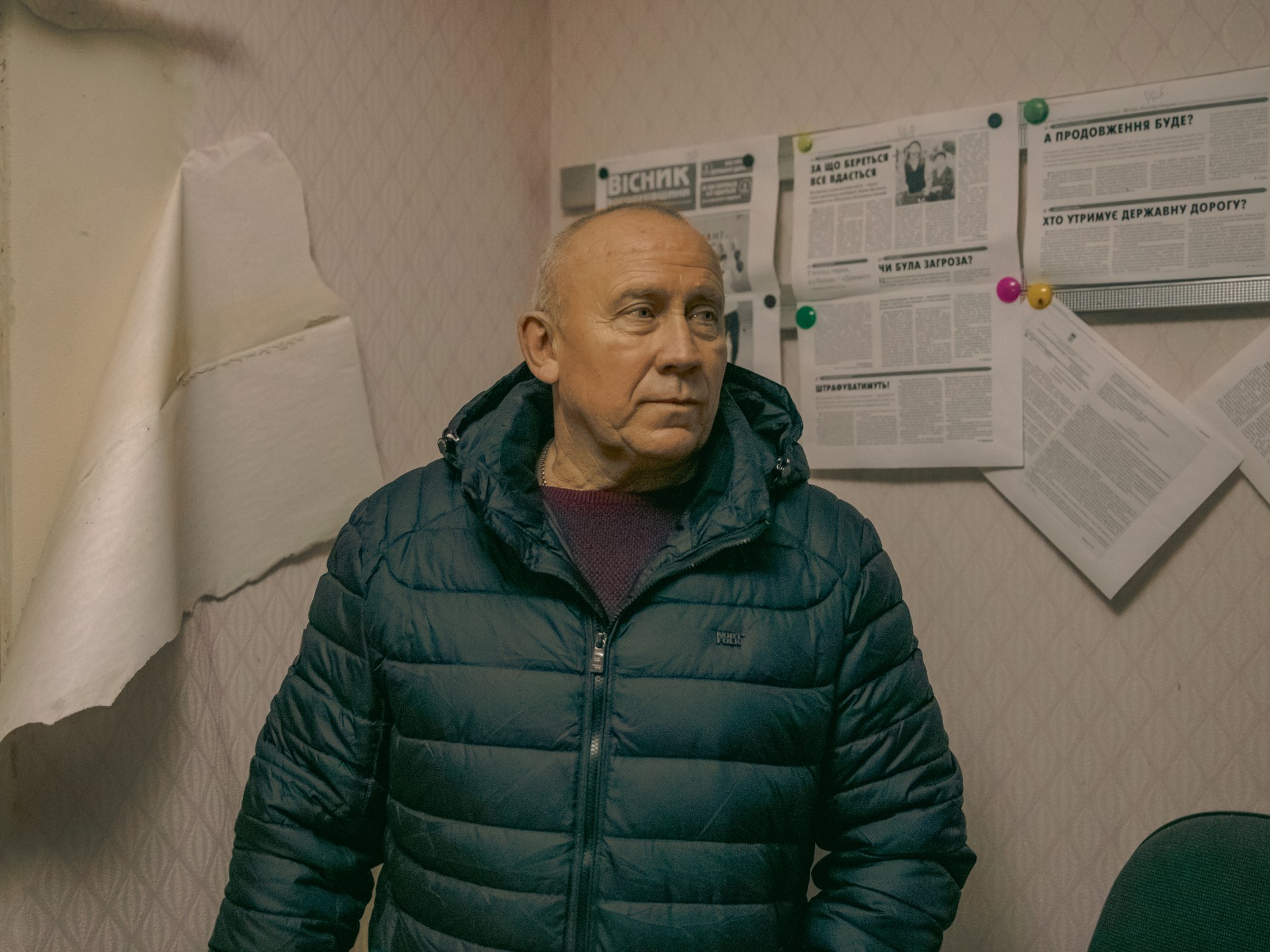
Newspapers on Russian radar
Vasil spent years reporting from Zolotyv before reporting the news along the broken roads of northeastern Ukraine. He wrote poetry as a teenager, studied literature at a university in Kharkiv, and joined the local Zolotiv newspaper at the age of 20. He retired at age 31 to work for the Department of Environmental Protection and Natural Resources, investigating corruption in the district. Ten years later, he returned to the weekly magazine.
“I can’t imagine doing anything other than journalism,” he says.
Vasil is proud that his newspaper was one of the first to be denationalized in 2017. He helped draft a bill that would allow the privatization of local newspapers in Ukraine, a step he saw as essential to relieve state pressure and protect editorial independence.
He continued to investigate local political corruption throughout the war, although he admits that much of the focus has shifted to the war.
“Russia feeds on internal divisions in our country. My priority at the moment is to counter the lies of our adversaries, even though holding our own authorities to account remains part of our job,” he says.
His life has been put in danger many times in the fight against Russian disinformation.
At 9:30 a.m. on April 5, 2022, two Russian artillery shells hit the weekly magazine’s newsroom, partially destroying the 140-year-old building that housed the magazine. Normally, Vasil would have been sitting at his desk at the time, but that day he stayed in bed longer than usual, which helped.
“I was going to be late for work…I partied with one of my friends the night before and drank a lot of bad vodka,” he says with a dark laugh. “It’s a time of war. The quality of the alcohol is very bad, but this is all we had.
“That saved me. I usually wake up early, but I was hungover.”
When I finally started moving and was walking with a friend, two shells passed overhead.
“Half a second later, everything exploded.”
Fortunately, no one was in the newsroom at the time. More than three years later, Vasil’s old desk is still covered in rubble, and he knows he was lucky to escape.
“I would have died considering the debris left in the room,” he says.
His newsroom has been targeted 10 times (twice with artillery fire and eight times with guided air bombs), the most recent attack taking place in the spring of 2025.
Early in the war, the Kremlin press claimed Vasil was responsible for spreading disinformation.
“Apparently, I run a propaganda outlet,” Vasil says sarcastically. “In 2022, Russian state television aired a report accusing me of trespassing into one of their villages and spreading false information.
“I’ve never been there. What I’ve done since the war started is record missile debris embedded in the ground to show where it came from.”
Tracing the origin of the missile debris could expose the Russian attack as a war crime or violation of international law.
“This work is why my newsroom was targeted,” Vasil says.

After the 2022 invasion and the bombing of a printing office in Kharkiv, the paper ceased publication for nearly six months. With Russian troops closing in, many people in Zolotiv were evacuated to safe areas, at least temporarily. However, Vasil chose to stay.
“I had to stay here and testify, but I couldn’t do it if my loved ones were also at risk,” he said, explaining how he sent his family to western Ukraine and then began documenting the destruction that engulfed his homeland.
At the time, enemy forces were less than 10 km (6.2 miles) away. Using his cell phone, he filmed the bombing, the evacuation of civilians and the shattered buildings.
“If I didn’t photograph what I was seeing with my own eyes, who would? We live in a very remote area. I had to show the world what was happening to us.”
Vasil taught himself how to edit videos and posted them on YouTube and social media to reach a wider audience.
“The Russians claimed they were attacking command posts and tank repair facilities,” he said, still furious. “In reality, they were attacking houses, hospitals and kindergartens.”

When Ukrainian forces began liberating the first villages near Zolotiv, Vasyl was determined to restore access to news in an area that had been cut off for six months. He found a new printing press and got to work.
“In these rural areas, there are often no alternative sources of reliable information. People trust us and we can’t walk away from them,” he says proudly.
Two members of the newsroom returned to working remotely, but the paper’s accountant, Kostyantyn Neoneta, remained at Zolotiv, as did Vasil.
“I didn’t want to go home,” said Kostiantin, who distributes newspapers in town every week on his bicycle. “I knew I would be much more useful here than in other cities.”
In villages where Russian signals leak into people’s homes, “people are left with propaganda,” Vasil said, adding, “My mission is to prevent that from happening.”
