

Taiwan’s Mr. Lai pledged to protect national sovereignty after the Chinese government conducted live-fire training near the island.
Chinese President Xi Jinping has vowed to achieve the “unification” of China and Taiwan, saying Beijing’s long-standing goal is “unstoppable.”
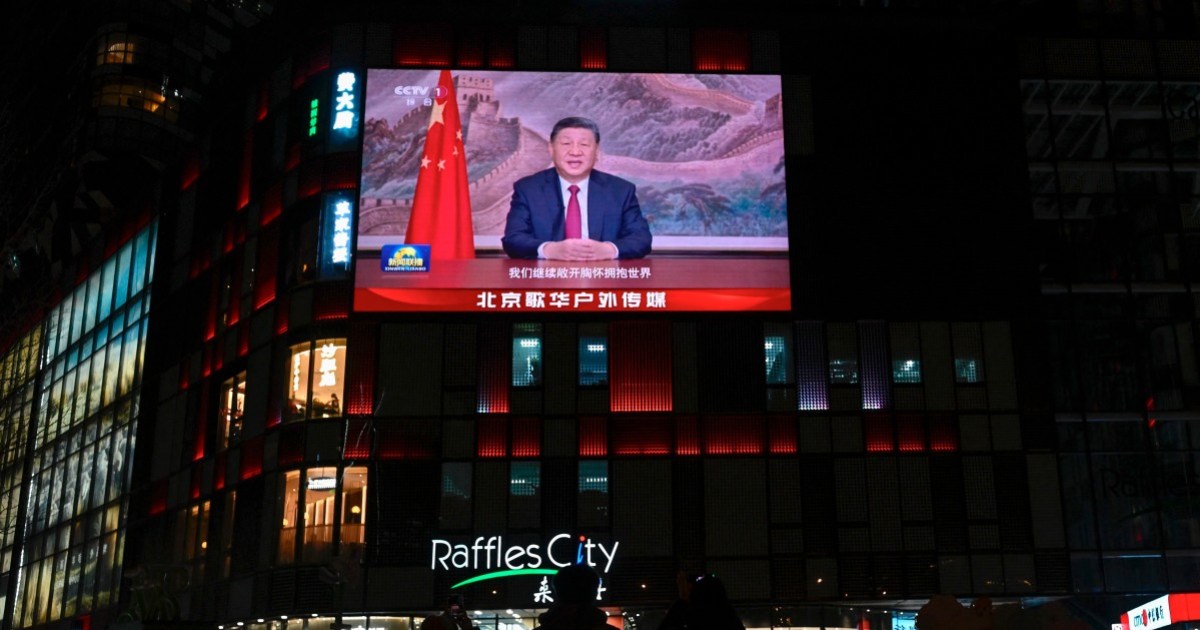
In his New Year’s address, delivered a day after the Chinese military concluded war exercises around Taiwan, President Xi on Wednesday evoked the “bonds of blood and kinship” between Chinese people on both sides of the Taiwan Strait.
Recommended stories
list of 4 itemsend of list
President Xi said, “The reunification of the motherland is a trend of the times and cannot be stopped.”
President Xi also welcomed the establishment of the annual “Taiwan Restoration Day” in 2025 to commemorate the end of Taiwan’s rule by Imperial Japan at the end of World War II.
Mr Xi’s speech came on the heels of a two-day live-fire drill simulating a blockade of the island, which authorities called a “stern warning” to “separatist” and “external interference” forces.
This exercise was the largest ever held around Taiwan in terms of geographic area.
The wargame, codenamed “Justice Mission 2025,” comes just days after the United States approved the largest-ever arms shipment to Taiwan, totaling $11.1 billion.
China considers autonomous Taiwan to be part of its territory and has long promised to keep the island under its control, willing to use force if necessary.
Although Taiwan’s ruling Democratic Progressive Party has not officially declared independence, it maintains that Taiwan is a de facto independent country.
In his New Year’s address on Thursday, Taiwanese President William Lai Ching-de vowed to “resolutely” protect national sovereignty and strengthen the island’s defense.
“As China’s expansionist ambitions escalate, the international community is watching closely to see whether the Taiwanese people are determined to protect themselves,” Lai said.
Taiwan elects its leaders and has its own army, passport and currency, but only 11 countries and the Vatican officially recognize the island.
China insists that countries do not officially recognize Taipei in order to maintain diplomatic relations with Beijing.
Although the United States does not formally recognize Taiwan, the U.S. government is committed to assisting Taiwan in its defense under the Taiwan Relations Act of 1979.
Although the United States is Taipei’s main arms supplier, the law does not provide for an obligation to directly intervene militarily in the event of a Chinese blockade or invasion.
Opinion polls show that a majority of Taiwanese support the status quo, with far fewer supporting formal independence or an imminent move towards reunification.
In his speech Wednesday, President Xi also praised China’s innovations in industries such as artificial intelligence and space.
“We aimed to stimulate quality development through innovation. We deeply integrated science and technology with industry and created new streams of innovation,” he said.
“Many large-scale AI models are competing for the top, and breakthroughs are being achieved in indigenous chip research and development. All of this has made China one of the economies with the fastest-growing innovation capabilities.”
