

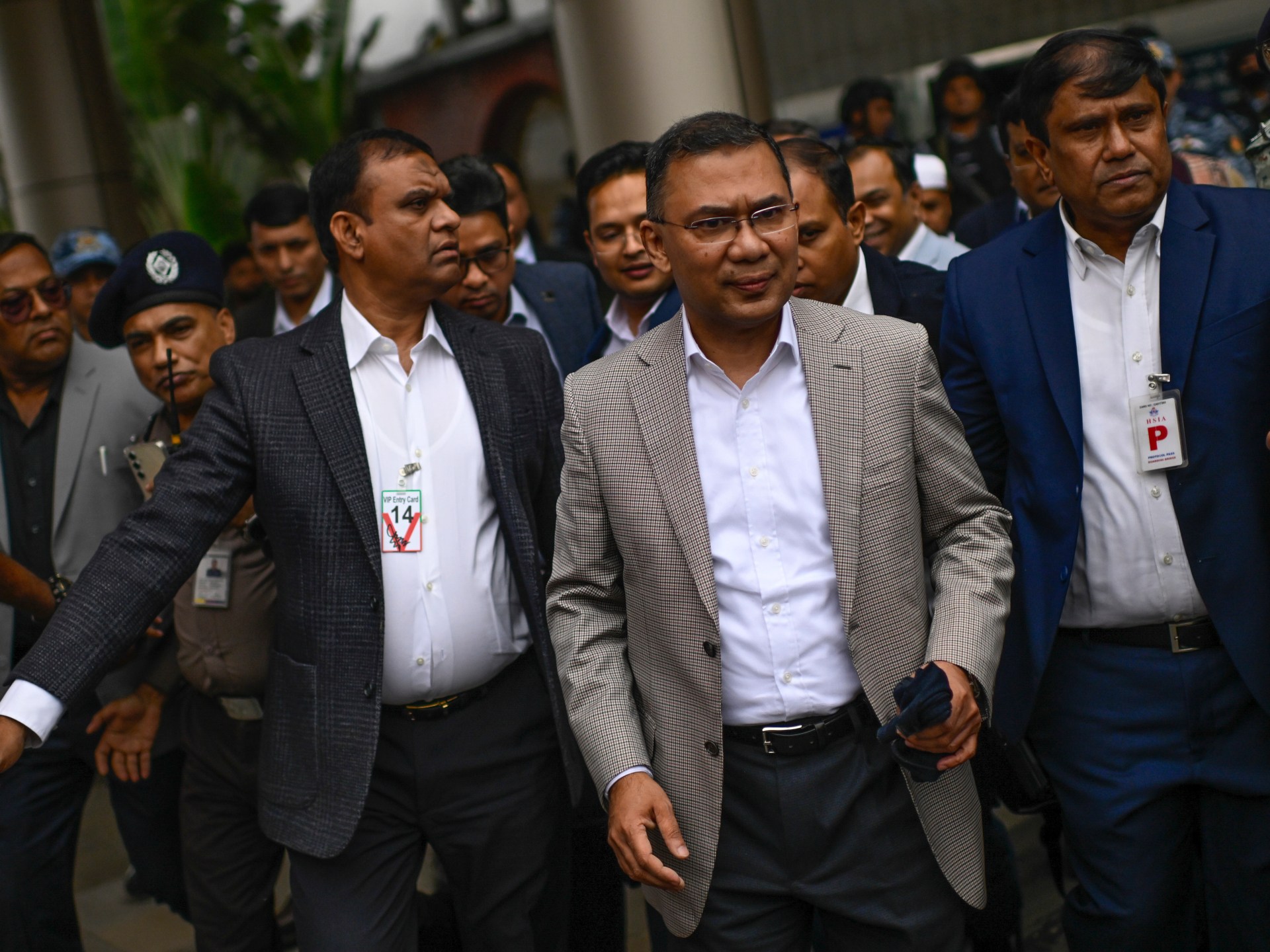
DHAKA, Bangladesh – The Evercare Hospital site in Bangladesh’s capital became the somber focus of national grief on Tuesday after news leaked from the medical facility. Khaleda Zia, three-time prime minister and long-time leader of the Bangladesh Nationalist Party (BNP), has passed away.
Khaleda had been receiving treatment at the hospital since the night of November 23rd.
Supporters, party leaders and ordinary citizens stood silently in front of the hospital’s gates, wiping away tears and offering prayers. “The news has made it impossible for us to stay at home,” said BNP activist Riadul Islam. “We don’t have a chance to meet, so we’re all waiting outside. There are tears in everyone’s eyes.”
Her funeral, held on Manik Mia Street in Dhaka on Wednesday, drew tens of thousands of BNP supporters from across the country, along with leaders of other political parties, caretaker government chief Muhammad Yunus and diplomats, highlighting the vestiges of Mr Khaleda’s legacy and how it extends far beyond Bangladesh’s borders.
But beyond sadness, political analysts say Khaleda Zia’s death marks a decisive political break for the BNP at a critical juncture.
National elections are scheduled for February 12, and the party is going into the campaign without a leader who has remained the ultimate symbol of unity even during years of illness and political inactivity.
With her death, the BNP will enter a complete post-Khaleda phase, with power and responsibility concentrated in her son and acting chairman, Tariq Rahman. The party is seeking to strengthen its base and compete in a reshaped political landscape following the July 2024 unrest and the subsequent banning of Awami League.

Legacy as anchor, absence as test
Over the decades, Khaleda Zia’s relevance extended beyond formal leadership.
Even away from the front line of politics, she served as the party’s moral center and final authority, helping to contain factionalism and defer questioning of the leadership.
Mahdi Amin, an adviser to Tariq Rahman, told Al Jazeera that Bangladesh had lost a “true protector” and described Khaleda Zia as a symbol of sovereignty, independence and democratic unity.
He said the BNP, if elected, would continue her legacy through its policies and governance priorities.
“The hallmarks of her politics were strong parliamentary democracy, including the rule of law, human rights and freedom of expression,” Amin said, adding that the BNP aims to restore institutions and rights that were eroded during 15 years of Awami League rule from 2009 to 2024 under then-Prime Minister Sheikh Hasina, Khaleda’s longtime rival.
Amin argued that Tarique had already emerged as a unifying figure, citing her role in coordinating the campaign against Hasina and developing a 31-point reform agenda aimed at restoring voting rights and institutional accountability.
But despite these claims, analysts say Khaleda’s absence removes a key layer of symbolic authority that has long helped stabilize the BNP’s internal politics.
Author and political analyst Mohiuddin Ahmed said Khaleda’s personal charisma played a key role in keeping the party vital and cohesive.
“That rhythm will be disrupted,” he said. “Tariq Rahman now has to prove his leadership through the process. His leadership is yet to be tested.”
Ahmed pointed out that Khaleda himself was once an unproven politician who rose to national prominence during the massive democracy movement of the 1980s that ultimately led to the ouster of military junta General Hussein Mohammad Ershad. Her husband, then President Ziaur Rahman, was assassinated during a military coup attempt in 1981.
Ahmed argued that February’s elections could play a similarly decisive role for Tariq Rahman, with a success certifying his leadership and a failure leading to increased scrutiny.

Tougher election situation
The BNP’s challenges are further exacerbated by the changing landscape of the opposition.
For more than three decades, electoral politics in Bangladesh has been shaped by a near binary opposition between the Awami League and the BNP, a pattern that emerged after the fall of military rule in 1990 and was further strengthened through successive elections in the 1990s and 2000s.
With the Awami League now non-existent and its political activities banned by the Yunus government, the dominance of the two-party system has collapsed, forcing the BNP to compete in a more crowded field that includes a powerful alliance led by Jamaat-e-Islami, Bangladesh’s largest Islamist group. The Jamaat coalition includes the National Civic Party, founded by many of the youth leaders who drove the July 2024 mass movement that forced Hasina from power into exile in India.
“This will not be easy for the BNP,” Ahmed said. “After July” [2024] Politics changed the equation. “A new polarization is emerging and the dominance of the two major parties can no longer be sustained,” he added.
Analysts also point to key uncertainties that remain, including whether the elections will be held as scheduled, whether they will be held peacefully, and whether the major parties will be able to ensure public confidence in the electoral process.
Political scientist Dilara Chowdhury, who closely followed both Khaleda and her husband, said Khaleda Zia served as a “guardian” not only of the party but of the country, and her death represented the loss of a senior figure who had stabilized Bangladeshi politics.
Mr Khaleda’s son, Mr Tarique, lived in exile in Britain from 2008 until December 25, 2025, but returned after a series of cases brought against him by the military-backed government in power from 2006 to 2009, or by the subsequent Hasina government, were concluded.
She argued that Tariq’s return alleviated fears of division within the party and that his recent speeches reaffirming Bangladeshi nationalism, rejecting authoritarianism and paying tribute to victims of violence in the July 2024 uprising had reassured party supporters of ideological continuity.
“Both BNP and Awami League were parties centered on individuals,” she said. “After Khaleda Zia, it is natural for Tariq Rahman to occupy that space within the BNP.”

From inheritance to judgment
However, BNP leaders admit that legacy alone will not determine the party’s future.
Allegations of extortion involving some party activists continue to surface, with adviser Mahdi Amin saying the issue is largely exaggerated, but that the party plans to address the issue through tighter internal controls.
At the grassroots level, some party members say Mr. Tariq’s leadership transition is not without its challenges.
“It would be unrealistic to say there are no challenges,” said Kamal Uddin, senior joint general secretary of the Chakaria district unit of Jubo Dal, the BNP’s youth wing in Cox’s Bazar district. “In the past, there have been disagreements with senior leaders who worked closely with Khaleda Zia, and even disagreements with Ziaur Rahman. That can make it difficult in decision-making. But I believe he will manage.”
Kamal Uddin traveled with three other BNP activists from Cox’s Bazar, a city on the Bay of Bengal coast about 350 kilometers (217 miles) south of Dhaka, to attend Khaleda Zia’s funeral on Wednesday.
But senior BNP leaders have dismissed doubts about Tariq’s authority.
Amir Qasr Mahmoud Chaudhry, a Standing Committee member who served as commerce minister in Khaleda Zia’s cabinet from 2001 to 2004, said Tariq’s leadership qualities were already established.
“His leadership has been proven,” Chaudhry told Al Jazeera earlier this month. “He is capable of leading the party effectively.”
As the BNP prepares for polls, analysts say the party’s ability to ensure discipline, plan reforms and contribute to peaceful elections will itself test Tariq’s leadership.
Another debate is emerging on social media and among political opponents.
On November 29, ahead of his eventual return home, Tariq wrote on his verified Facebook page that the decision to return home was not “completely within his control” and was not “under his sole control.” Critics interpreted this as raising questions about possible outside influence, particularly India, on whether and when he would return.
BNP leaders rejected these claims, insisting that his return was a political and legal matter tied to domestic realities rather than diplomatic negotiations, and that national interests would guide the party’s policy if it came to power.
But for many supporters, politics is deeply personal.
Dulal Mia, 57, who came from the northeastern district of Kishoreganj to attend Mr Tariq’s welcome rally in Dhaka on December 25, still remembers the moment that made him a lifelong BNP supporter.
He said that in 1979, when he was in the sixth grade, then-President Ziaur Rahman visited the rice fields where he was working and shook his hand. Ziaur Rahman is remembered for coping with drought by digging canals across the country and visiting remote areas, often barefoot, without formal ceremonies.
“Tariq Rahman will have to carry on his parents’ legacy,” Mia said. “If he doesn’t do that, people will turn away. BNP politics is people’s politics. It started with Ziaur Rahman and has been carried by Khaleda Zia for a long time. I believe Tariq Rahman will do the same. Otherwise, it is the people who will reject him.”
