

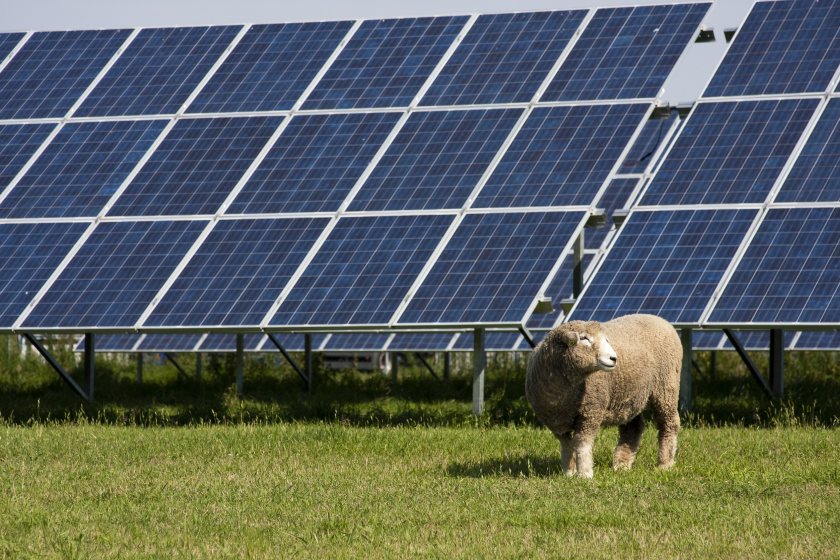
The rapid expansion of large-scale solar projects could lead to the loss of productive farmland unless environmental assessments are more consistent, new guidance warns.
The Institute of Sustainability and Environmental Professionals (ISEP) said discrepancies in environmental impact assessments (EIAs) for solar power development on agricultural land risk harming food production and biodiversity as the adoption of renewable energy accelerates.
The warning comes as the UK government pushes to deliver 47 gigawatts of solar power by 2030, almost three times the current installed capacity. This target is expected to result in a rapid increase in the number, size and scope of solar power schemes seeking planning consent across the country.
ISEP said the increasing complexity of energy, environment and planning policy across the board, including differences between the UK and local authorities, was leading to an uneven approach to EIA for large-scale solar projects.
In response, the Institute has published new guidance aimed at improving consistency across the planning system. The advice note ‘Solar PV on agricultural land – Essential components of an environmental assessment and report’ is intended to support developers, environmental consultants and local planning authorities.
It sets out expectations regarding agricultural land classification studies, soil assessments, biodiversity net benefits, pollution risk management, and socio-economic impacts, with the aim of enhancing evidence-based decision-making.
Dr Rufus Howard, ISEP’s senior policy leader for impact assessment, said current practice was inadequate. He said there was “inconsistency in the approach taken to environmental impact assessments and planning applications for solar projects”.
He warned that the number of applications is expected to rise sharply over the next five years and that “without proper assessment, British farmland is at risk”.
Dr. Howard said the challenge is to strike the right balance. “We need to balance energy security with tackling the climate crisis, food security with the need to conserve biodiversity and natural habitats,” he said.
He added that clearer guidance would help provide “consistent, transparent and high-quality assessments” and ensure that renewable energy development does not come at the expense of local sustainability.
A central focus of this guidance is to protect the most productive agricultural land. Dr Howard said the plan “highlights the importance of protecting the ‘best and most versatile’ agricultural land and maintaining the reversibility of solar power development”.
ISEP recommends prioritizing poor quality land wherever possible and calls for an independent soil audit after decommissioning to ensure the land is restored to good condition.
The guidance also highlights potential benefits such as enhanced biodiversity and carbon sequestration, as well as broader social and environmental impacts, such as impacts on rural livelihoods.
Solar power developments range from small schemes covering a few hectares to projects spanning hundreds of hectares, with some proposals covering over 1,200 hectares. Under current rules, local governments decide on plans for up to 100 megawatts, but larger projects are considered nationally.
ISEP noted that solar farms currently account for less than 0.1% of UK land, but said development location was important. Recent analysis shows that a significant proportion of the largest solar farms operating in the UK are located on highly productive agricultural land, including land classified as the highest mixed-use land.
With planning decisions expected to accelerate towards net zero, ISEP said clearer and more consistent environmental assessments are essential to ensure that the expansion of renewable energy does not undermine long-term food security and the resilience of rural environments.
