

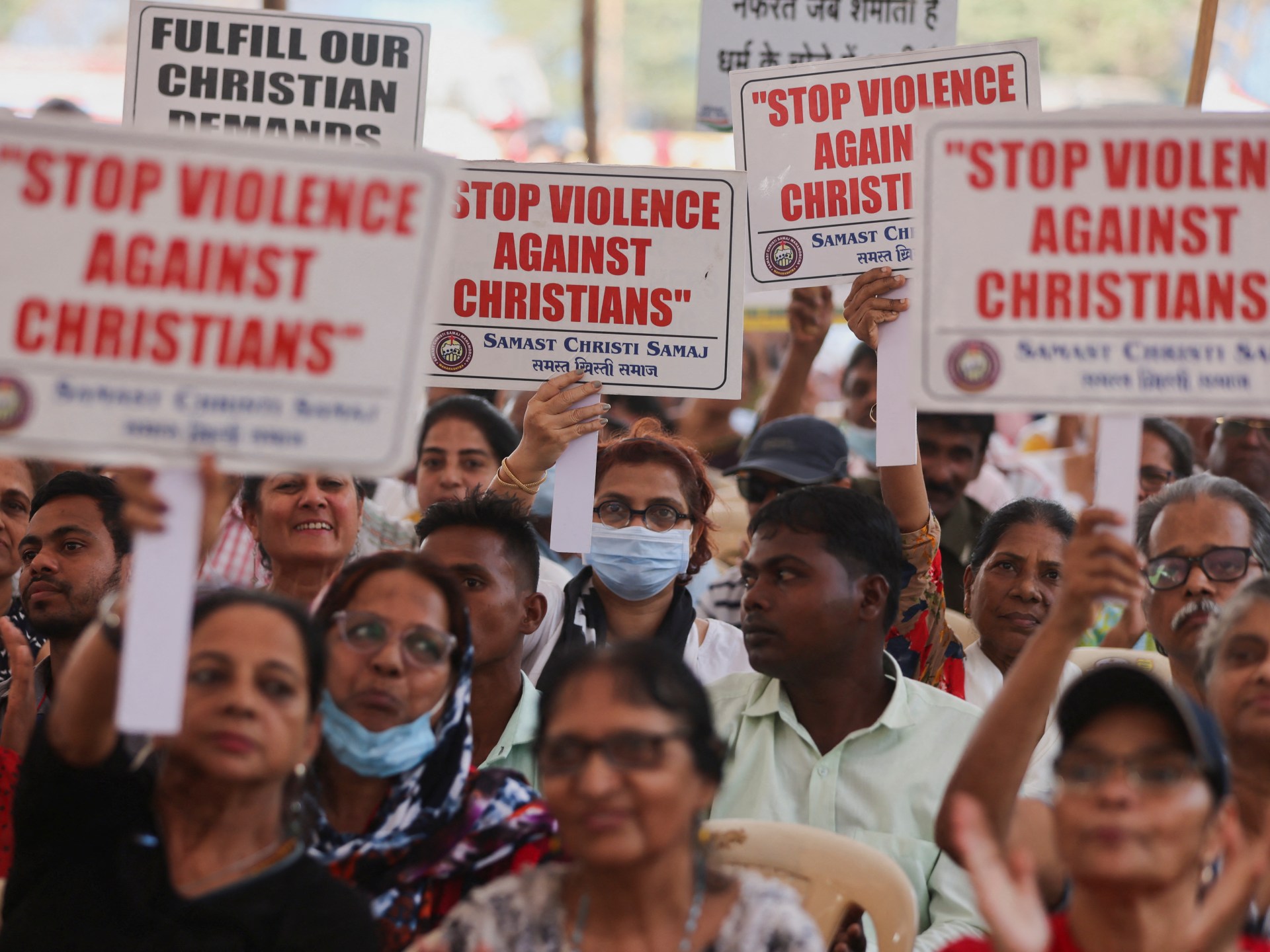
On Christmas Eve, hard-line Hindu groups affiliated with Prime Minister Narendra Modi’s Bharatiya Janata Party (BJP) announced the closure of the central Indian city of Raipur. The protests were called over allegations of “forced” conversion by Christians, a charge often leveled against the Christian community despite scant evidence.
On the same day, a group of men armed with wooden sticks attacked a shopping mall in Raipur, destroying Christmas decorations and disrupting the celebrations. Police charged 30 to 40 unidentified assailants, but only six were arrested. They were released on bail within days, and upon their release they were welcomed with public processions, wreaths and chants outside the prison, and the video was widely shared on social media.
On Christmas morning, Prime Minister Modi visited a Catholic church in New Delhi to mark the occasion, but did not condemn the violence.
This was not the only incident. Religious hate speech and violence are escalating in India, with the country’s Christian minority emerging as increasingly prominent targets alongside Muslims amid an escalation of Hindu majoritarian rhetoric, according to a new report.
A study by the India Hate Lab, a project of the Washington DC-based Center for the Study of Organized Hate (CSOH), found that the country recorded a total of 1,318 hate speech incidents in 2025, an average of more than three per day.
These events, primarily organized and led by Hindu majority groups and the ruling Bharatiya Janata Party, targeted Muslims and Christians, with hate speech increasing by 97 percent since 2023 and 13 percent compared to 2024. Although Muslims remained the main targets, the report found a surge in anti-Christian rhetoric. Hate speech events targeting Christians increased by 41% from 115 in 2024 to 162 in 2025.
This was borne out by the violence and intimidation unleashed by Hindu supremacists during last month’s Christmas celebrations. Instances were recorded across India, in the capital Delhi, as well as in Madhya Pradesh, Assam, Kerala, Uttar Pradesh, Telangana and Chhattisgarh. Raipur, the capital of Chhattisgarh, where a mob ransacked a shopping mall.
In Madhya Pradesh state, leaders of Prime Minister Modi’s Bharatiya Janata Party led a mob to disrupt and attack a Christmas lunch for visually impaired children. In Delhi, a woman wearing a Santa hat was threatened by Hindu nationalists. In Kerala, some schools were reportedly warned not to hold Christmas celebrations by officials of the Rashtriya Swayamsevak Sangh (RSS), the parent organization of the Bharatiya Janata Party and many other Hindu-majority groups, prompting the local government to announce an inquiry into the matter. This came after RSS workers attacked Carol, a teenager in the same state.
Christians make up only 2.3 percent of India’s population, while Muslims make up 14.2 percent. The Hindu community accounts for 80%.
Hindu supremacists have fueled suspicion, anger, and hatred against religious minorities based on conspiracy theories and other false claims.

escalation
But experts say the latest figures point to a new escalation in the religious hatred that India’s religious minorities have had to contend with since the Bharatiya Janata Party came to power in 2014.
The RSS, the ideological leader of the BJP, founded in 1925, believes that India must be a “Hindu state”, an idea that runs counter to the secularist values enshrined in the constitution. Historical Hindu nationalist ideologues such as Vinayak Savarkar and MS Golwalkar, whom PM Modi has publicly admired, have argued that religious minorities such as Muslims and Christians are India’s “undesirable” and “internal enemies” and called for “perpetual war” against them.
CSOH’s Rakib Naik said instances of hate speech recorded in a recent report reflected this rhetoric. They present Muslims and Christians as a “dual threat,” “foreign demonic forces” seeking to harm Hindus.
“At the heart of this story is a story of ‘forced conversion’, depicting all acts of Christian charity, education and medicine as deceptive means to convert Hindus to Christianity,” Naik said. “The most pervasive theme around the world is [the] The 2025 incident involves allegations that Christian missionaries are converting Hindus through recruitment. ”
This is despite the fact that from 1951 until the last census in 2011, the Christian community in India never exceeded 3 percent of the total population, according to Pew Research Center data.
John Dayal, former president of the All India Catholic Union and former member of the Council for National Unity, the Indian government’s advisory body on matters of religious harmony, said the hate incidents were causing fear and deep anxiety within the country’s Christian community. Dayal said many people are taking unusual and extreme measures out of fear of vandalism by Hindu supremacists.
“In Raipur, the archbishop was forced to advise all churches and Christian organizations to seek police protection during the Christmas period,” Dayal said. “I couldn’t believe I had to write this letter.”

Attacks on Muslims increase
In addition to this rise in anti-Christian rhetoric, there has also been a sharp rise in hate speech against Muslims, according to the report. CSOH recorded that 1,289 of a total of 1,318 hate speech events included hateful and violent references to Muslims.
In 2024, this number was 1,147, while in 2023 it was 668. This represents a 93% increase in anti-Muslim hate speech between 2023 and 2025.
At these hate events, speakers (often from the Bharatiya Janata Party and related Hindu nationalist groups) invoked conspiracy theories against Muslims. From claims that Muslims are occupying Hindu land (‘land jihad’), to claims that Muslims strategically outnumber Hindus (‘population jihad’), to Muslim men trying to seduce Hindu women in order to convert them to Islam (‘love jihad’).
Using such conspiracy theories, the report revealed that most of these incidents ended with calls for violence against the Muslim community. The calls range from boycotting Muslims to destroying places of worship to taking up arms and violently attacking Muslims.
“These narratives are designed to portray minorities as systematic aggressors with the aim of eviscerating Hindu culture, demographic superiority and wealth,” said Naik of CSOH.
“The massive dissemination of these conspiracies is a deliberate strategy to create an environment in which Hindus are perpetually victimized and to enable the passage of anti-minority laws to ostensibly deal with these imagined threats,” he added.
Since the BJP came to power, several Indian states have introduced laws criminalizing forced conversion, but critics say these laws are a covert attempt to prevent interfaith marriages. Several ministers in these states have publicly called the law an attempt to curb “love jihad.”
In November 2025, the US Commission on International Religious Freedom highlighted what it called “several discriminatory laws” regarding citizenship and religious conversion in India in its annual report.

BJP link
Much of this hatred is linked to the Bharatiya Janata Party, the report found. Almost nine out of 10 hate speech incidents, 88 per cent of the total, took place in states ruled by the Bharatiya Janata Party or its allies. The report found that five of the top 10 people most involved in hate speech had ties to the Bharatiya Janata Party, including Home Minister Amit Shah, widely considered India’s second most powerful man after Prime Minister Modi.
Uttar Pradesh Chief Minister Yogi Adityanath and Uttarakhand Chief Minister Pushkar Singh Dhami are also named in the report as perpetrators of hate speech. In fact, Dami topped the list of hate speech perpetrators, with a total of 71 hate speeches.
Al Jazeera contacted Bharatiya Janata Party chief spokesperson Anil Baruni via text and email, as well as the Home Ministry for comment. Neither responded.
Ram Punyani, an author and director of the Center for the Study of Society and Secularism (CSSS), a research institute working to promote religious harmony, said the rise in hatred was directly related to the electoral fate of the Bharatiya Janata Party. Mr. Modi suffered an electoral setback in the 2024 general elections, and the BJP lost its parliamentary majority, but returned to power with its allies.
“Hindutva foot soldiers have become increasingly bold with the party’s return to power, leading to an increase in attacks on religious minorities,” Puniyani said. Hindutva is a Hindu majoritarian political movement advocated by the RSS.
Pointing to the attacks on Christian missionaries, Punyani said it was an attempt to strengthen the Bharatiya Janata Party’s base among the tribal and Dalit communities where Christian missionaries primarily operate. Dalits have historically been considered the most disadvantaged community under Hinduism’s complex caste system and have faced systematic discrimination for centuries.
“This is all very dangerous,” Punyani said, “because hate speech ultimately leads to violence.”
