

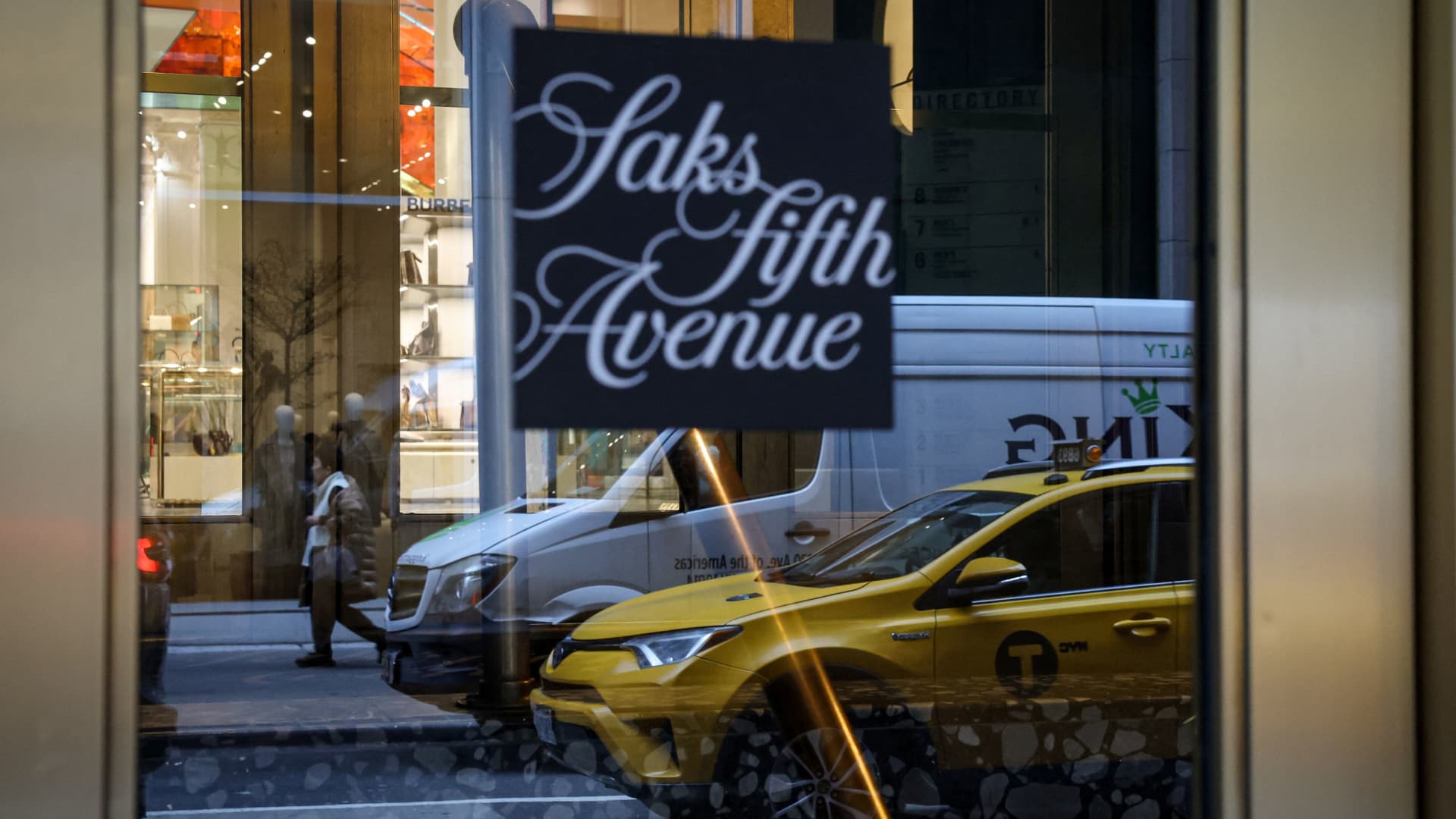
The entrance to the Saks Fifth Avenue flagship store in New York on January 14, 2026, after the company filed for bankruptcy protection.
Brendan McDiarmid | Reuters
For more than a decade, the former executive chairman of Saks Global had dreamed of adding Neiman Marcus to his collection of legacy department stores, believing that combining the two companies would create a luxury brand powerhouse strong enough to counter the changes that were holding the industry back.
Instead, Richard Baker’s $2.7 billion acquisition of Neiman Marcus in 2024 ultimately sent the company into bankruptcy just over a year after the deal closed. From the beginning, the company struggled to pay its bills, which angered its vendors and left little margin for error.
In a declaration filed Wednesday in Houston bankruptcy court, hours after Saks filed for Chapter 11 protection, chief restructuring officer Mark Weinsten wrote that the deal created “immediate liquidity challenges” and created an “unsustainable” capital structure.
Mickey Chada, vice president of corporate finance at Moody’s Ratings, called this a “recipe for disaster.”
“We had two companies that weren’t doing well, and then we merged them and ended up with a lot of debt,” Chadha said. “It was an unsustainable capital structure from the beginning.”
The deal was financed with $2.2 billion in junk bonds, resulting in an influx of liquidity. But once the deal was completed and the companies paid their debts related to the deal, there was not enough money left to pay Saks’ vendors.
The vendor was reluctant to send Saks inventory because the invoice was late. Soon, the situation worsened as retailers lacked the right assortment to increase sales.
“This created an inventory gap, drove away customers, and sharply reduced revenue and cash generation. This classic vicious cycle left the business in an unsustainable situation,” Neil Saunders, a retail analyst and managing director at GlobalData, wrote in an email.
“While the previous management team had always presented the merger as an opportunity to create a luxury powerhouse, behind the shiny surface this transaction had a complex tangle of financial engineering that made it impossible to implement the group’s stated vision.”
Weinsten said he expects Neiman Marcus, Bergdorf Goodman and Saks Fifth Avenue to become part of the new Saks Global umbrella, resulting in $600 million in run-rate synergies over the five years after the deal closes. But soon after the deal closed, Mr. Sachs realized that integrating Neiman Marcus would be more difficult and costly than he expected.
Just before last year’s critical holiday shopping season, Saks was “impacted by temporary merchandising system integration issues,” Weinsten wrote, disrupting the flow of inventory at Neiman Marcus and Bergdorf Goodman at a time when sales and inventory were already at “seasonal lows.”
Sachs’ borrowing was asset-based, meaning the loans were backed by inventory. With fewer goods on hand for the company, Sachs was unable to borrow as much as he needed. Due to reduced liquidity, we are no longer able to pay vendors according to agreed terms.
Immediately, the $244 million in “catch-up payments” Saks had raked in to pay vendors “voided,” Weinsten said, and the company is once again struggling to stock its stores with the assortment its wealthy customers expect.
By the end of the second quarter on Aug. 2, inventories were down 9% from a year ago, and inventory receipts were more than $550 million lower than previously expected. This further reduced liquidity based on asset-based financing terms.
Saks created problems during the critical holiday season because it was unable to do what retailers always have to do to stay competitive: to “chase” inventory and ensure that in-demand and trending items were available during the busiest time of the year.
“You can’t really sustain that much debt on synergies alone,” Chadha said. “To sustain this amount of debt, we need to increase sales, increase sales, and increase profitability.”
Four months after securing new financing, Sachs failed to make an interest payment to bondholders at the end of December. Two weeks later, it went bankrupt.
“This is not a declining brick-and-mortar business.”
In his statement to the court, Mr. Weinsten made it clear that it was liquidity challenges and subsequent problems with vendors that drove Saks into bankruptcy, not any major problems related to the decline of the luxury goods market or department stores.
”[Saks] “We are not a brick-and-mortar business in decline,” Weinsten wrote. “There are strong indications that the debtor’s most profitable customers continue to spend through the retail channel… In that regard, the constraints we face are not driven by reduced demand.” Where product is available, performance remains strong. ”
He said the company does not need to invest heavily in marketing or capital expenditures to improve sales trends. Additionally, the synergies expected to be achieved through the merger with Neiman Marcus are beginning to materialize more quickly.
Sachs had projected run-rate synergies of approximately $150 million by the end of fiscal 2025, but now expects that number to increase to $300 million. Top customer retention rates are high and sales increase when inventory is available.
“This shows that our challenges are tied to inventory availability and vendor trust,” Weinsten said. “There is no underlying demand for luxury goods.”
Through a reorganization plan that must be approved by the court, Saks secured $1.75 billion in new funding and committed to making “upfront” payments to vendors, complying with all customer programs, and continuing employee pay and benefits. Part of the funding, $500 million, will be available to the company after it emerges from bankruptcy and is expected to close later this year, the company said.
It will be up to new CEO Geoffroy Van Raemdonck, the former chief executive of Neiman Marcus, to win back the vendor and get the business back on track.
Company executives maintain that conditions are strong for a recovery as long as the company replenishes its balance sheet, but department stores are not in the same situation as they once were. Luxury brands now have their own websites and stores and are no longer as dependent on wholesalers like Saks and Neiman Marcus as they once were.
“They’re going to have to do something drastic, right? They can’t survive on this funding as it is…because just applying doesn’t change what Saks is actually doing. It’s not going to get people in the door to buy more stuff,” Chadha said. “It’s going to take some time because we have to change the whole operation. It’s an uphill battle. They’re not in the best space. As it stands, it’s a department store.”
