

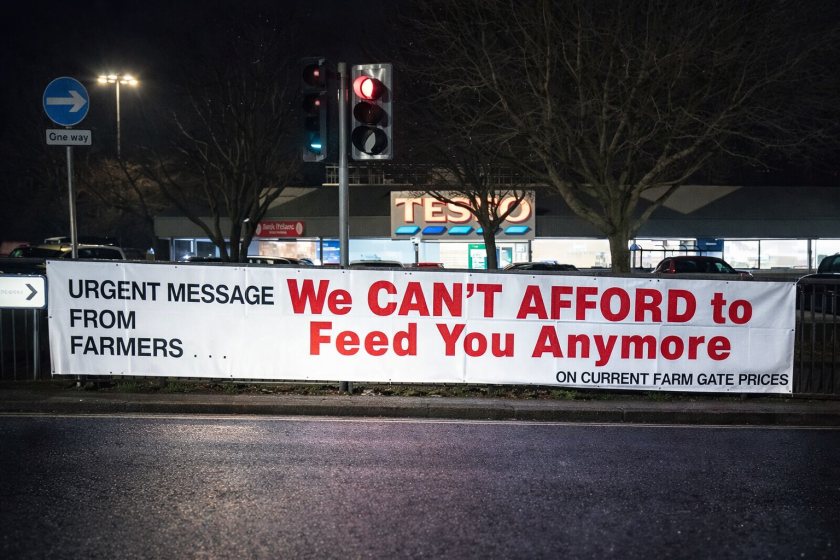
Tractor protests flared up again on Thursday night (January 29), with farmers restricting access to Tesco and Asda distribution points in Oxfordshire and Leicestershire, and further action was reported in County Londonderry in Northern Ireland.
The demonstrations are part of a growing campaign across the UK over inheritance tax reform, supermarket pricing and food standards, with farmers warning that policy changes and low returns are putting the future of family farming at risk.
On Thursday night, tractors were placed at the entrances to Tesco and Asda distribution centers in Didcot, Oxfordshire, restricting vehicle movement as part of a concerted action targeting major retailers.
A similar protest was later reported at Asda’s Magna Park depot in Lutterworth, Leicestershire, and overnight action spread to the Midlands.
Further protests were reported in County Londonderry, Northern Ireland, highlighting the geographical expansion of the movement beyond mainland Britain.
Farmers for Action, which organized the Northern Ireland protest, said the action was aimed at demanding big retailers take a more active role in addressing pressure on family farms.
The group said farmers wanted supermarkets to commit to lobbying the UK government on issues such as inheritance tax, farmgate pricing and food standards.
It called for action to end inheritance tax on farms, introduce a UK-wide welfare framework to ensure farmers are paid at least the actual cost of production plus a margin, and cut unnecessary food imports that increase emissions.
The group also raised concerns about imports of food produced to lower standards than those expected of UK farmers.
Farmers for Action said in a statement that family farmers are calling on retailers to “make a fresh start” and support changes in Westminster.
Farmers argue that distribution centers are the focus of protests because they have become key pressure points in the food supply chain and the purchasing power of major retailers, which continues to drive down Farmgate prices.
Campaigners say January became a flashpoint after months of warnings to governments and retailers, with little movement on issues they believe threaten the long-term viability of agricultural businesses.
They argue that recent and proposed changes to inheritance tax relief could make it difficult to pass farms on to the next generation, while rising input costs and reliance on substandard imports continue to squeeze profit margins.
Last week, farmers also targeted national infrastructure, with tractors blocking vehicular traffic at the port of Felixstowe in Suffolk overnight from just after midnight to around 7am on January 23.
The port is Britain’s largest container hub, handling a significant portion of the country’s container traffic, and has been the focus of protests despite assurances that shipping operations are uninterrupted.
Protesters expressed their opposition to current government policy with banners attached to tractors reading “Save your farm, save your future, fight your taxes” and “Take back British farming.”
The East Anglia Farmers’ Union, a group supporting Felixstowe’s action, said the protests were part of a co-ordinated action across the country.
“Farmers have joined others across the UK in taking to the port of Felixstowe to blockade supermarket warehouses and the port in protest against cheap, substandard imports and inheritance tax,” the group said.
In a statement issued during the Felixstowe protest, a port spokesperson said the action was expected and measures had been taken to limit disruption.
“We were made aware of the proposed protest and worked with port users to reduce its impact,” they said.
It added: “While this protest did not disrupt our transportation operations, it did cause some inconvenience to our ground operations. We would like to apologize to our affected customers.”
More than 15 farmers are reported to have taken part in the Felixstowe blockade, which was part of a wider series of actions across the country.
Earlier this month, Tesco distribution centers in Peterborough, Doncaster and Hinckley were blocked off by tractors, preventing trucks from entering and exiting.
Farmers also targeted Lidl distribution centers across England, including Peterborough in Doncaster and Houghton Regis near Luton, close to the retailer’s UK headquarters.
Farmers taking part in the protests say their demands center on protecting farm property relief, ensuring fairer prices for British produce and ensuring imported food meets comparable production standards.
They say further action is likely to be taken unless progress is made on tax policy, retailer pricing and food standards, suggesting the current wave of protests could continue in the coming weeks.
