

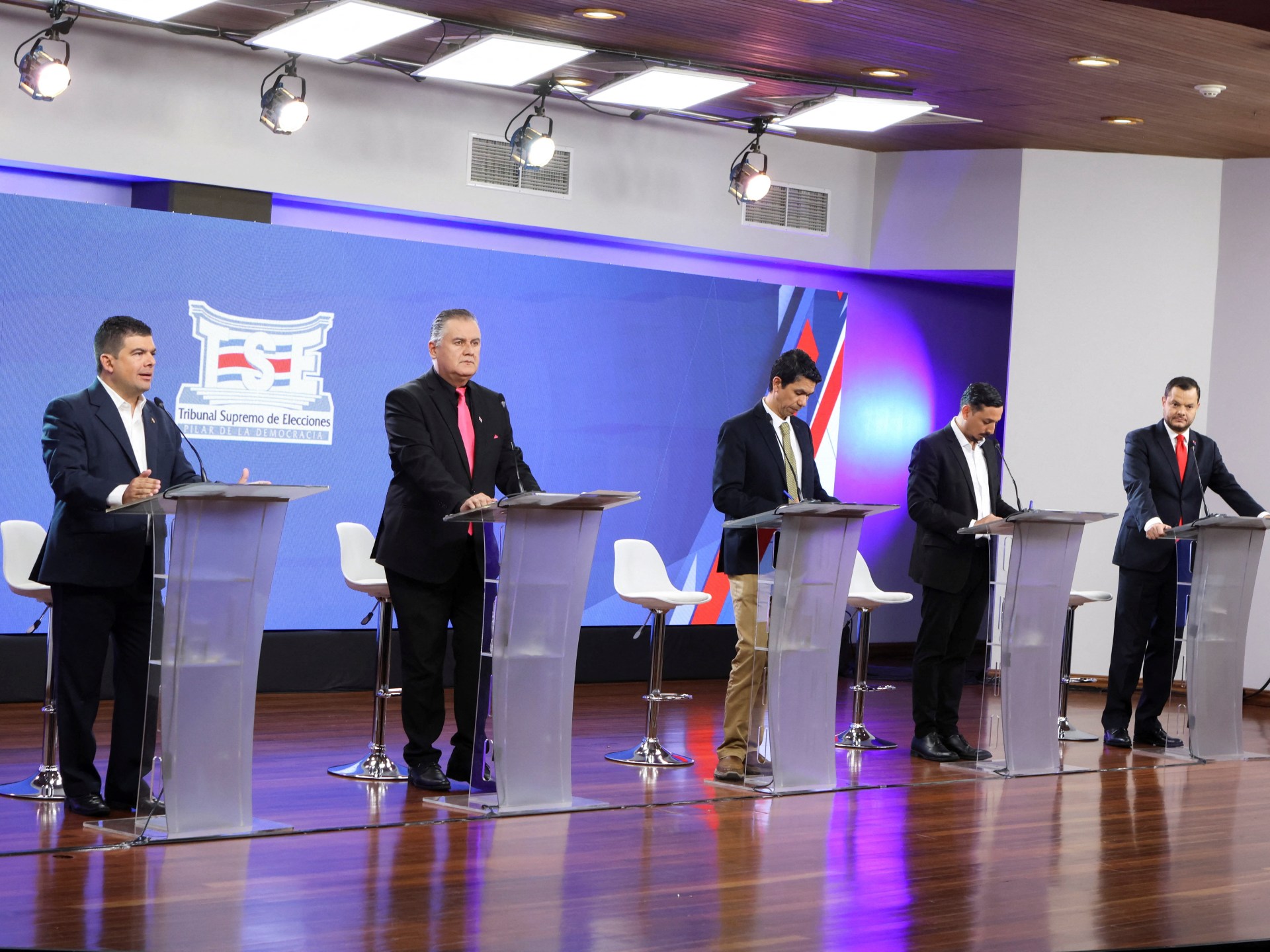
Costa Rica’s ruling party hopes to extend the president’s powers for another four years in the next election, as voters express indifference to their options and opposition parties struggle to rally support.
Millions of Costa Ricans will head to polling stations to cast their votes on Sunday. But while the outlook looks promising for the centre-right populist movement championed by outgoing President Rodrigo Chávez, this election conceals a wild card: a large number of undecided voters.
Recommended stories
list of 3 itemsend of list
One-third of Costa Ricans have not yet decided on a presidential candidate.
Still, Chavez’s campaign appears on track to secure enough votes to avoid a runoff. That outlook is strengthened by fragmentation in the opposition and declining support for center-left groups such as the National Liberation Party and Citizen Action, which held the presidency before Chávez.
Just as voters’ preferences have changed, so have their priorities. Opinion polls show Costa Ricans are more concerned about security than the economy in the upcoming election.
“Costa Rica is moving towards political realignment,” said Ronald Alfaro, coordinator of the Public Opinion and Political Culture Unit at the University of Costa Rica.
Who are the candidates? What issues matter most to voters? This brief answers these questions and more.
When is the election?
Voting is scheduled to take place over a 12-hour period on February 1, with the presidential, two vice-presidential positions, and all 57 seats in parliament at stake.
What happens if no candidate wins outright in the first round?
If no presidential candidate passes the 40% threshold needed to avoid a runoff, the top two candidates will face off in another round of voting on April 5.
Is voting compulsory in Costa Rica?
Costa Rica’s constitution states that voting is a “compulsory civic activity,” but there are no penalties for those who do not participate.
More than 3.7 million Costa Ricans are eligible to vote. However, many people have expressed disinterest in this year’s election cycle.
In a January 21 poll conducted by the Center for Political Studies and Research at the University of Costa Rica (CIEP), nearly 79% of respondents said they felt little or no enthusiasm for the election campaign.
However, when asked about their willingness to actually vote, respondents gave mixed answers. More than 57% of respondents said they were willing to vote. Only 19.5% of respondents said they had no intention of participating in the election.

Who are the candidates?
Former government minister Laura Fernández is running to replace President Chávez from the People’s Party of Sovereignty (PPSO), promising continued leadership.
Chavez remains popular in Costa Rica, where he has built a reputation for fiercely criticizing what he defines as the corrupt status quo.
However, presidents are restricted from running for office consecutively, and Mr. Fernández has campaigned for his work within Chávez’s government, including as Chávez’s chief of staff and minister for national planning and economic policy.
She also promised to appoint Mr. Chávez to her cabinet if elected president.
Meanwhile, the opposition to Mr. Chavez has not yet solidified around a single candidate.
Álvaro Ramos, an economist and administrator of Costa Rica’s health and pension system, is running as a candidate for the centre-left National Liberation Party, which once dominated the country’s politics.
But on the left, he faces competition from former first lady Claudia Dobres, whose husband Carlos Alvarado Quesada was president from 2018 to 2022.
Dobres, an urban planner, will head the Civic Agenda Coalition (CAC), which is made up of two left-wing groups: the Citizen Action Party and the National Democratic Agenda.
Also splitting the opposition vote is Ariel Robles (34), a member of the left-wing Broad Front Party (FA). He hopes to stir up dissatisfaction with the status quo on the left.
Where does the candidate rank in the polls?
According to CIEP’s latest poll released on January 28, about 43.8% of respondents expect to vote for Fernandez. This level of support would be enough to avoid a runoff.
Ramos came in second with 9.2%, followed closely by Dobres with 8.6%. Meanwhile, Robles is in fourth place with an approval rating of 3.8%.
About 26% of respondents said they have not yet decided who they will vote for, down from 32% the previous week.
Fernandes appears well-positioned to secure a first-round victory, which is unusual in the country’s recent history. But analysts say another candidate could still outperform expectations, given the disintegration of traditional political blocs and the large number of undecided voters.
Upsets are not uncommon in Costa Rica’s presidential elections. Opinion polls before the 2022 election showed Chavez’s approval rating at just 7%, but he still won the presidential election.
“In the last three elections, we’ve seen big gains from underdogs that no one thought about,” Alfaro said. “Are there conditions for that? Maybe it was higher before, but there’s still a chance.”

What’s the problem front and center?
National security is a top issue in this year’s election cycle, with nearly every candidate touting tough policies to fight crime.
For example, Mr. Fernández proposed in his platform to complete the massive maximum-security prison that Mr. Chávez began construction in August.
According to Fernandez’s plan, the completed prison would “isolate organized crime leaders” and cut them off from the outside world. She also advocates for compulsory prison labor and tougher criminal penalties.
Costa Rica was once known for its relative stability, but murders and organized crime are on the rise in the country.
According to the government’s provisional statistics for 2025, there were 873 reported murders in the country, down slightly from the high of 907 in 2023 and on par with 2024.
Right-wing candidates are exploiting similar concerns in other Latin American countries, including El Salvador, Ecuador and Chile.
In the final weeks before Sunday’s vote, President Chávez invited El Salvador’s President Nayib Bukele, known for his “mano dura” or “iron-fisted” approach to security, to tour the grounds of a new mega-prison. The government also accused human rights activists of trying to assassinate him.
The activist denied the allegations and claimed they were politically motivated. But experts say such accusations could serve to heighten voter anxiety ahead of the crucial vote.

What role does President Chavez play?
Alfaro said that more than any particular policy issue, the election was a referendum on dissatisfaction with Chávez’s presidency and traditional opposition parties.
Although the current president is not on the ballot, he has played a significant role in the lead-up to the election.
Chávez also faces numerous allegations of illegal election interference, with the head of the Supreme Electoral Tribunal (TSE) accusing him of “threatening the peace and political stability of the country.”
Analysts say his efforts to influence race are unusual in Costa Rica, alarming observers who see them as evidence of his individualistic political style.
“Costa Rica is one of the few countries where the principle remains that the president plays no role in the campaign and does not work to influence the campaign,” Alfaro said. “The current president is pushing those boundaries to the limit.”
