

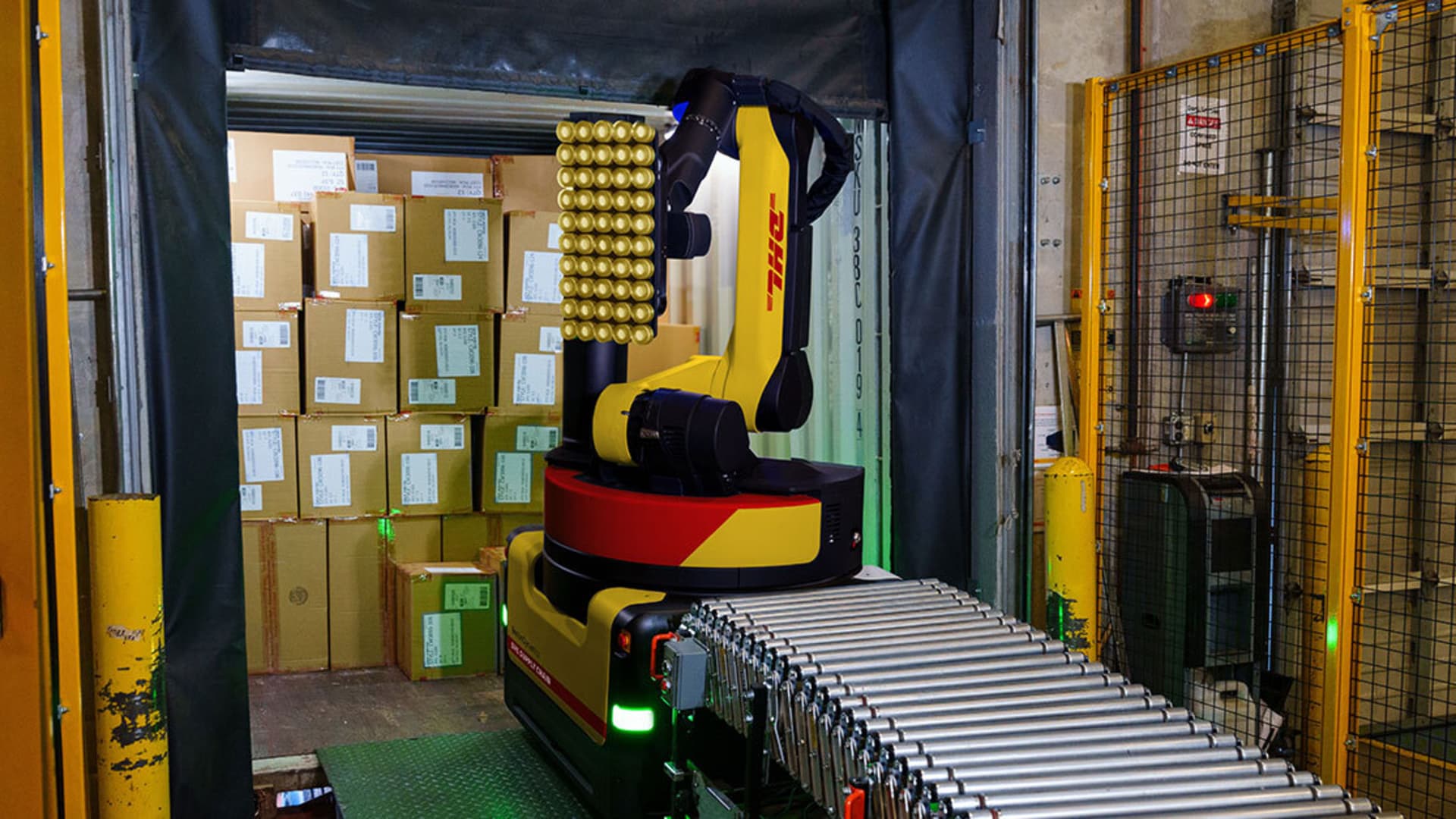
DHL’s autonomous robots are at work.
Source: DHL
DHL Group employees walked nearly a half-marathon every day just to sort, pick, and move goods through a large warehouse.
Autonomous mobile robots can now unload containers at rates of up to 650 per hour for package delivery and supply chain management companies, significantly reducing distance and effort.
Tim Tetzlaff, global head of digital transformation at DHL, told CNBC: “That’s what we’re looking forward to, and over the past five years we’ve been successful in deploying the technology at scale. We started with 240 projects in 2020 and are now at 10,000 projects.”
The company’s autonomous innovations have sped up processes in 95% of DHL’s global warehouses. The company said an item-picking robot at one warehouse increased the number of items picked per hour by 30%, and an autonomous forklift at the same warehouse helped improve efficiency by 20%.
Tetzlaff said automation is important because the company is a very labor-intensive business.
“We still have ambitions to grow the business further, but when you think about where these distribution centers should be located, it’s usually very difficult to find additional labor or additional space just to build a warehouse there,” he said.
DHL is one of several fulfillment companies leveraging automation and artificial intelligence as the industry strives to improve efficiency.
At a financial results conference with analysts in late January, united parcel service CEO Carol Tomé said the company installed automation in 57 buildings in the fourth quarter, for a total of 127 automated buildings, and plans to install 24 more in 2026.
“This year, we plan to further automate our network, and as a result, we expect the share of U.S. volume processed through automated facilities to increase from 66.5% at the end of 2025 to 68% by the end of 2025,” she said.
Similarly, fedex sees automation as an opportunity to improve the work of its employees, installing a robotic arm at its Memphis location to help process small packages and working with AI company Dexterity to use robots to load boxes into containers. The company’s ‘Network 2.0’ initiative is working to improve efficiency in the packaging process.
The company recently announced that it is partnering with Berkshire Gray to launch a fully autonomous robot to optimize container unloading operations.
The global warehouse automation market is projected to exceed $51 billion by 2030.
“We currently have approximately 24% of our average daily volume flowing through our 355 Network 2.0-optimized facilities,” CEO Raj Subramaniam said on a conference call with analysts in December.
human fleet
Workers unload packages from a FedEx truck on Wednesday, December 17, 2025, in San Francisco, California, USA.
David Paul Morris | Bloomberg | Getty Images
With the rise of automation, companies are weighing the balance between human workers and technological innovation.
UPS has announced more than 75,000 job cuts over the past year as it focuses on efficiency and reduces partnerships. Amazon It is in the midst of a multi-year rebuilding plan.
The company also said it plans to close 93 buildings in 2025 and at least 24 in the first half of 2026.
“What’s happening is there’s a knock-on effect where facilities that are legacy brick-and-mortar facilities are closing and it’s going to take a significant effort to operate those facilities into more nimble, faster, automated, integrated facilities,” he said on a conference call in January.
In a statement to CNBC, a UPS spokesperson said the company is focused on making employees’ jobs easier, with AI and robotics taking over repetitive tasks and “improving the efficiency of other functions.”
FedEx did not respond to requests for comment about how the company balances its workforce and technology. Subramaniam said in a recent earnings call that the Network 2.0 initiative led to “structural cost savings,” but the company did not disclose the amount of job cuts.
The Teamsters, the union representing workers at many large packaging companies, said it remains focused on giving team members a voice at the table when it comes to technology.
“We never want to hinder technology and its development, but in all of it technology must support workers and never work against them,” spokeswoman Lena Melentijevic told CNBC. “Workers are the backbone of each of these companies and essential to their success, and we are here to advocate for them and hold them accountable.”
DHL’s Tetzlaff said the company wants automation to complement human labor rather than completely replace it. Tetzlaff said that no matter how advanced DHL’s technology has become, the manual labor of packaging and shipping still remains in the hands of employees.
“When we introduced 8,000 cobots into our operations around the world, we still employed 40,000 people,” he said.
The biggest area where DHL has introduced robotics is in item picking, where more than 2,500 robots use trained arms to select items for packages. This past holiday season, the company added 30% to its robot fleet capacity to meet Black Friday and Christmas demand.
“Companies have the advantage of having great employees who are motivated and love their jobs, but complementing this with a fleet of robots gives us the flexibility and stability to scale up and down and adapt to change. Even big changes like coronavirus can peak throughout the year.” [customer] Things like changing your profile,” he said.
Future path for investment
DHL’s automatic forklift truck is in operation.
Source: DHL
Still, warehouses are unlikely to be filled with humanoid robots in the near future, says Benjamin Reich, supply chain expert and head of logistics and fulfillment at Accenture.
Humanoid robots are growing in popularity as technology companies innovate human-like machines. Nvidia CEO Jensen Huang said he believes innovation is happening rapidly. At the CES trade show in January, google announced a partnership with Boston Dynamics, the same company that works with DHL, to power its new robot Atlas.
But Reich said he recognized among his customers that “humans are still in control.”
“We’re also seeing a shift where the market is looking more for skill sets that address the degree of automation, operational tasks, and gaps between organizations, rather than job replacement,” Reich told CNBC.
He added that automation is geared towards specific jobs, with robots taking over repetitive tasks and companies not eliminating job growth entirely, but instead “pivoting” hiring towards technical roles.
Reich said the industry is increasing investment in automation, and the biggest gains will come from improving the efficiency of supply chain and warehouse execution processes, rather than replacing talent.
There are also broader industry factors impacting the workforce, said Ronnie Horvath, head of transportation and logistics at Accenture. There is a shortage of skilled workers with both the manual and organizational skills needed in this field, and competition among companies for warehouse personnel based on wages, benefits, lifestyle, and more.
“So automation can also help fill, rather than replace, the gaps and voids created by not having the workers we currently have,” Horvath said. “And we see a lot of clients who have an automation or robotics strategy…but they also still have plans to employ human workers.”
Horvath added that the industry is benefiting from new technology. He has seen companies respond to high demand, increase efficiency and engage in more automated processes to accommodate warehousing.
A March study from Accenture found that 51% of global factories expect to have fully automated warehouses by 2040, and 70% of transportation logistics executives see autonomous supply chains as a top investment priority.
“There are very few autonomous organizations at this point,” Horvath said. “So most or some of these customers are starting from scratch and it will take time for these investments to be completed and for them to reap the benefits in all of those areas.”
