

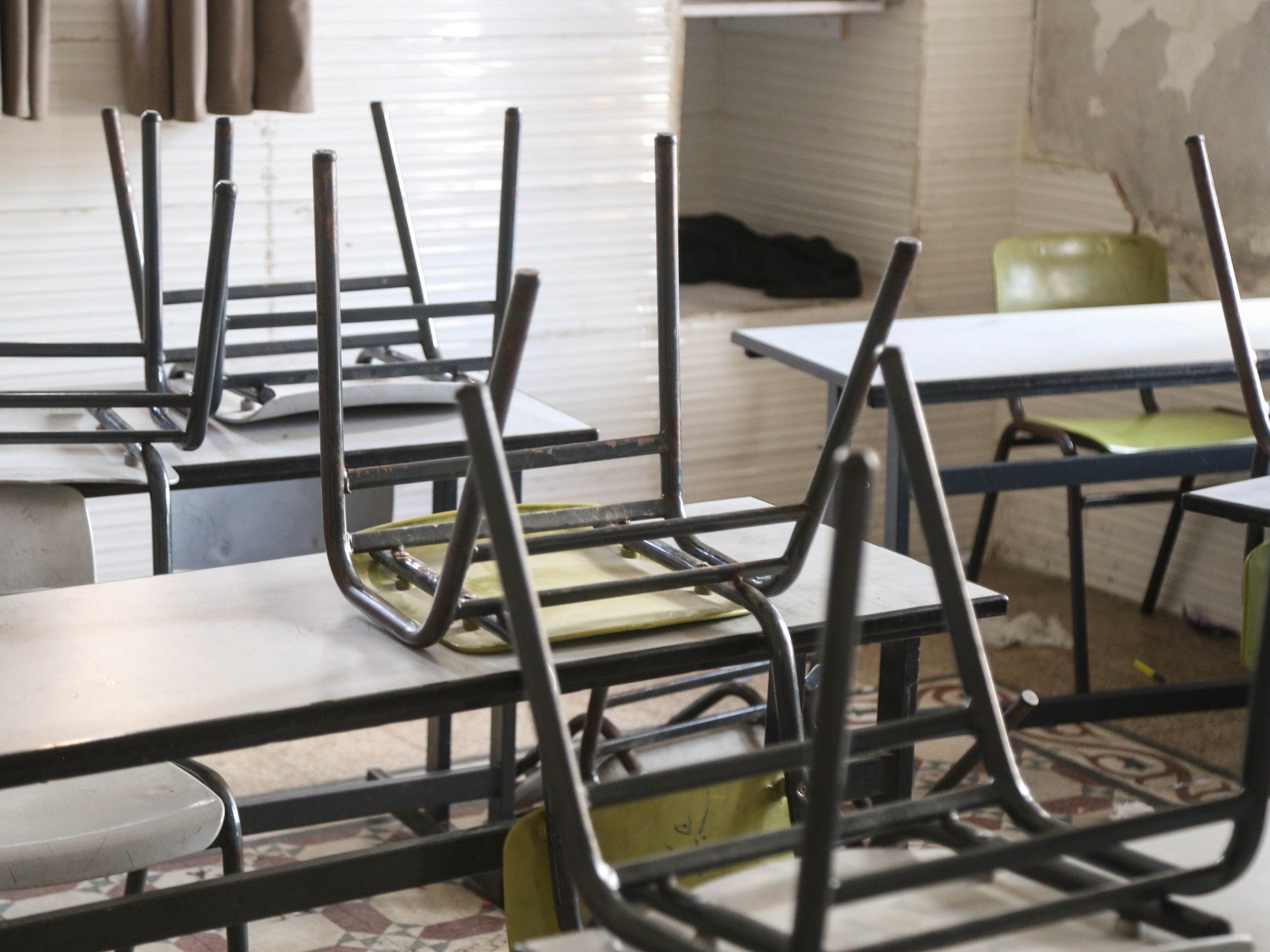
Nablus, the occupied West Bank – For decades, the Zenabia Elementary School has been offering an intimate learning environment to aspiring young students from across the educational spectrum in the northern West Bank city of Nablus.
But now, due to Israel’s years-long withholding of tax revenues owed to the Palestinian Authority, the Palestinian school system is effectively broke. Like administrators at all government-run schools in the West Bank, the Zenabia school principal, Aisha al-Khatib, is struggling to keep her small, public school in session.
For most of the week, the Zenabia school is shuttered, and children roam the streets or stay at home. School supplies are woefully missing, with even regular schoolbooks now reduced to “bundles of pages”.
“We do everything we can, but we do not have the time or the materials or the consistency to properly teach our children and keep them off the streets,” says al-Khatib. “And this is everywhere in the West Bank.”
Targeting the education of Palestine’s children, she says, “means destroying the nation”.
Under the direction of far-right Finance Minister Bezalel Smotrich, Israel has systematically been withholding billions of dollars in tax revenues over the past two years that Israel collects on behalf of the Palestinian Authority (PA). The measure is partly intended to punish the PA for its longstanding policy of paying families of Palestinians imprisoned by Israel for resisting the occupation – even after the PA announced early last year that it was reforming such policies.
Public services have faced severe cuts, affecting the salaries of bureaucrats, sanitary workers, and the police.
But possibly nowhere has that budgetary crisis been felt more than in the education sector.
At Zenabia and elsewhere in the West Bank, public schools are currently only open for a maximum of three days a week. Teachers face long stretches of not being paid, and when they are, they only receive about 60 percent of what they were earning before, resulting in strikes.
And the effects of these cuts in education are showing up on the days when school is in session. Class time is so diminished at Zenabia that teachers focus almost solely on teaching mathematics, Arabic, and English, with subjects like the sciences being essentially cut altogether.
The result, educators warn, could be lasting educational gaps for a generation of Palestinian students.
“As principal of the school, I know that [the students] are not [at] the same [educational] level as before,” al-Khatib says.
‘We are always absent from school’
Spending most of his days out of school, star student Zaid Hasseneh, 10, tries to keep improving his English by looking up words on Google Translate. Zaid dreams of going to university someday in the United States, with hopes of becoming a doctor.
“I want my son to grow up to be cultured – not just memorise the material he learns at school,” says his mother, Eman. “No, I want his cultural knowledge to develop and become diverse and advanced.”
Eman helps Zaid when she can with his studies, but she is busy keeping the family afloat financially after her husband lost his work in Israel. Before Israel’s war on Gaza began in 2023, Eman’s husband worked in Tel Aviv as a mechanic. After Israel revoked his work permit, along with those of some 150,000 other West Bank Palestinians, he has been unable to find work. Eman now works in a halawa factory as the sole breadwinner.
“I go home tired from work, but I have to keep up with [Zaid] regularly,” says Eman. “I tell him, ‘The most important thing is studying. Studying is essential for life.’”
But Eman realises how limited she is in helping her son with his studies. “The teacher knows one thing, but I don’t know how to explain it,” says Eman. “And now, the books [they receive in school] aren’t complete books anymore. They’re bundles. Regular books are 130 pages, but these are 40 or 50 pages.”
To compound the dearth in school resources, students and their families describe erratic schedules that make cumulative learning a near impossibility. “The whole family’s routine is affected,” says Eman.
Even Zaid is now often spending his days out in the streets rather than studying in the classroom – or otherwise on his phone, playing mobile games.
That is the case for most students these days.
Muhammad and Ahmed al-Hajj joined Zenabia four years ago as six-year-olds when they faced extreme bullying in another school. They came to love the new school and the intimate setting it offers. But the twins now mostly spend their time on their phones. With their parents also struggling to earn enough money to get by, they’re left at home alone during their days off from school.
“It’s not good at all. We are always absent from school,” says one of the twins. “It’s not like a full schedule, and we try to study as much as we can, but still, we don’t feel good about it.”
Some families have switched their children over to private schools, but few can afford to do so. “My [monthly] salary is 2,000 shekels [$650],” explains Eman Hassaneh. “About 1,000 goes towards the home rent. Another 500 goes towards bills. And only very little is left for food. I cannot also take care of his education.”
![Eman Hassaneh and her 10-year-old son, Zaid [Al Jazeera]](https://www.aljazeera.com/wp-content/uploads/2026/02/Eman-Hassaneh-and-her-son-Zaid-2-1770951543.jpg?w=770&resize=770%2C578&quality=80)
Teachers quitting, and mounting dropouts
Collectively, the PA’s multi-year budget cuts of billions of dollars are shrinking both the attendance of students and the number of teachers, too.
“Many of the teachers left working in the schools to work in factories because they do not get enough salary,” says al-Khatib. “And they don’t feel that they are giving what they need to give the students.”
Tamara Shtayeh, a teacher at Zenabia, nowadays only teaches maths, English, and Arabic due to the reduced funding. “As a teacher, the three-day solution is a bad solution because it doesn’t cover the minimum education that is needed,” she said. “Not for the students, and not for the teachers as well.”
Due to her reduced salary, Shtayeh, a mother of three girls, is selling products online on the side to support her family. Even the school’s principal, al-Khatib, says she can now only afford to send one of her two college-age daughters to university, with the other daughter staying at home.
School hours are reduced even further as Israeli soldiers regularly raid the surrounding areas, closing the school every time they do so. With the crisis stretching on for years now, Shtayeh is sensing a generational gap widening between the previous generation that received five days of school, and this one going to school for about half of that.
Shtayeh and al-Khatib worry about the lack of routine in the children’s lives. For every student like Zaid, who is devoted to educating himself despite the circumstances, many more students are dropping out of the system altogether.
![Abu Zaid al-Hajj with his twin sons, Muhammad and Ahmed, age 10 [Al Jazeera]](https://www.aljazeera.com/wp-content/uploads/2026/02/Abu-Zaid-Al-Hajj-with-his-sons-Muhammad-and-Ahmed-2-1770951593.jpg?w=770&resize=770%2C578&quality=80)
Not far from Zenabia, Talal Adabiq, 15, now spends his days selling sweets and drinks for eight hours a day on the streets of Nablus.
“I don’t really like school,” says Talal. “I prefer working.”
Talal told his parents about a year ago that he wanted to drop out of school. Though they wanted him to continue his studies, he told them he did not find much use for school anymore – and he used the irregular school schedule to prove his point.
Offering to help support his struggling family financially, Talal subsequently dropped out of al-Kindi School. He now makes “about 40 to 50 shekels a day” ($13-16) hawking street goods.
As he sells lollipops and other sweets on a Tuesday afternoon, several teenage boys looked on nearby. They say they’re still in school, but on this budget-mandated day off, some of the boys joke about how “fun” it would be to not go to school at all.
Talal, meanwhile, shrugs off questions about what dropping out of school portends for his future. “God willing, things will be better,” says Talal. “I don’t know how.”
In the estimations of educators and representatives from the Palestinian Authority, about 5 to 10 percent of students have dropped out of school in the West Bank in the past two years.

‘Our children deserve a chance at life’
While massive budget cuts roil the education sector, the Palestinian Authority is struggling to come up with solutions as its budgetary woes deepen – and schoolchildren otherwise face threats, violence and demolitions at the hands of Israeli soldiers, settlers and the Israeli Civil Administration.
Even before the war on Gaza began, the school sector was facing a variety of crises, with teacher strikes commonplace, as well as Israeli attacks on school infrastructure and children on their way to class, with at least 36 demolitions of 20 schools between 2010 and 2023.
But systemic attacks on education are now intensifying. According to Ghassan Daghlas, the governor of Nablus, in his district alone, three schools have been attacked in the last two months by settlers. In nearby Jalud last month, settlers set a school on fire. The rise in violence is leaving students at once traumatised and fearful of going to school, says Daghlas.
“In the past three months, most of the invasions that target homes in the Nablus district are targeting schoolchildren. They will take the kid along with one of the parents. They subject them to interrogation for a few hours,” says the governor. “What kind of psychological state will the students have after these interrogations?”
According to PA estimates, more than 84,000 students in the West Bank have had their education disrupted by incidents including settler attacks, military raids and demolitions of schools. More than 80 schools serving approximately 13,000 students are under threat of full or partial demolition by Israeli authorities in the West Bank and occupied East Jerusalem. Between July and September 2025 alone, more than 90 such education-related incidents were documented in the West Bank.
In Area C – the 60 percent of the West Bank under full Israeli military control – students from isolated villages sometimes have to walk several kilometres to reach their schools, in which they regularly face harassment or attacks from settlers as well as soldiers on the way, with a rising trend in settler outposts deliberately placed near schools.
“These are not individual acts by some violent settlers,” says Mahmoud al-Aloul, the vice chairman of the central committee of Fatah, the Palestinian Authority’s ruling political party. “Rather, it’s a general policy that is supported by the occupation.”
In 2025, Nablus governorate alone had 19 students killed by Israeli army gunfire, according to Daghlas. A total of 240 were injured.
Education officials say the longer the crisis persists, the greater the long-term impact will be as teacher attrition, interrupted learning and rising dropout rates compound over time.
“The continuation of the crisis means risking long-term institutional erosion, in which temporary solutions become permanent, and the regime becomes less able to restore its previous level of quality, efficiency and justice,” says Refaat Sabbah, the president of the Global Campaign for Education. “Saving education today is not a sectoral option, but a strategic necessity to protect society and its future.”
For Eman Hassaneh, that means safeguarding her son Zaid’s future hopes and dreams. “We hope all of these barriers to education won’t actually affect our children and their passion for learning,” she says.
“Our children deserve a chance at life.”
