


Luxury brands from Harry Winston to Loewe are going all out with their Lunar New Year collections to attract Chinese customers.
Ahead of the Year of the Horse, which begins on Tuesday, Harry Winston has unveiled a limited-edition $81,500 rose gold watch with a diamond bezel and a red lacquer horse. Luxury fashion brand Chloé unveiled a capsule collection that ranges from a $250 silk scarf to a $5,300 snakeskin and leather shoulder bag with a horsebit chain connecting the head and tail of a horse. Many other brands, including Loewe, Gucci and Loro Piana, have introduced new bag charms with horse motifs.
The Year of the Horse comes at a cautiously optimistic time for designer brands, and could mark the beginning of a resurgence in China’s luxury goods market.
Chinese consumers, once a major driver of the global luxury goods sector, have sharply cut back on spending in recent years, weighed down by the country’s economic slowdown and low house prices.
Bain estimates that China’s luxury goods market will reach approximately RMB 350 billion (approximately $50 billion) in 2024. The consultancy estimates the market will contract between 3% and 5% in 2025, but Bain analysts said the sector is starting to show signs of recovery in the second half of 2025 on the back of strong stock market performance and consumer confidence.
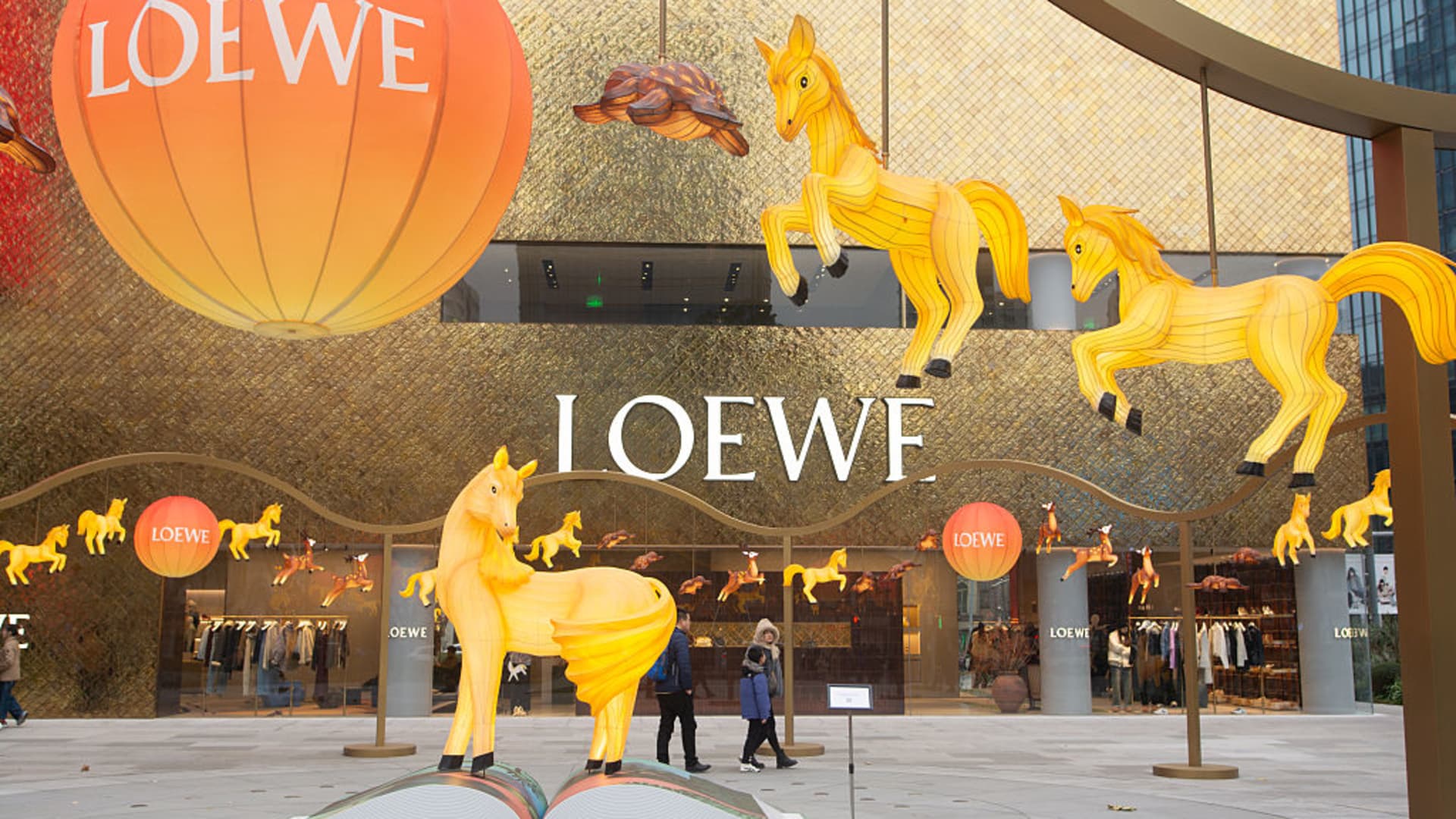
Loewe celebrated the Year of the Horse with an installation at a store in Shanghai, China.
Ying Tan/Nur Photo via Getty Images
Bernstein senior analyst Luca Sorca said he expects China’s luxury spending to stabilize and grow at a mid-single-digit rate in 2026. But the market is still much more competitive than it was at its peak, he said.
Before the coronavirus pandemic, Chinese consumers accounted for about a third of the global luxury goods market, according to Solca. Since then, that rate has dropped to about 23%, he said.
The fate of the luxury goods market does not just depend on the Lunar New Year, he said, but it is also an opportunity for Western brands to show respect for Chinese culture.
This annual holiday is associated with the colors red and gold, which symbolize good luck and wealth in Chinese culture. Each Chinese New Year is represented by one of the 12 zodiac signs. Last year’s animal was a snake.
But Solka said brands need to go beyond expected motifs to capture the full potential of Chinese luxury consumers.
“The Chinese are no longer in awe of what comes from the West,” Solka said. “A knee-jerk interpretation of the renminbi will not work.”
Veronique Yan, head of BCG’s consumer practice in Greater China, said a literal interpretation could seem lazy or even disrespectful to Chinese consumers. Younger shoppers are also looking for fresher items, she says.
“Young Chinese people respect old Chinese culture, but to be honest, there are many things they don’t understand, and they want it to be reinterpreted in a modern way,” she says. “It’s important to tell a story that connects tradition with a modern vision.”
Daniel Langer, a professor of luxury strategy at Pepperdine University, said the origins of the Lunar New Year collection date back to the early 2010s, when Western brands were eager to tap into China’s burgeoning luxury consumer market. At the time, there were few luxury boutiques in China outside big cities like Shanghai and Beijing, and China’s newly wealthy consumers were eager to spend money on branded goods, especially when traveling abroad, he said.
With greater access and choice, brands need to work harder to attract new customers.
And in the 12 years since last Year of the Horse, China’s high-income consumers have become more discerning, Langer said.
“They’ve visited the best places in the world, eaten in the best restaurants in the world, shopped in the best stores in the world. Their expectations of brands are sky-high,” he said. “China has completely transformed from a country with pent-up demand for luxury goods to one of the most sophisticated.”
Burberry’s Lunar New Year products.
Provided by Burberry
They have also become accustomed to spending less on Western brands during the pandemic travel restrictions and the rise of domestic luxury brands, Langer said.
Before the pandemic, Chinese consumers did most of their luxury shopping overseas. Pandemic travel restrictions have permanently changed this situation. According to Bain, two-thirds of China’s luxury spending in 2019 was made overseas, but last year overseas spending accounted for just one-third.
The Year of the Horse is a natural opportunity for many Western brands to participate in this holiday. Langer said he favors brands that take a less literal approach, like Loewe, which adorned its signature puzzle bags with fringe and tassels to capture a cowboy aesthetic.
However, Yang pointed out that the zodiac sign of the year is a symbol of good fortune only for those born in that year, and it is dangerous to have too much influence on the image of the horse.
Instead, brands can use immersive experiences to connect with Chinese customers, especially younger customers, in a more authentic way, she said.
For example, Valentino held a three-day lantern festival in January at Tianhou Temple, a historic temple along Shanghai’s Suzhou River. In mid-December, Burberry launched a major Lunar New Year campaign with Chinese brand ambassadors and a pop-up boutique and ice rink in Beijing.
“There are a lot of different cultural elements that can be integrated to build a story,” Yang said. “It’s not just about animals.”
