

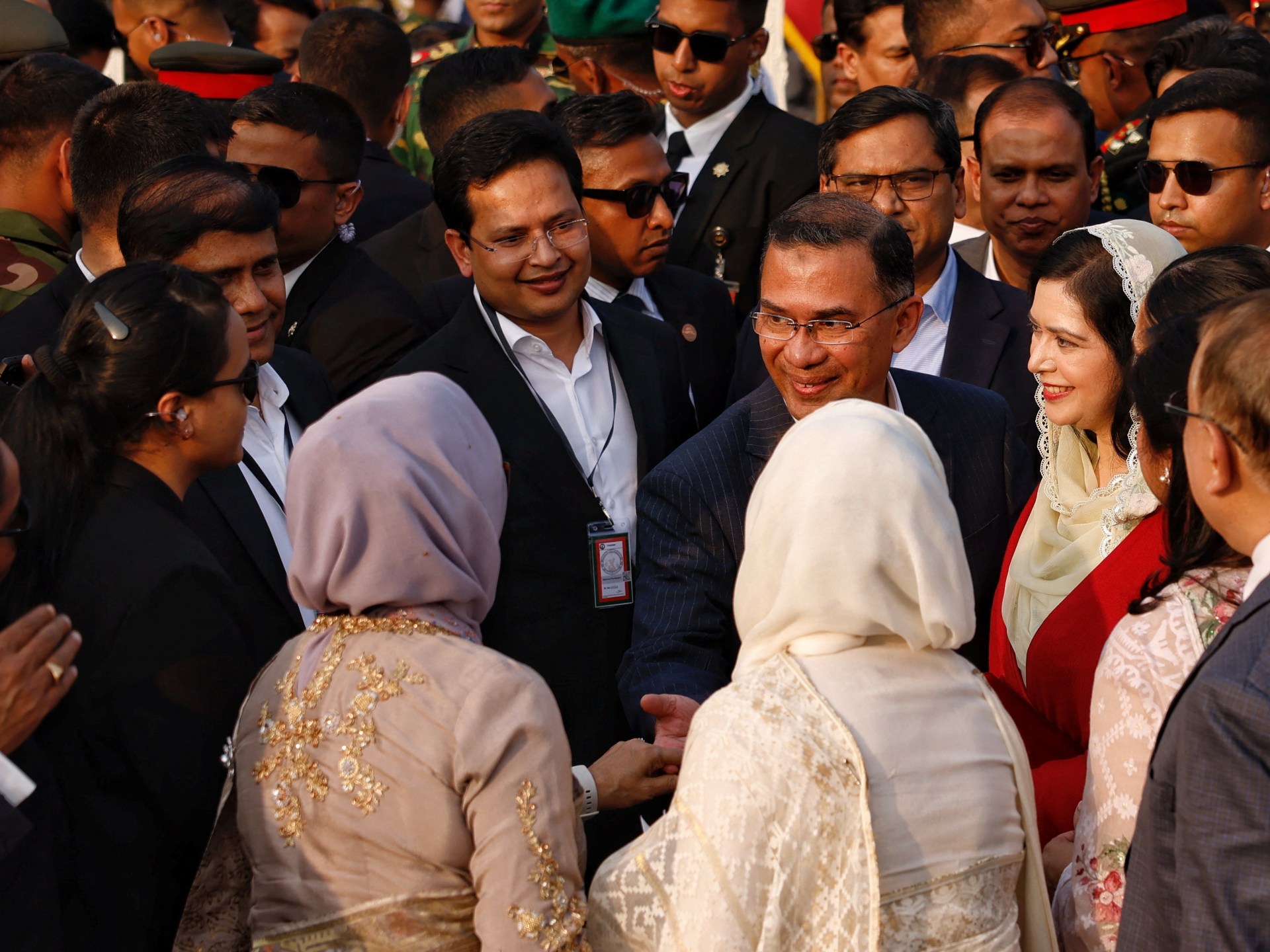
Alongside last week’s parliamentary elections in Bangladesh, voters also voted in a referendum on key constitutional reforms proposed for the country following the July 2024 riots and the ouster of former Prime Minister Sheikh Hasina.
The July National Charter, which most political parties signed last year, was approved by 60.26 percent of voters.
But the vote revealed a divide between the victorious Bangladesh Nationalist Party (BNP), led by Tariq Rahman, and the opposition party, led by Jamaat-e-Islami.
On Tuesday, newly elected BNP MPs refused to take the oath as members of the new Constitutional Reform Council, casting doubt on the future of reforms.
A detailed look at what the Bangladesh referendum was, why it divided the country, and what happens next.
What is the context?
In July 2024, students in Bangladesh began protests against the traditional employment quota system, which reserves a significant proportion of valuable government jobs for descendants of 1971 Bangladeshi freedom fighters, who are now widely considered to be part of the political elite.
As protests intensified, Hasina ordered a brutal crackdown. Nearly 1,400 people were killed and more than 20,000 injured, according to the country’s International Crimes Tribunal (ICT), and Hasina was later found guilty of crimes against humanity and sentenced to death. She is currently in exile in India and fled after being deported.
After Hasina’s defection, the Awami League, which had been in power for 15 years under her leadership, was banned from all political activities. This election was the first since the uprising.
What is the July Charter?
After Hasina’s ouster, Nobel laureate Muhammad Yunus was installed as interim leader of the transitional government in August 2024.
The National Charter of July 2025 was drafted by the caretaker government and outlined a roadmap for constitutional reform, legal reform, and the enactment of new laws.
According to the International Institute for Democracy and Electoral Assistance (IDEA), the draft plan includes more than 80 proposals to overhaul Bangladesh’s governance system, with key reforms “increasing women’s political representation, imposing term limits for the prime minister, strengthening presidential powers, expanding fundamental rights, and protecting the independence of the judiciary.”
The Charter also recommends the creation of a 100-member Senate, parallel to Bangladesh’s current single parliamentary body, the 350-member Jatiya Sanghsad.
For several months during the interim government, the BNP had been skeptical about the July national charter referendum, sometimes saying no, but on January 30, party leader Tariq Rahman publicly supported a yes vote and announced that the BNP would adopt the charter if approved by the referendum.
In particular, analysts say the BNP appears to be opposed to the idea of proportional representation in the upper house, arguing that the current electoral system could dilute its parliamentary majority.
Now that the Charter has been approved, the new parliamentarians must establish a Constitutional Reform Council to enact constitutional amendments to the Charter. The implementation process must be completed within 180 days of the establishment of the council.
Did the referendum cause division in Bangladesh?
On Tuesday, newly elected members of Congress were sworn in.
They were asked to take two oaths. The first was the standard pledge to uphold the Constitution of Bangladesh. The second mandated respecting and implementing the July 2025 National Charter.
However, the newly elected parliamentarians from the BNP did not take the oath for the second time, inviting criticism from members of the Jamaat and its allies, the National Civic Party (NCP), formed by students who led the 2024 protests against Hasina.
Based on the July Implementing Order that stipulates how to legislate the National Charter, the Constitutional Reform Council will be made up of members of parliament, who will also be sworn in as members at the same ceremony. Strictly speaking, this means that only the Jamaat, NCP, and a few others who have taken the second oath are currently eligible to join the council.
The council has not yet been established as more than two-thirds of parliamentarians did not take the second oath. It is unclear what will happen in the future regarding the establishment of the council.
What are the main problems with BNP?
Salahuddin Ahmed, a BNP standing committee member and member of parliament, told local media after the ceremony that in the BNP’s opinion, BNP members refused to take the oath of the charter because the Constitutional Reform Council, which is responsible for enacting reforms, has not yet been approved by parliament.
“None of us have been elected members of this ‘Constitutional Reform Council’. This council is not even part of the constitution yet. It is only considered legal once it is approved by an elected parliament,” Ahmed said, according to local media reports.
But on Tuesday, he reaffirmed the BNP’s commitment to pass reforms, saying: “We are committed and committed to implementing the July National Charter as signed as a political agreement.”
The main concern the BNP is believed to have regarding this reform concerns the creation of a second 100-member Senate.
“The major political parties seem to agree on almost all the core issues of the referendum. However, disagreements remain on the specific details, especially on the proposed establishment of the Senate,” Dhaka University law professor Asif Nazrul told Al Jazeera earlier.
Bangladesh currently conducts all elections using the first-past-the-post (FPTP) electoral system. Each voter chooses one candidate, and the person who receives the most votes in a seat wins that seat.
This can lead to large differences between a party’s overall vote share and its actual seat share. Theoretically, one party could win 51 percent of the vote in all seats and another party could get 49 percent of the vote in all seats. However, the largest party will win 100% of the seats.
Any party that wins at least 151 of the 300 seats will be able to form a sole government, with the party in second place becoming the official opposition party.
In last week’s elections, the BNP-led alliance won 212 of the 297 seats for which results were declared, followed by the Jamaat-led alliance with 77 seats.
Although the BNP wants to maintain the FPTP system, the July Charter recommends filling the upper house with members elected according to a proportional representation system, which allows each party to receive a share of seats based on its overall vote share.
In contrast, structuring the Senate along the lines of the FPTP system would favor the BNP, as it would gain a larger share of the seats in parliament.
“BNP is in favor of its establishment.” [the upper house] Jamaat and NCP, on the other hand, prefer proportional representation. Resolving this conflict remains a key challenge,” Nazrul said.
