



Insights for developers and investors to avoid interconnection risks and accelerate portfolio and project success
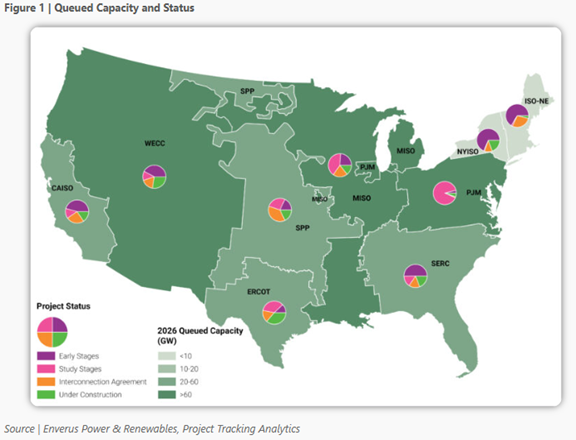
AUSTIN, Texas (February 24, 2026) Enverus, a leading energy SaaS and analytics platform, announced its 2026 interconnection queue outlook. This report provides a comprehensive view of power generation and transmission projects seeking connection to the U.S. power grid.
Interconnection queues remain one of the most important barriers to bringing new generation online. As utilities and grid operators balance grid reliability, load growth, and energy policy demands, market participants face increased uncertainty regarding interconnection review timelines, network upgrade requirements, and project viability. The 2026 Interconnection Queue Outlook is designed to help users overcome that complexity by linking queuing risk to market structure and utility actions across major U.S. electricity markets.
Powered by Enverus’ proprietary machine learning technology, this outlook assesses standby generation and transmission projects while incorporating ISO market rules, utility planning approaches, and policy considerations that impact interconnection outcomes. This unified view allows users to better identify where projects are likely to face delays, interruptions, or increased costs, and where opportunities for grid access remain more favorable.
“Developers need more than just snapshots of queues; they need to understand the market forces that shape interconnect outcomes,” said Ryan Luther, Director of Enverus Intelligence® Research. “By integrating ISO dynamics into interconnection analysis, we are providing our customers with a more complete picture of where their projects face the most friction and where opportunities still exist.”
“Interconnection is no longer an independent technology process; it is deeply influenced by regional market design and utility decision-making,” Luther added. “The 2026 Interconnection Queue Outlook helps customers understand not only where their projects are in the queue, but also how ISO trends and market conditions are shaping the path forward.”
By examining interconnection activity in conjunction with ISO-level market trends, the 2026 Outlook provides important context for developers prioritizing their portfolios, investors assessing grid risk, and policymakers assessing grid readiness as demand for new generation continues to grow.
Customers like Alexandria Walling, vice president of development at Innoveteus Solar, have publicly supported Enbels’ efforts in the power and renewable energy space. “Very few projects in our industry are easy. We work really hard to eliminate as much uncertainty as possible on the front end. What used to take six months to a year to build and validate target areas, maps, etc. now takes hours. This allows our team to focus more on permitting efforts and ordinance research. Enverus is an invaluable resource, and having a dedicated team to help us get the most out of those resources is invaluable.”
Important points
Interconnection outcomes increasingly depend not only on queue location but also on regional ISO market structures and utility planning practices, creating grid access risk profiles that differ substantially across U.S. electricity markets. Despite reform efforts, grid congestion and delays in interconnection considerations persist, reinforcing interconnections as a key gate element for new generation and transmission projects ready for construction. As grid operators balance reliability, electrification, and evolving energy policy requirements, utility strategies and load planning assumptions are reshaping interconnection schedules. Project risks vary widely by region, highlighting the importance of understanding ISO-specific rules, research processes, and market trends when prioritizing development pipelines. Developers and investors face increasing pressure to assess interconnection risks early as late-stage delays and rising costs continue to challenge project economics. Several regions have implemented our SUGAR software to automate the interconnection review process, achieving significant time savings and laying the foundation for automation with other transmission providers.
Download the 2026 Interconnection Queue Outlook
additional resources
Share this:
