

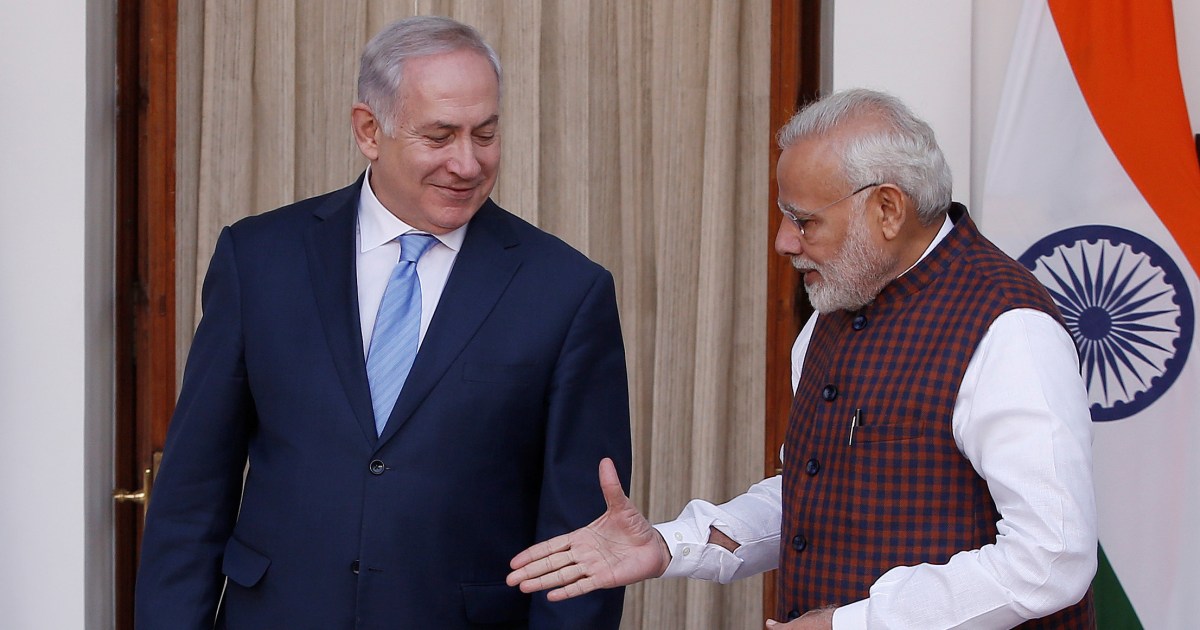
Indian Prime Minister Narendra Modi will begin a two-day visit to Israel from Wednesday. Modi’s first visit to Israel was in 2017, when he became the first Indian leader to visit the country.
India was one of the countries that opposed the creation of the state of Israel in 1948, and for decades was one of the strongest non-Arab critics of Israel’s policies toward the Palestinians. Although diplomatic relations with Israel were established in 1992, relations between the two countries have flourished since Mr. Modi came to power in 2014.
Here, we detail the agenda of PM Modi’s visit and why it is important.
Who will Prime Minister Modi meet and what will he say?
Prime Minister Modi is scheduled to land at Ben Gurion International Airport on the outskirts of Tel Aviv at 12:45 pm local time (10:45 pm Japan time).
Israeli Prime Minister Benjamin Netanyahu is expected to receive Mr. Modi at the airport, just as he did when the Indian prime minister visited in 2017. The two leaders are scheduled to hold talks soon.
Later, at 4:30 pm (4:30 pm Japan time), PM Modi is scheduled to address the Knesset, Israel’s parliament, in Jerusalem. He then returns to Tel Aviv and spends the night.
Prime Minister Modi is scheduled to visit the Yad Vashem museum, a memorial to Holocaust victims, on the morning of February 26 before meeting Israeli President Isaac Herzog. PM Modi and Prime Minister Netanyahu will then meet again and oversee the conclusion of an agreement between the two countries, after which PM Modi will depart from Israel in the afternoon.
Overall, PM Modi and Netanyahu aim to use the visit to strengthen the strategic economic and defense pact between India and Israel, officials from both countries said.
“We do not compete, but rather complement each other,” JP Singh, India’s ambassador to Israel, told state broadcaster All India Radio on Monday. Regarding relations with Israel. “Israel is very good at innovation, science and technology, so there will be a lot of discussion about AI, cybersecurity and quantum.”
The two countries signed a new bilateral investment treaty in September last year, replacing the 1996 investment treaty, to provide “certainty and protection” to investors in both countries. The two countries also aim to strengthen existing bilateral security agreements during the talks.
In a video posted on the Israeli embassy’s social media channels on Monday, Israeli Ambassador to India Reuven Azar said, “Our economic partnership is gaining serious momentum. We have signed a bilateral investment agreement and are moving forward with signing a free trade agreement, hopefully by the end of the year.”
Azar said Israel wants to encourage Indian infrastructure companies to come to Israel to build and invest.
Furthermore, he said, “We will deepen our defense relationship by renewing the security agreement.”
Prime Minister Netanyahu wrote in his X post on Sunday that he was looking forward to greeting PM Modi in Jerusalem.
“We are partners in innovation, security and a common strategic vision. Together we are building an axis of nations committed to stability and progress,” he wrote.
“From AI to regional cooperation, our partnerships continue to reach new heights,” Prime Minister Netanyahu added.
What is the relationship between India and Israel?
Relations between India and Israel have improved by leaps and bounds over the years. Although still under British rule in the 1920s and 1930s, India strongly identified with the Palestinian struggle for independence.
In 1917, Britain signed the Balfour Declaration, which promised a homeland in the British Mandate of Palestine to Jews who had been expelled from Europe due to Adolf Hitler’s oppression. This was opposed by many countries, including India, which was fighting British colonialism at the time.
“Palestine belongs to the Arabs in the same sense that Britain belongs to the British and France to the French,” wrote Mahatma Gandhi, India’s most prominent freedom fighter and revered as the Father of the Nation, in an article in the weekly newspaper Harijan on November 26, 1938.
India was one of the countries that opposed the creation of the State of Israel in 1948. In 1949, India also voted against Israel’s membership in the United Nations. Although Israel was recognized as a state in 1950, it was not until 1992 that the two countries formally established diplomatic relations, and economic ties gradually expanded over the next two decades.
There have been major changes in India-Israel relations since Mr. Modi became India’s leader in 2014. Nine years ago, Prime Minister Modi became the first Indian Prime Minister to visit Israel.
India is currently Israel’s second largest trading partner in Asia after China. According to India’s Ministry of External Affairs, trade volume has soared from $200 million in 1992 to $6.5 billion in 2024.
India’s main exports to Israel include pearls, precious stones, automotive diesel, chemicals, machinery and electrical equipment. Imports include petroleum, chemical machinery and transportation equipment.
Azad Essa, a senior reporter at Middle East Eye and author of the 2023 book Hostile Homeland: The New Alliance between India and Israel, told Al Jazeera that Prime Minister Modi’s visit to Israel shows how much India-Israel relations have evolved over the past decade.
“Partnerships existed, but they were much more limited before the Modi government. [New] “Delhi has now emerged as Israel’s strongest non-Western ally, now seen as a ‘special relationship’ rooted in strategic cooperation and ideological unity,” Essa said.
“This visit will be an opportunity for Prime Minister Netanyahu to express his gratitude to Prime Minister Modi, which PM Modi will use to demonstrate to the Israeli people that he is a respected and popular leader in the Global South.”
Under the Modi government, India has become Israel’s largest arms customer. And in 2024, an Al Jazeera investigation revealed that an Indian arms company supplied Israel with rockets and explosives during Israel’s genocidal war in Gaza.
Prime Minister Modi’s Hindu nationalist Bharatiya Janata Party (BJP) envisions India as a Hindu homeland, reflecting Israel’s self-image as a Jewish state. Both India and Israel have identified “Islamic terrorism” as a major threat, and critics say the label is used to justify widespread anti-Muslim policies.
“The India-Israel alliance is not just about arms sales and trade. It is about India’s open embrace of authoritarianism and militarism in building a supremacist state in Israel’s image,” Essa said.
“This is also a story about how the language of security, nationalism and democracy can be used to justify and normalize increasingly illiberal policies, and this has implications for all democracies.”
Why is this visit important?
Mr. Modi’s visit comes at a time of complex geopolitical tensions in and around the Middle East.
Despite good relations between the two countries in recent decades, PM Modi’s visit comes just a week after India joined more than 100 countries in condemning Israel’s de facto expansion in the occupied West Bank. New Delhi appeared hesitant at first, but signed the statement on February 18, one day later than most countries.
Prime Minister Benjamin Netanyahu this week claimed he plans to form a new coalition of regional states, dubbed the “Hexagonal” alliance, to counter “radical” Sunni and Shiite-majority countries.
Netanyahu said Sunday that the alliance includes Israel, India, Greece and Cyprus, as well as other unnamed Arab, African and Asian countries. None of these governments, including India, have formally approved the plan.
But analysts predicted Mr. Modi’s visit would be seen by many as a sign of support for Israeli policies.
“The timing of this visit is noteworthy, as it comes at a time when Prime Minister Netanyahu has lost immense credibility around the world. For the leader of the world’s largest democracy to visit Israel and show affection for Prime Minister Netanyahu, who has a warrant in his name from the International Criminal Court, is a strong endorsement of Prime Minister Netanyahu and Israel’s policies,” Essa said.
PM Modi’s visit also comes at a time of heightened tensions between Iran and the US.
India and Iran have had a long-standing cooperative relationship. After Prime Minister Modi’s visit to Iran in 2016, the two countries signed a major agreement allowing India to develop the strategically located Chabahar port on Iran’s southeast coast. However, India reportedly began withdrawing from Chabahar after the US imposed additional sanctions on Iran last year and threatened to impose penalties on all countries doing business with Tehran.
In June 2025, India did not join the Shanghai Cooperation Organization (SCO) in its condemnation of Israeli attacks on Iran during the 12-day war between Iran and Israel. However, it later joined Israel and the US in condemning the attack on Iran by the BRICS group of major emerging economies.
The United States, which has been applying its own pressure on India over the past year in retaliation for Russian oil purchases, has been building up vast military assets in the Arabian Sea near Iran, as President Donald Trump ramps up pressure to agree to a deal over Iran’s nuclear program and ballistic missile inventory.
President Trump said last Friday that he was considering a limited strike against Iran if the country fails to reach a deal with the United States. “I can tell you that we are considering it,” he told reporters.
Iran said it was seeking a diplomatic solution but would defend itself if the United States resorted to military action.
Analysts say Israel is likely to be a front-line participant in any escalation from a U.S. attack or Iranian retaliation.
