

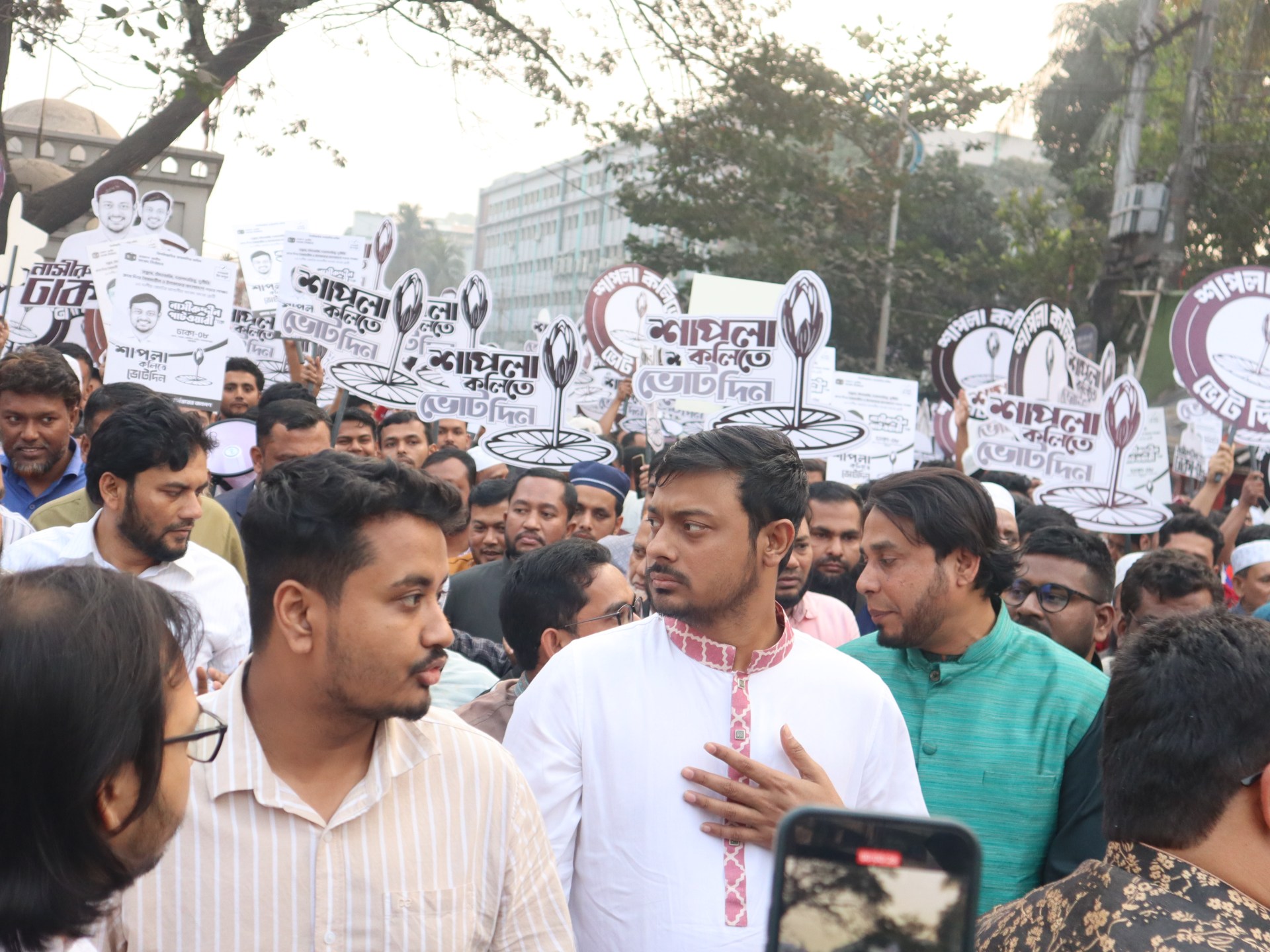
DHAKA, BANGLADESH – Ruhul Amin has long been disillusioned with Bangladesh’s established political parties and has been waiting for a reliable third force.
When the student leaders behind the 2024 uprising that ousted longtime leader Sheikh Hasina formed the National Civic Party (NCP), Amin, who is in his early 30s, felt he had finally found a party he could vote for and call his own.
Recommended stories
list of 4 itemsend of list
NCP was officially launched in February 2025. Its leaders had claimed broad popular support and strong electoral prospects and hinted at forming a future government.
But reality soon set in. Despite the momentum and widespread support enjoyed by student leaders during the uprising, the NCP was unable to organize enough grassroots organizations to fight parliamentary elections on its own. Opinion polls in the run-up to the February 12 election suggested the party’s support remained in the low single digits.
In the end, the NCP struck a deal with the Bangladesh Jamaat-e-Islami Party as a junior coalition partner, contesting just 30 of the 300 seats and winning six. The coalition led by the Bangladesh Nationalist Party (BNP) won the polls by a landslide, winning 212 seats, while the Jamaat-led coalition secured 77 seats.
However, the victory of the established parties has not dampened Amin’s spirits.
“As a new party, we did well in this election,” he told Al Jazeera from Kushtia district in western Bangladesh. “We are just getting started. In the next few election cycles, the NCP will emerge as the new strongman.”
From the uprising to parliament
Some of the NCP leaders who rose to fame during the 2024 uprising are now members of parliament.
For their supporters, six seats represents an unlikely breakthrough for the nascent party. But for critics, the party’s performance highlights the structural limits to the movement’s transition into formal politics.
NCP Spokesperson Asif Mahmood, who is also the NCP election management committee chairman, said the poll results were encouraging.
“It was a very good performance for a party that is only 11 months old,” he told Al Jazeera. “Of course it could have been better. We expected more. But considering the circumstances, we are satisfied.”
Mahmood claimed that the NCP may have lost a few more seats by a narrow margin due to the alleged vote-counting irregularities. Asked about the evidence, the party said it had already raised concerns during the election process.
Still, he acknowledged that a compromise would have to be made to enter the race. He said initially the NCP wanted to fight independently. “But given the political structure, we needed to form alliances to ensure representation and survival,” he said.
The alliance with Jamaat became a tension that determined the future of the NCP after the elections.

Alliance politics and internal rifts
Jamaat, Bangladesh’s largest faith-based political party, has historically championed Islamic law and held conservative positions on women’s rights. Despite the party’s recent pledge to uphold an inclusive and secular constitution and fielding a Hindu candidate in elections for the first time, the decision to ally with Jamaat has caused a rift within the NCP.
More than a dozen party leaders resigned within a week of the coalition announcement because they felt that a coalition with Jamaat was fundamentally incompatible with the NCP’s ideology and overarching values that shaped the 2024 uprising. They feared that this alliance would undermine the party’s credibility and centrist base.
However, Mahmoud rejected such concerns. “We are not playing shadow politics,” he told Al Jazeera. “If you look at our statements, they are not identical to Jamaat’s statements.”
Mahmood stressed that the deal with Jamaat is an electoral alliance and “not a political merger.”
The NCP has so far said it is preparing to contest the upcoming municipal elections on its own, but the leadership has not completely ruled out the possibility of another arrangement with Jamaat.
NCP leader SM Souza Uddin, who ran unsuccessfully in the February 12 election from Bandarban, a border district with Myanmar, told Al Jazeera that the party had “limited options” at the time and said the alliance with Jamaat was political realism.
He claimed that the NCP is a “generational corrective” to what he called a widespread leadership crisis across all political parties. “Young politicians in many parties are frustrated. People want change. I saw that desire everywhere I went,” he said.
“The NCP is a hope, the NCP is an alternative,” he added, arguing that having six members would give him institutional experience.
But not everyone is convinced.
Former NCP leader Anik Roy, who resigned last year before the Jamaat alliance was announced, believes the alliance structurally ties the party to the Jamaat.
“Right now, I don’t see any realistic way for the NCP to break away from the Jamaat,” he said, noting that the opposition’s role in parliament is already organized along alliance lines.
“The real test will be local government elections,” Roy added. “If they work with Jamaat again, that will point them in the right direction.”
He also questioned the party’s ideological clarity. “If they claim to be centrist, what does that mean? Center-right or center-left?” he asked. “In Bangladesh, these distinctions are important. But the NCP has not yet articulated its values.”
Mr. Roy claimed that without Jamaat’s support, the party probably would not have won any seats at all. “The foundations are weak,” he told Al Jazeera. “They are [NCP] There is a danger that he will become an agent that strengthens the Jamaat. ”
Spokesman Mahmoud disputes the idea that the party’s grassroots base is weak. “There is a tendency among grassroots organizations to think that BNP will come first, then Jamaat and then NCP,” he said. “But the reality varies from district to district.”
In some constituencies, NCP candidates outperformed expectations by focusing on local issues, he claimed. He pointed to seats where long-term community involvement, rather than traditional patronage networks, led to victories, even against the efforts of the major parties.
“This is a model we want to expand on,” he said.
Will a third force ever take root?
Much of the NCP’s political capital comes from the 2024 Uprising, a student-led movement that temporarily united various rebel factions. At the time, leaders like Nahid Islam and Mahmoud enjoyed broad cross-party appeal. Islam, one of the most prominent figures in the July 2024 uprising, is now the convener of the NCP. He was elected as a member of parliament from the Dhaka constituency and currently serves as the chief leader of the opposition coalition.
“It’s unfair to compare party politics with the uprising era,” Mahmoud said. “Once you get into partisan politics, conflict is inevitable.”
He pointed out that during the 2024 anti-government protests, figures from the BNP, Jamaat and other political parties were participating in a broader movement aimed at restoring democracy in Bangladesh. However, after forming the party, the NCP became a political competitor and therefore a target.
Asif bin Ali, a geopolitical analyst and postdoctoral fellow at Georgia State University in the US, sees the shift as decisive.
“In fact, the NCP has shown little interest in becoming an autonomous third force,” he told Al Jazeera. “Since the election, it has not articulated any agenda that is different from Jamaat-e-Islami and seems to be operating very comfortably under the Jamaat-e-Islami umbrella.”
In his view, the party’s tactics increasingly resemble those of the establishment. “It’s a traditional party with young faces,” he says.
Abdul Latif Masum, a political scientist and retired professor of politics and political science at Jahangirnagar University, said the NCP’s entry into parliament is a “positive beginning” but believes there is little room for the NCP to grow independently.
“The NCP’s chances of developing into a strong, independent third force are limited,” he said, citing organizational weakness and internal divisions.
Still, he acknowledged that the emotional legitimacy of the 2024 upheaval has not completely disappeared. If the party can unite and set a clear direction, “there is still potential.”
For now, experts believe the NCP occupies a gray area. Although it formally exists in Congress and is symbolically tied to historic popular uprisings, it is still navigating alliances within a deeply polarized political system.
Spokesman Mahmoud insisted that party leaders should be evaluated by their actions. He said the landmark February 12 elections were a test and the NCP has now “officially emerged as the third party in Bangladesh”.
But analysts say whether the six seats become a third force depends on what happens next. Can the party expand beyond alliance politics, build deeper grassroots networks, and articulate a clearer ideological coherence?
Amin still has hope. For him, winning six seats in parliament is not a goal, but proof that student-led experiments can survive in Bangladesh’s tough political terrain.
“We started on the streets, and now we’re in Congress. We’re not going back,” he said.
