

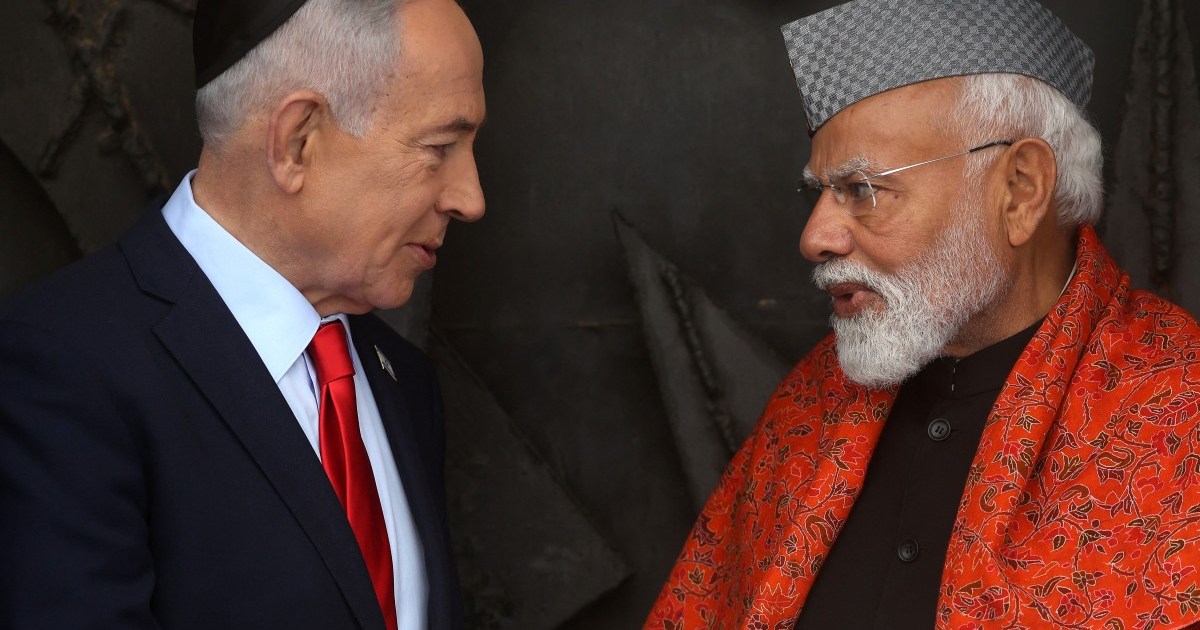
Indian Prime Minister Narendra Modi has concluded a two-day visit to Israel marked by a welcoming hug from Prime Minister Benjamin Netanyahu and a notable silence about Israel’s genocidal war in the occupied Palestinian territories.
During the visit, which began on Wednesday, the two leaders praised the strong friendship that has deepened their relationship and signed agreements on a wide range of issues, including innovation and agriculture.
“You are a great friend of Israel, Narendra. You are more than a friend. You are a brother,” Netanyahu told Modi on Wednesday as the two leaders addressed the Israeli parliament in Jerusalem.
Netanyahu gave Modi a tour of Yad Vashem, a memorial to Holocaust victims in Jerusalem, and hosted a dinner after the meeting in parliament, where Modi was awarded parliament’s highest honor.
This is the second visit to Israel by an Indian Prime Minister, after Prime Minister Modi’s first visit in 2017. Again, India did not visit Palestine despite its long history of supporting the Palestinian cause.
India opposed the creation of Israel in 1948 and first formalized diplomatic relations in 1992, but relations have improved since then and flourished, especially after Mr. Modi became India’s prime minister in 2014.
Since then, ties between the two countries have developed, anchored in their defense and common nationalist tendencies in their leadership.
Here are five key takeaways from PM Modi’s visit to Israel.

Full support for Israel, silent on Gaza massacre
Wednesday was the first time an Indian leader addressed Parliament. Prime Minister Modi received a standing ovation when he declared, “India stands firmly with Israel in this moment and in the future with full faith.”
“I extend my deepest condolences to the people of India for all the lives lost and all the families whose worlds were shattered in the barbaric terrorist attack by Hamas on October 7, 2023,” PM Modi told Israel’s parliament in 2023.
“We feel your pain. We share your grief. India stands firmly with Israel in this moment and in the future with full faith,” he said. “No cause can justify the killing of civilians. No cause can justify terrorism.”
“Like you, we have a consistent and uncompromising policy of no double standards and zero tolerance for terrorism,” the Indian prime minister said, referring to the 2008 Mumbai attacks, which New Delhi blamed on neighboring Pakistan.
Prime Minister Modi also supported US President Donald Trump’s 20-point Gaza peace plan and said India “supports all efforts that contribute to lasting peace and stability in the region.”
Prime Minister Modi said he supported “dialogue, peace and stability in the region” but avoided any mention of the ongoing genocide in Gaza, where Israeli forces have killed more than 72,000 Palestinians since October 2023.
Anwar Alam, a senior fellow at the Policy Perspectives Foundation think tank in New Delhi, said the timing of Mr Modi’s visit was “so bad that it seriously undermined India’s historic pro-Palestinian position”.
Alam argued that New Delhi, the leader of the anti-colonial Non-Aligned Movement, can continue to maintain ties with Tel Aviv, but “India cannot show such insensitivity to the suffering of the Palestinians and side with the colonialists.”

PM Modi emphasizes ‘civilizational ties’ with Israel
Analysts said one reason why Prime Minister Modi, unlike previous Indian leaders, was so warm towards the Israeli prime minister was the enthusiasm of India’s Hindu right for the ideology of Zionism.
Prime Minister Modi’s Bharatiya Janata Party (BJP) has its roots in the philosophy of Hindutva, which ultimately aims to transform India into a Hindu nation and a natural homeland for Hindus everywhere in the world, similar to how Israel sees itself as a homeland for Jews.
Prime Minister Modi, in his speech in Parliament, therefore emphasized on what he called the “civilizational ties” between the two countries. At the beginning of his speech in Congress, he declared himself “as a representative of one ancient civilization to another.”
“We are both ancient civilizations, and it is perhaps not surprising that our civilizational traditions reveal philosophical similarities,” he said, citing Israel’s “tikkun olam principles about healing the world.”
“In India, we greatly admire Israel’s determination, courage and achievements,” PM Modi said. “Long before we related to each other as modern nations, we were connected by bonds that go back more than 2,000 years.”
Prime Minister Modi reflected on his “return to the land that I have always been drawn to.” “After all, I was born on the same day that India officially recognized Israel, September 17, 1950.”
India officially recognized Israel in 1950, two years after its founding, but it did not establish diplomatic relations until 1992.

Strengthen defensive bonds
India is currently Israel’s largest arms buyer, pumping billions of dollars into Israel’s defense industry every year. According to an Al Jazeera investigation, Indian arms companies sold rockets and explosives to Israel when it launched a war in Gaza in 2024.
On Thursday, Prime Minister Modi spoke with Prime Minister Netanyahu and focused on strengthening ties in the fields of trade, technology and agriculture, as well as defense and security.
“We have decided to establish a Critical and Emerging Technology Partnership. This will give new momentum to cooperation in areas such as AI, quantum and critical minerals,” PM Modi said.
The two countries are also currently negotiating a free trade agreement.
enhance strategic relationships
India and Israel are reportedly inching closer to an alliance with other world powers to enhance security cooperation.
Before Modi’s visit, Netanyahu announced a “hexagonal alliance” including India, Greece, Cyprus and other unnamed Arab, African and Asian countries to collectively counter what he called a “radical” Shiite and Sunni Muslim “axis” of rivals in the region.
Although Prime Minister Modi did not confirm the plan, he called for cooperation on multilateral projects including the India-Middle East-Europe Economic Corridor (IMEC) and I2U2, which comprises India, Israel, the United Arab Emirates, and the United States.
IMEC envisions connecting India with the Middle East and Europe through integrated rail and transport corridors. The economic corridor will pass through India, UAE, Jordan, Saudi Arabia, Israel and Europe. It was announced during the G20 Summit held in New Delhi in September 2023.
“IMEC is very ambitious in bringing these countries together in a way that was previously incomprehensible,” said Harsh Pant, vice president of the Observer Research Foundation, a New Delhi-based think tank. “Today, that is possible because of India’s growing influence in the Middle East and Europe.”
Geopolitical analysts refer to I2U2 as the “West Asian Quad,” in reference to the Quadrilateral Security Dialogue, a forum of the United States, Japan, Australia, and India.
PM Modi also referred to the US-brokered Abraham Accords from 2020 for Gulf and North African countries to normalize diplomatic ties with Israel and “admired your courage and vision.”
“Things have changed a lot since then. The path has become more difficult. Still, it is important to keep that hope alive,” PM Modi said.

“De-hyphenating” India from Israel and Palestine
Pant said India, like some Arab countries, wants to de-stress relations in the region to better suit its strategic interests. Dehyphenation is a foreign policy in which states aim to maintain independent relations with states that may conflict with each other.
“India’s own relations have evolved to the point where India no longer exaggerates its relations in the region,” Pant said.
Analysts argued that New Delhi is betting on Israel for its own strategic interests, even at the expense of Palestine. From the Indian government’s perspective, “this is the beginning of a new strategic imagination in the region,” Pant told Al Jazeera.
In his speech in Parliament, Prime Minister Modi said that many Indians migrate to Israel for work, adding that young Indians are contributing to building modern Israel, including “on the battlefield”. Thousands of foreigners serve in the Israeli army, including nearly 200 soldiers with dual Indian and Israeli citizenship.
However, PM Modi did not mention former Indian army officer Col. Waibhav Kale, who was killed in May 2024 in the Gaza Strip when Israeli troops collided with a UN vehicle. He became the first international UN official to die in the war in Gaza.
“India’s position is clear: humanity must never become a victim of conflict. The path to peace has been forged through the Gaza peace plan. India fully supports these efforts,” Prime Minister Modi said before his departure on Thursday.
But analysts said there was a sharp departure from India’s past support for Palestine, and that India would not accuse Netanyahu of war crimes in the Palestinian territories.
Mr. Modi’s previous government had laid the foundations for the current bilateral relationship, but Mr. Pant “brought this relationship into the light,” Mr. Pant said. “What used to be done in secret behind closed doors is now fact.”
“India is trying not to make its relations with Israel hostage to the Palestinian issue,” he asserted.
Azad Essa, author of the 2023 book Hostile Homelands: The New Alliance Between India and Israel, said India had previously positioned itself as a friend of Palestine because “it was in its national interest to be seen as pro-Palestinian.”
But the populist political forces in New Delhi have since changed their position. Given the close defense and security ties between Israel and India, Essa said, “It will be very difficult for the opposition to commit to a change of direction because being pro-Israel has become essential to our national interests.”
“Being pro-Palestinian is now considered to be against India’s national interests,” he said. Some have been detained and prosecuted in India for expressing support for Palestine.
“For India to change more than just its attitude towards Palestine, it needs to become more democratic and break away from the rule of majoritarian politics,” Essa told Al Jazeera.
