

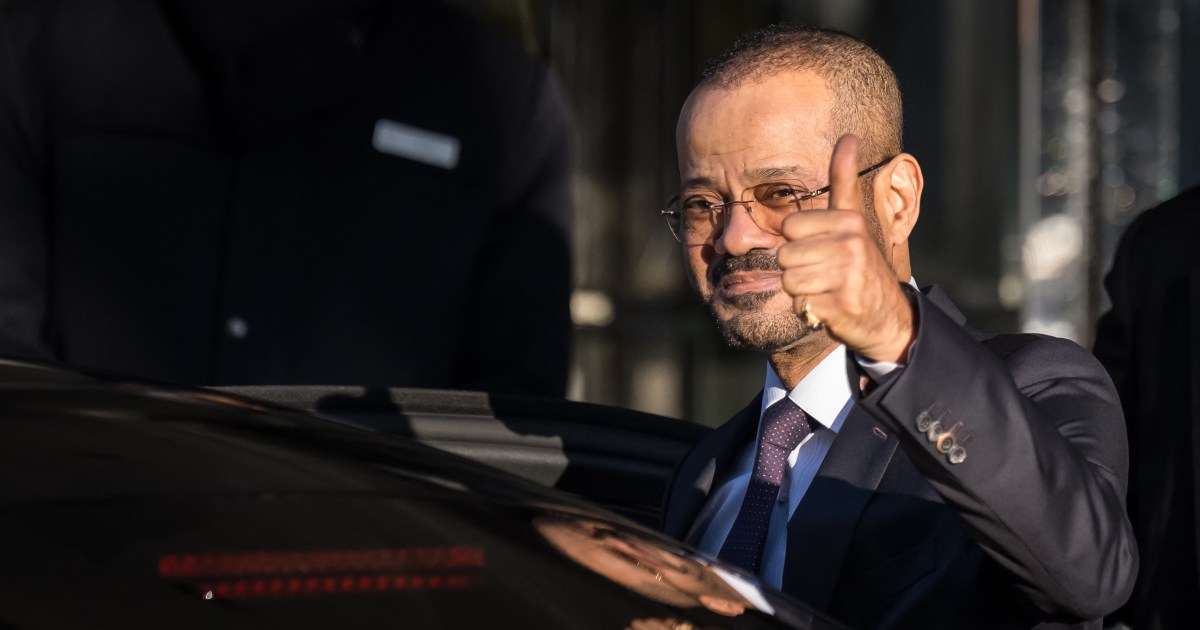
Oman’s foreign minister said recent indirect negotiations between the US and Iran have made “very significant progress” and diplomacy needs to be allowed to play its part.
listen to this article3 minutes
information
Oman’s top diplomat said Iran had agreed in indirect talks with the United States never to stockpile enriched uranium, calling the development a major step forward.
Oman’s Foreign Minister Badr bin Hamad al-Busaidi also said on Friday that he believed all issues in the Iran-US deal could be resolved “amicably and comprehensively” within months.
Recommended stories
list of 4 itemsend of list
“A peace deal is within our reach…if we just give diplomacy the space it needs to get there,” al-Busaidi said in an interview with CBS News in Washington, D.C., after Oman mediated the third round of indirect talks between the United States and Iran in Geneva on Thursday.
“If the ultimate goal is to prevent Iran from ever having a nuclear bomb, I think we have resolved that issue by reaching an agreement through these negotiations.” [on] This is a very important advance that has never been achieved before,” said Al Busaidi.
“I believe the most important outcome is the agreement that Iran will never have nuclear material to make a bomb,” he said.
“Right now we’re talking about zero stockpiling, which is very, very important because if you can’t stockpile concentrated material, it’s impossible to actually make a bomb,” he added.
There will also be a “full and comprehensive review by the IAEA.” [International Atomic Energy Agency]”, referring to the United Nations nuclear watchdog.
Oman’s top diplomat also said Iran would reduce its current stockpile of nuclear material to the “lowest possible level” and “convert it into fuel and make that fuel irreversible.”
“This is something completely new. Now we’re talking about zero stockpiles, so the enrichment argument really becomes less relevant,” Al Busaidi said.
“I believe that Iran is ready to discuss everything,” Foreign Minister al-Busaidi said of recent U.S. demands regarding Iran’s missile program.
“I hope so,” he said when asked if he thought recent talks in Geneva had provided enough evidence to deter a U.S. attack on Iran.
“We’ve made really significant progress. Obviously, I think there are a lot of details that still need to be ironed out, so we need some more time to really achieve the ultimate goal of putting together a comprehensive agreement package,” he said.
“But the big picture is that the deal is in our hands,” he added.
The foreign minister’s comments came after a meeting with US Vice President J.D. Vance earlier on Friday in which US President Donald Trump vowed to continue the armed attack while also supporting a diplomatic solution with Tehran.
President Trump said Friday that he was not satisfied with the recent talks that concluded in Geneva.
“We’re not satisfied with the way they negotiated,” Trump told reporters in Washington, adding that Iran “should make a deal.”
“It would be wise if they cut a deal,” he said.
President Trump later said he would prefer it if the U.S. did not have to use military force, but said: “Sometimes we have to use military force.”
The U.S. and Iranian sides are scheduled to meet again in Vienna, Austria, on Monday for more indirect negotiations.
