

Artificial intelligence is moving from technology buzzword to farm conversation as producers grapple with what data-driven systems mean for the future of resilient agriculture.
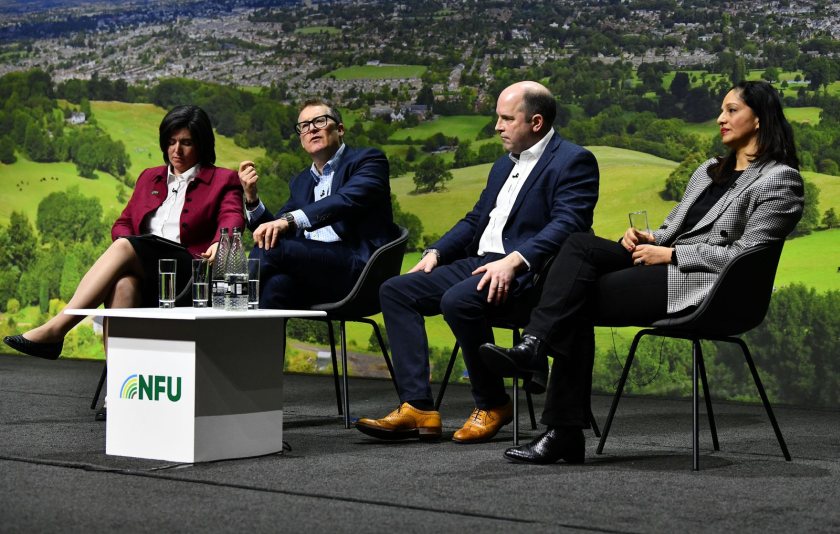
Today (February 25), on the second day of the NFU conference, a packed room heard from technology, academic and commercial livestock experts about how AI has the potential to quietly reshape decision-making across sectors.
The session, chaired by NFU Cymru Vice-Chairman Abi Rieder, was attended by Best Practice AI’s Tim Gordon, Professor Jasmeet Kahler from the University of Nottingham, and OptiPharm Chief Executive David Speller.
The discussion began by clarifying that this was not about artificial insemination or bird flu. It was about artificial intelligence and its potential role in strengthening agricultural systems under increasing economic and environmental pressures.
The tone was not evangelical, but rather cautious. Producers are more accustomed to discussing disease outbreaks, volatile markets, and rising input costs than algorithms and machine learning.
But speakers argued that AI may be sitting quietly in the background of many of the solutions that will define the next decade.
Tim Gordon reflects on the speed at which technology is advancing. What was considered abstract just a few years ago is now mainstream. He suggested that the speed of development is non-linear, and that acceleration is what is disruptive.
He likened AI to a highly skilled agriculture graduate. Be able to speak fluently about livestock systems, grassland management, and disease control. We have absorbed a huge amount of research and data. But it never walked a yard.
This analogy captured both promise and limitations. AI has information but no experience.
Mr Gordon spoke not only as a technical advisor but also as a Cumbrian shepherd. Profit margins are tight, diversification is often essential, and every decision involves risk.
For him, AI served as a “thinking partner” to stress test ideas, explore assumptions, and model scenarios faster than traditional methods.
One farmer asked the question many have been thinking: “Will this replace us?”
Gordon’s response was blunt. It won’t replace farmers, but it could replace certain tasks. Routine analysis and paperwork can potentially be automated.
The bigger risk, he suggested, is that companies that ignore these tools may fall behind those that use them wisely.
Trust was another theme. “How can I trust a cow when I’ve never seen one?” asked one farmer.
AI systems can sound confident even when they are wrong. They operate based on statistical patterns rather than actual experience. Over-reliance carries risks, especially when legal or welfare decisions are involved. Gordon emphasized that human judgment must remain central.
David Speller brought the discussion to the pig and poultry sectors, where data collection is already routine.
Feed conversion, mortality, environmental conditions, and behavioral indicators generate vast amounts of information every day. The potential of AI lies in identifying patterns that are invisible to the human eye.
Early detection of changes in health and well-being can protect both productivity and profitability.
One poultry producer asked if this meant constant monitoring in the future. “Are we heading toward a world where every bird is tracked and every movement analyzed?”
Speller acknowledged that concern and argued that analysis should focus attention rather than replace instinct. When used correctly, technology reduces noise and allows producers to focus on higher value decisions.
Inevitably, costs will surface. “This seems expensive. Who will pay for it?”
Speakers noted that not all AI applications require large hardware investments. Many tools already available can assist with policy interpretation, business modeling, and compliance at relatively low cost. As adoption increases, pricing may also become more accessible.
Professor Jasmeet Köhler expanded the focus to cattle and sheep systems.
Wearable sensors, behavioral analysis, and predictive modeling are being investigated as early warning systems for lameness, disease, and nutritional imbalances.
In the context of labor shortages, changing climate, and evolving disease dynamics, such tools have the potential to enhance operational durability.
One beef farmer questioned whether producers were “fixing what ain’t broke.”
Professor Kahler responded that experience remains valuable, but the business environment is changing. Technology does not erase instinct. It expands its range.
Data ownership turns out to be one of the most sensitive issues. “If you’re putting all this information into a system, who owns it?”
Production data has commercial value. There are concerns that aggregated data could be used to enhance supply chain leverage or be used in ways farmers did not anticipate. The Committee agreed that contractual clarity and transparency are essential to maintain trust.
As the session ended, there was one final question that broke through the complexity. “Where do I start?”
The advice was practical. Start with AI-powered analytical tools to summarize policy updates, compare company profitability, test diversification strategies, and more.
The atmosphere in the room was neither hype nor hostility. It was a cautious curiosity.
