

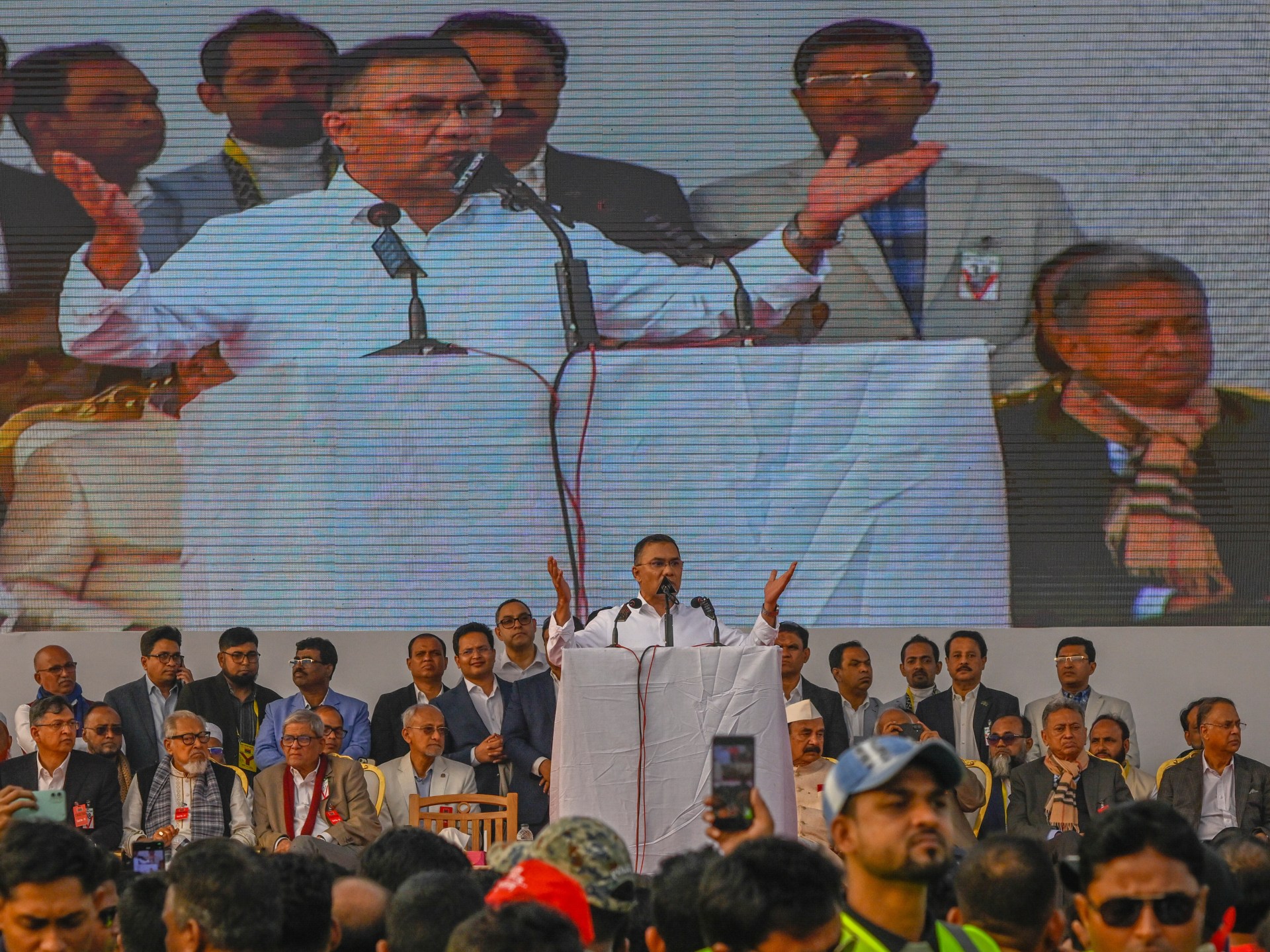
DHAKA, Bangladesh — Standing among a wave of people on the outskirts of Dhaka, Tariq Rahman, acting leader of the Bangladesh Nationalist Party (BNP), declared: “We have a plan for the people and the country.”
This is a plan that took 17 years to complete. On Thursday, the critically ill BNP leader’s son and former prime minister Khaleda Zia arrived in Dhaka after returning from the UK, where he had lived in exile since 2008. Tens of thousands of supporters gathered at rallies to welcome him back home.
“We want peace,” Rahman said. “This country has people from the hills and the plains – Muslims, Hindus, Buddhists and Christians. We want to build a safe Bangladesh where every woman, every man and every child can leave their homes safely and return home safely.”
His return comes at a time of heightened political uncertainty and tension in Bangladesh ahead of national elections scheduled for February 2026 following the assassination of prominent youth leader Osman Hadi. The BNP has long been widely seen as the front-runner in opinion polls, and Rahman is seen as a likely candidate for the prime minister’s post.
But Mr Hadi’s assassination sparked violence in the country, with the buildings of two of the country’s leading newspapers set on fire and a Hindu man lynched, and deepening political tensions raising concerns that the election could be derailed.
Analysts say Tariq Rahman’s return and his speech are likely to help calm the political situation in Bangladesh and build momentum for holding elections as planned.
Asif Mohammad Shahan, a development studies professor at Dhaka University, said: “His arrival opens up new opportunities. I think this will reduce electoral uncertainty and create the sense of stability the country is looking for.”
Even a few days ago, none of this was guaranteed.

Uncertainty about stability
With his mother Khaleda Zia in critical condition, Mr Rahman, whose father Ziaur Rahman was president from 1977 until his assassination in 1981, had long been expected to play a decisive role in shaping the BNP’s prospects in the next election. But until recently, his return from exile remained uncertain.
Rahman himself was hesitant about committing to a return. Shahan said his arrival removed that uncertainty but raised new questions. “Can Mr. Rahman really become a leader?”
“If he takes a firm stand against extremism, understands the people’s concerns, assures them that he will work for a stable political future, promises to bring about normalization, and shows that he is ready to govern while establishing firm control over the party apparatus, the political situation will improve significantly,” Shahan said.
But if Rahman fails to send a clear message, “the situation will get worse,” Shahan said.
Mubashar Hasan, an adjunct researcher at Western Sydney University’s Humanitarian Development Research Initiative (HADRI), said the public enthusiasm seen on Thursday over Mr Rahman’s return suggested he could benefit from support beyond traditional BNP voters.
“People’s interest and reaction to his return is not just limited to the BNP, but includes people from all walks of life,” Hasan said, adding that many in Bangladesh would see the party as a stabilizing force amid the turmoil of the past 16 months since former Prime Minister Sheikh Hasina was ousted following massive student-led protests. The interim government of Nobel laureate Muhammad Yunus, which took office after Hasina defected to India in August 2024, has come under growing criticism for failing to ensure law and order and implement wide-ranging reforms promised.
Hasan also said the huge rally by supporters to welcome Rahman showed the BNP’s organizational and political strength.
But there are other factors that could work in Rahman’s favor, Hasan said. On the streets of Bangladesh, many believe that Khaleda Zia’s son was treated unfairly and was forced to leave the country. Rahman faced various charges under the military-backed transitional government that ruled from 2006 to 2009. He was subsequently convicted in absentia in some of these cases.

son’s return
Since 2006, when the BNP last lost power, the political tide had been against Rahman.
He had a string of convictions for crimes ranging from murder to corruption, while his alleged misdeeds were heavily covered in the Bangladeshi media during Sheikh Hasina’s government.
However, despite this, he managed to maintain strong control over the party and maintain its unity. The 2024 uprising gave him a second chance. In the past year and a half, all charges against him have been dropped and convictions suspended, paving the way for his reinstatement.
Shafqat Rabie, a US-based Bangladeshi geopolitical columnist, said: “Tariq Rahman’s defining characteristic as a politician may be his focus on policy. He is known among his inner circle as a policy buff, and in today’s speech to millions of supporters he reiterated that he has a plan.”
One of the key aspects of his plan that will be noticed throughout South Asia is his approach to India.

“There’s an adult in the room.”
Traditionally, India has had a mostly frosty relationship with the BNP, always maintaining a functional relationship when the Bangladesh Party was in power, but has too often made clear its preference for Hasina and her Awami League as a partner.
The BNP’s decades-old alliance with Jamaat-e-Islam, the country’s largest Islamist group, has not helped strengthen ties with India. The Jamaat opposes Bangladesh’s independence from Pakistan and has historically supported close ties with Islamabad.
But in recent months, the BNP has maintained a relatively restrained stance, even as anti-Hasina sentiment within Bangladesh has led to fierce anti-India rhetoric from some political groups in the country.
It also appears to be breaking away from the Jamaat and positioning itself as a centrist party, attempting to occupy the political space vacated by the Awami League, which was banned from participating in February’s elections.
Despite Tariq Rahman’s “Bangladesh First” slogan, political observers believe he is unlikely to become an anti-India inflammatory politician.
“The basic assumption for India with Mr. Tariq returning to Bangladesh is that he will eventually have an adult with serious political capacity present with whom the Indians can negotiate,” Rabie said.
Recent political surveys in Bangladesh show a close race between the BNP and Jamaat ahead of the elections, with a significant number of voters still undecided.
Analysts said Rahman’s return should help the BNP there too.
“His presence will definitely energize the party base and encourage undecided voters to support the BNP,” said Dhaka University’s Shahan. “If he performs well, there is a strong possibility of a “wave” election in which the BNP could win in a landslide. ”
But for that to happen, Rahman will need to show that:He can connect with people, reassure them and provide a clear path to reform and democratic transition,” Shahan said.
