

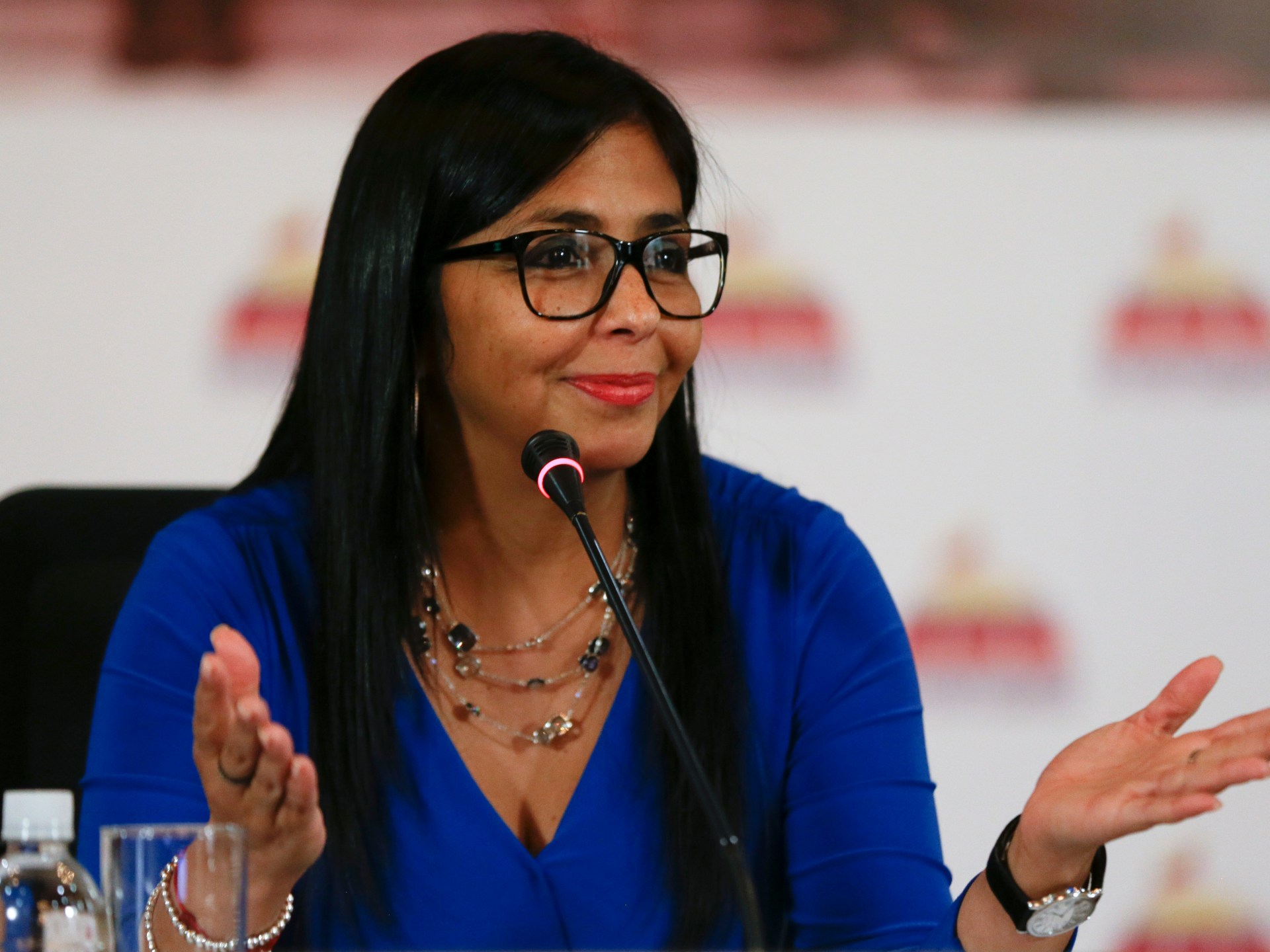
Venezuela’s former vice president Delcy Rodriguez has officially taken the oath to lead the South American country following the abduction of Nicolás Maduro in a US military operation.
On Monday, Rodriguez appeared at Venezuela’s National Assembly and took the oath of office.
Recommended stories
list of 3 itemsend of list
Addressing a legislative body made up mostly of government supporters, Rodriguez reiterated his opposition to the military offensive that led to the capture and removal of Maduro and his wife, Cilia Flores.
“I am saddened by the kidnapping of two heroes, President Nicolás Maduro and First Lady Cilia Flores, who are being held hostage,” Rodriguez, 56, said at the rally.
“I pledge to work tirelessly to ensure the peace, spiritual, economic and social tranquility of our people.”
Rodriguez, a former labor lawyer, has been acting president since the early morning attack that led to the abduction. Explosions were reported early Saturday in the capital Caracas, as well as nearby Venezuelan military bases and some civilian areas.
Monday’s swearing-in ceremony was overseen by Rodríguez’s brother, National Assembly Speaker Jorge Rodríguez, and Maduro’s son Nicolás Maduro Guerra, who had a copy of Venezuela’s constitution.
Maduro’s closest allies, including Interior Minister Diosdado Cabello and Defense Minister Vladimir Padrino, also attended.
The ceremony took place as Maduro, his predecessor and former boss, was arraigned in a New York City court.
Federal prosecutors in the United States have indicted Maduro on four charges related to his alleged use of government authority to export thousands of tons of cocaine to North America.
The charges include narco-terrorism conspiracy, conspiracy to import cocaine, unlawful possession of machine guns and other destructive devices, and conspiracy to possess such firearms and devices.
The Maduros have maintained their innocence of the charges, and their allies, including Rodriguez, have accused their abduction of violating not only Venezuelan sovereignty but also international law.
In court on Monday, Maduro said: “I’m still president,” insisting he remains Venezuela’s legitimate leader.
But while President Donald Trump’s administration has signaled its intention to cooperate with Rodriguez for the time being, Trump himself has warned that his term as president could be cut short if Rodriguez fails to comply with U.S. demands.
“If she doesn’t do the right thing, she’s going to pay a very high price, probably more than Maduro,” Trump told The Atlantic in an interview Sunday morning.
A day earlier, in a televised address announcing the attack, President Trump said his administration planned to “run the country until such time as we can have a safe, appropriate and prudent transition of power.”
On Air Force One returning to Washington, D.C., on Sunday, President Trump doubled down on that statement.
“Don’t ask me who is in charge, because I will give you a very controversial answer. We are in charge,” he told reporters.
Rodriguez said he is “cooperating” and has not spoken to her personally, but added: “We are dealing with people who have just been sworn in.”
The Trump administration’s willingness to allow Rodriguez, a former labor lawyer, to continue in the post has raised eyebrows.
Rodriguez, who has served as vice president since 2018, is known as a hardcore “Chavesta,” a follower of the left-wing political movement founded by Maduro’s late mentor Hugo Chávez. She held various ministerial roles under Maduro, including leading the Ministry of Foreign Affairs.
But Trump’s Republican supporters argue that keeping Rodriguez in office is just a practical reality.
“We do not recognize Delcy Rodriguez as the legitimate ruler of Venezuela. We do not recognize Nicolás Maduro as the legitimate ruler,” Republican Sen. Tom Cotton told CNN on Sunday.
“It is true that she and other indicted and sanctioned officials are in Venezuela. They control the military and security services. We must address that fact. That does not make them the legitimate leaders.”
While aboard Air Force One, President Trump largely avoided involvement in Venezuela’s new elections, saying he would instead focus on “rebuilding” the country and giving U.S. oil companies access to Venezuela’s vast oil reserves.
One of the reporters on the plane asked, “How soon will the election be held?”
“Well, I think we’re thinking more about solving it, getting ready first, because it’s a mess. This country is a mess,” Trump responded. “It’s driving badly. It’s just running oil at a very low level.”
He added: “We’re going to do everything. We’re going to do it and fix it. We’ll have elections at the right time. But the main thing that has to be fixed is that this country is broken. There’s no money.”
Venezuela’s recent presidential elections have been widely condemned as fraudulent, with Maduro claiming victory in both elections.
For example, during the disputed 2018 election, the United States briefly recognized opposition leader Juan Guaido as president rather than Maduro.
Maduro then declared victory for a third term in the 2024 presidential election, despite electoral rules.
No official vote tally was made public, and the opposition released documents that appear to show Maduro’s rival Edmundo Gonzalez won. Protests have erupted in the streets of Venezuela, with the nonprofit Human Rights Watch reporting that more than 2,000 protesters have been illegally detained and at least 25 people have been killed in what appears to be extrajudicial killings.
Opposition parties have largely boycotted Venezuela’s parliamentary elections, accusing them of being rigged in favor of “Chavistas.”
Monday’s swearing-in ceremony was attended by 283 members of parliament who were elected last May. There were very few opposition candidates among them.
