

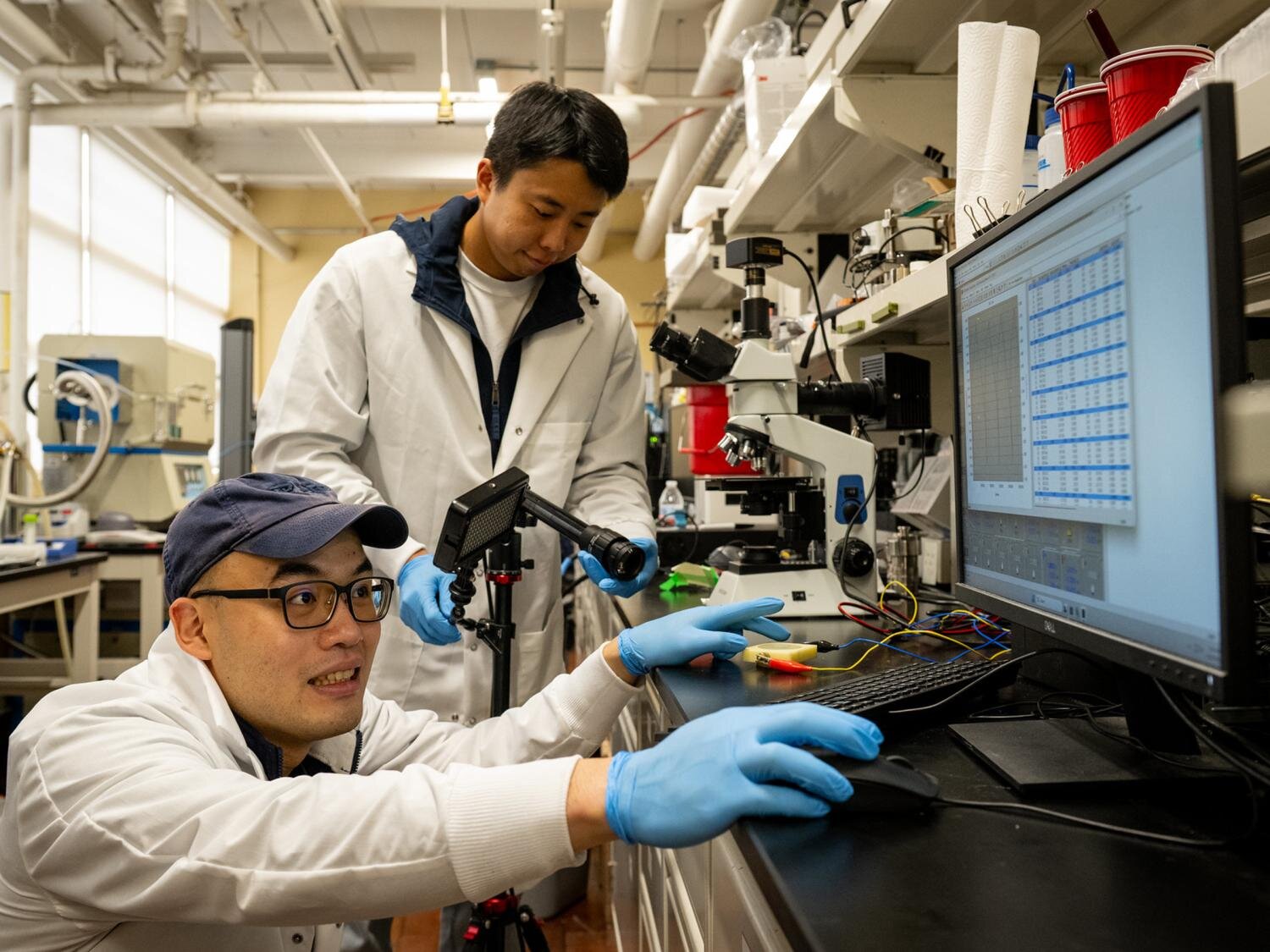

A team at Penn State University is researching a new approach to manufacturing extremely thick electrodes while maintaining battery performance. Credit: Poornima Tomy/Pennsylvania State University. Unauthorized reproduction is prohibited.
Electrodes are the veins of a battery, and are responsible for harnessing and transporting electricity, the lifeblood of energy storage devices. Battery power and efficiency are highly dependent on the performance of these electrodes. Now, a team led by researchers at Penn State University has created a new design that could potentially find practical applications in things like mobile electronics and electric vehicles.
Researchers recently developed a dense, thick electrode that significantly increases cell-level charging capacity while also improving mechanical strength to withstand degradation from repeated battery charging cycles. By using a new manufacturing process that improves electrode performance, the research team overcame the drawbacks commonly associated with increasing electrode density and thickness.
The study was published today in the journal Nature Communications.
The key to improving batteries is increasing the amount of active material (the component that stores energy and influences battery performance) in the electrodes, said Hongtao Sun, assistant professor of industrial manufacturing engineering (IME) and principal investigator on the project.
“Traditionally, active materials make up only 30% to 50% of commercially available battery cells,” Sun said. “Simply by making the electrode thicker, we can increase the total amount of active material and increase the total energy of the battery.”
Sun, who is also in the Department of Biomedical Engineering, Materials Science and Engineering, and Penn State’s Materials Research Institute, explained that increasing the thickness of an electrode typically requires making the structure highly porous (more than 40% voids) so that charge can move easily.
However, the extra porosity reduces the amount of active material that the entire battery can store, which in turn reduces energy. Packing electrodes more densely seems like an obvious solution to increase power, but Sun explained how the compact structure limits charge transport and weakens the battery’s performance.
To overcome this tradeoff, Sun’s team designed a synthetic boundary within the electrode. This acts as a “reservoir” for charge, allowing rapid movement throughout the system. These boundaries allow electrodes to be 5 to 10 times thicker and twice as dense as conventional electrodes, significantly increasing energy density within a limited volume.

Schematic diagram illustrating opportunities, challenges, and solutions for developing thick composite electrodes. Credit: Nature Communications (2025). DOI: 10.1038/s41467-025-65257-2
Sun says the resulting battery exhibits a potential energy density of more than 500 watt-hours per kilogram at the cell level, a power level that could potentially enable electric vehicles to achieve much greater range on a single charge.
According to Sun, this strategy provides an optimal balance of weight, thickness, volume, and capacity, producing cell-level performance that exceeds today’s commercial electrodes.
“By creating a three-dimensional network of synthetic boundaries within the electrode, we can increase energy output while simultaneously increasing density and thickness, overcoming the limitations of current commercially available electrodes,” Sun said.
Sun’s team used various liquid additives during densification, compressed the mixture, and gradually heated it to about 120 degrees Celsius (C). This temperature is much lower than traditional densification heating, which can reach 1,000 degrees Celsius. This low-energy densification process helped the team form a synthetic boundary made of a special polyionic liquid gel within the electrode.
In addition to improved performance, Sun explained how this approach resulted in significant mechanical improvements to the electrode.
“We were able to improve the toughness by 10 times and the ultimate strength of the electrode by 3 times compared to hot-pressed electrodes without liquid additives,” Sun said, explaining that the team developed digital imaging correlation as a tool to monitor the strain response of the electrodes in real time during cell operation.
Unlike complex synchrotron-based techniques, this method is affordable with standard laboratory equipment and provides researchers with a practical way to visualize and study battery degradation.
According to Sun, battery electrodes often wear out over time due to dynamic stress caused by repeated charging and discharging. This damage is very noticeable in devices such as cell phones, where batteries undergo charging cycles almost every day. By making the electrodes more resistant to damage, the team’s batteries became less susceptible to charging cycles, significantly extending their useful life.
Sun said the team’s electrode manufacturing technology is affordable, scalable for industrial use and compatible with standard equipment. The researchers are looking to scale up electrode manufacturing for commercialization, planning to move the technology from batch-scale production, where only small quantities of specific electrodes can be assembled at a time, to continuous roll-to-roll manufacturing. The system incorporates pressure- and temperature-controlled rollers and built-in quality control tools, enabling large-scale production of the team’s improved electrodes.
Further information: Bo Nie et al, Unveiling multifunction Synthetic Bounders for Enhanced Mechanical and Electrochemical Performance in densified Thick Composite Electrode, Nature Communications (2025). DOI: 10.1038/s41467-025-65257-2
Provided by Pennsylvania State University
Citation: Bridging boundaries: Dense, thick electrodes pack more energy into batteries (October 29, 2025) Retrieved October 31, 2025 from https://techxplore.com/news/2025-10-bridging-boundaries-dense-thick-electrodes.html
This document is subject to copyright. No part may be reproduced without written permission, except in fair dealing for personal study or research purposes. Content is provided for informational purposes only.
