

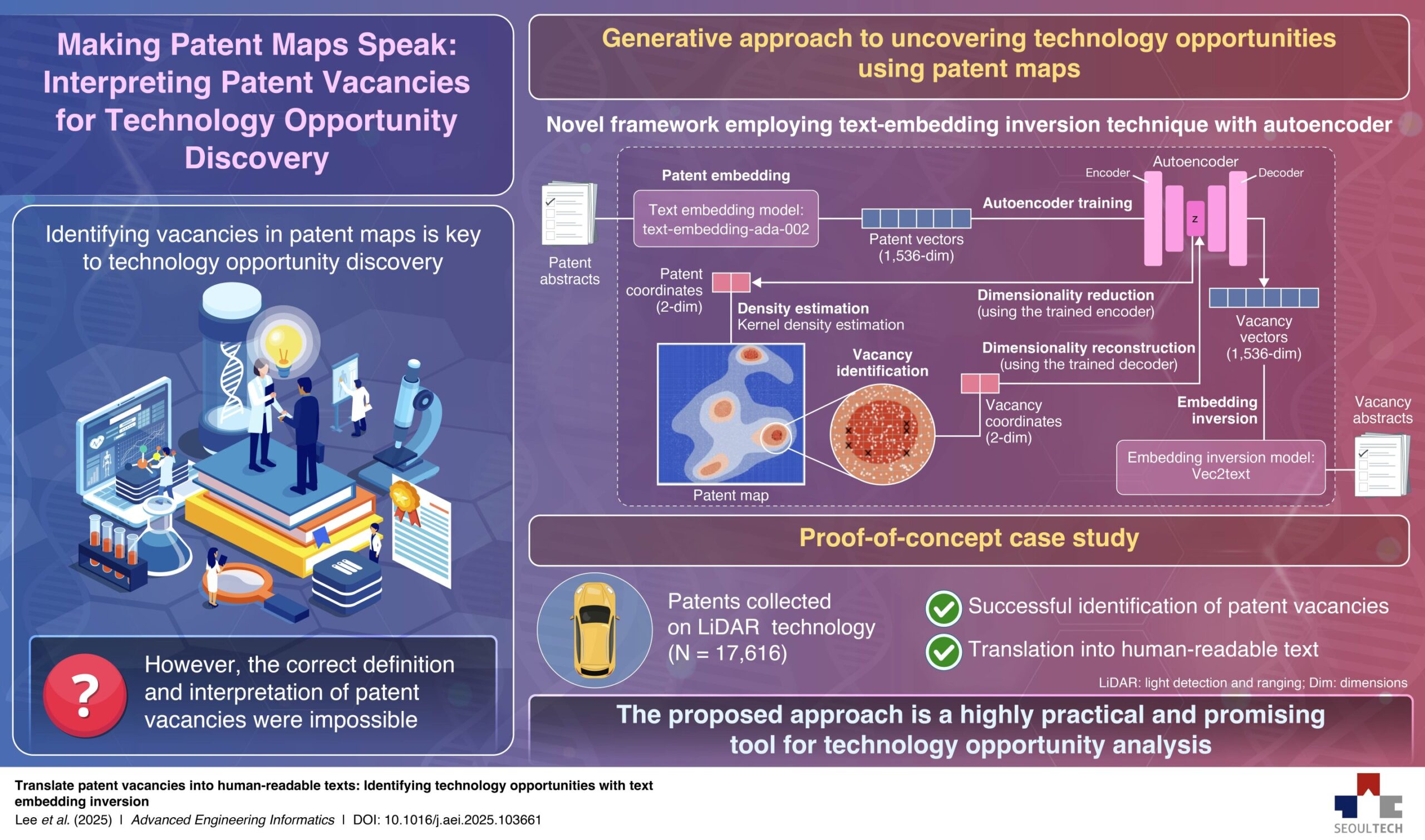

Researchers demonstrate a new approach to discovering technology opportunities by leveraging text embedding inversion techniques. Credit: Professor Hakyeon Lee, Seoul Institute of Technology
Patents are valuable for creating new ideas through technological discovery. In recent years, scientists have made several attempts to identify technology opportunities by determining the availability of patent maps, which are visual representations of patent distribution in specific technology fields created using dimensionality reduction techniques. However, this approach has a major bottleneck. That is, it is difficult to accurately define and interpret the technical content of these patent deficiencies.
In a recent study, researchers from South Korea and the United States, led by Professor Hakyeon Lee of the Department of Industrial Engineering at Seoul University of Science and Technology, South Korea, developed an innovative generative approach to discover technology opportunities from patent maps using machine learning. Their findings are published in the academic journal Advanced Engineering Informatics.
The approach proposed in this study utilizes a text embedding inversion technique that returns high-dimensional embeddings to the original data format to transform patent vacancies into more useful and human-readable text.
This consists of a total of 5 steps. Converting patent summaries to high-dimensional vectors using text embedding. Autoencoder training to project high-dimensional embeddings into 2D space and facilitate bidirectional mapping. Creation of grid-based patent maps using kernel density estimation techniques. Determine the empty cell and its coordinates as a patent hole. We reconstruct the hole coordinates into high-dimensional embedding vectors via a decoder, followed by generating human-readable text via vec2text.
Professor Lee said, “The most innovative aspect of our research is that we can transform abstract patent empty spaces into concrete, human-readable technical descriptions. Previous methods could only identify empty spaces on patent maps without explaining their significance. But this AI system can pinpoint locations on a patent map and instantly generate detailed summaries that describe the specific technologies that should be there. It’s like having a treasure map, not just empty spaces.” But also reveal exactly what treasures lie beneath each location. ”
The researchers demonstrated the novelty of their work through a case study of LiDAR technology using 17,616 patents. This approach successfully identified patent vacancies and converted them into human-readable text, showing potential as a very promising tool for technology opportunity analysis.
“Our work can fundamentally democratize innovation forecasting. Currently, only large companies with deep R&D resources are able to predict future technology trends. In five to 10 years, this tool will help small start-ups become more innovative by identifying untapped opportunities.” It could enable them to compete with tech giants, enable developing countries to leapfrog in technological development by focusing on anticipated breakthrough areas, enable academic researchers to automatically discover interdisciplinary research opportunities, and enable policymakers to predict technological disruption.” Prepare appropriate regulations. The time from opportunity identification to solution development is significantly reduced, thereby shortening the innovation cycle,” concludes Professor Lee.
In particular, the proposed system has already been extended to automatically generate detailed research proposals and complete patent documents from identified opportunities, with the potential to build an end-to-end AI innovation pipeline.
Further information: Sungsoo Lee et al, Translate Patent Vacancies into human-readable texts: Identifying technology opportunities with text embedding inversion, Advanced Engineering Informatics (2025). DOI: 10.1016/j.aei.2025.103661
Provided by Seoul National University of Science and Technology
Citation: AI-Based Patent Abstract Generator Can Discover and Describe Technology Opportunities (October 9, 2025) Retrieved October 10, 2025 from https://techxplore.com/news/2025-10-ai-based-patent-abstract-generator.html
This document is subject to copyright. No part may be reproduced without written permission, except in fair dealing for personal study or research purposes. Content is provided for informational purposes only.
