

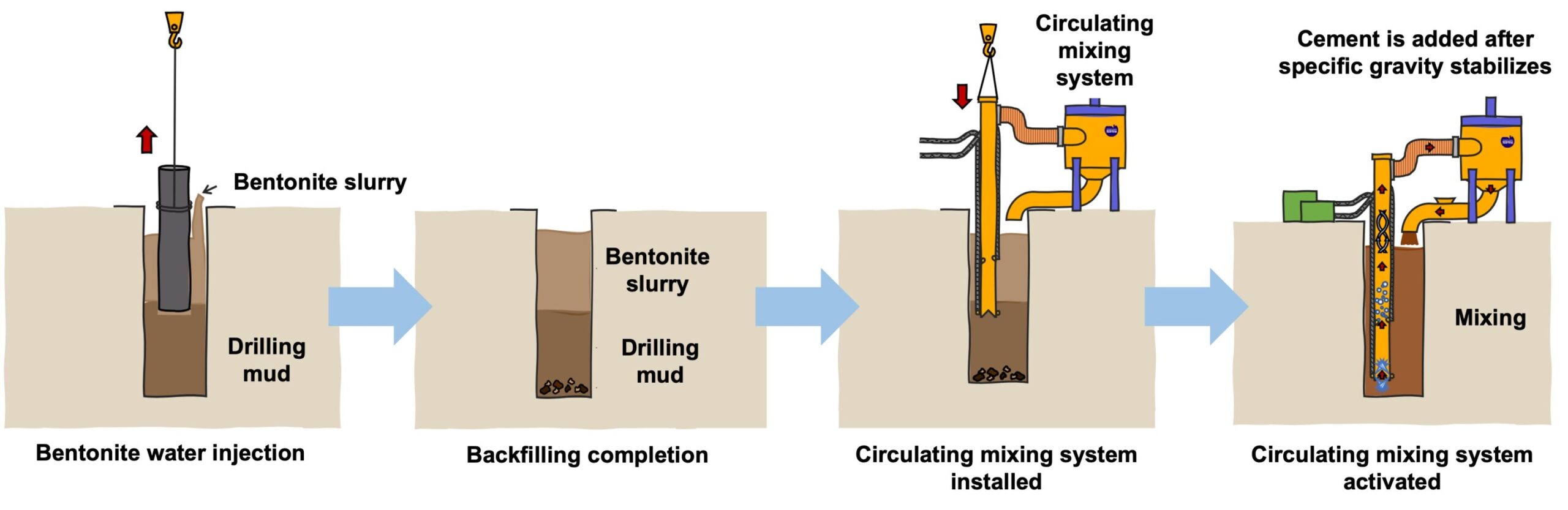

Researchers propose a sustainable approach for urban pile removal through innovative circulation mix assessment. Credit: Professor Shinya Inazumi, Shibaura Institute of Technology Source link: https://www.sciencedirect.com/science/article/pii/S2666790825002265?via%3Dihub
Many developed countries are simultaneously facing the aging of infrastructure built during periods of high economic growth. Japan is currently at a critical tipping point where many buildings and structures built during the post-war economic boom need to be demolished or replaced. After the 2011 Great East Japan Earthquake, its effects intensified dramatically, exposing the vulnerability of structures that did not meet modern disaster prevention standards and leading to a surge in demolition activity in urban areas.
When demolishing a structure, the foundation piles must be removed and classified as industrial waste, but traditional backfilling methods always result in an uneven distribution of material throughout the depth of the borehole. This technical limitation creates serious risks such as ground subsidence, structural tilting of adjacent buildings, and misalignment of newly installed foundations. As a result, the critical backfill process lacks scientific rigor and quality control mechanisms.
In a recent breakthrough, a research team led by Professor Shinya Inazumi from Japan’s Shibaura Institute of Technology has developed a new method that can ensure uniform backfill throughout the depth of a borehole, addressing both immediate safety concerns and long-term infrastructure sustainability. Their innovative discovery was published in the magazine “Cleaner Engineering and Technology”.
The proposed cyclic mixing method was validated through model testing, field experiments, and advanced numerical simulations using the moving particle semi-implicit (MPS) method within a computer-aided engineering (CAE) framework. These tests demonstrated excellent uniformity with a coefficient of variation of only 0.036, which is approximately 10 times better than traditional soil amendment methods, which typically range from 0.3 to 0.5. Furthermore, field tests in a 15 meter deep borehole confirmed that all samples exceeded the target strength of 1,500 kN/m² with no structurally unsuitable weak zones detected.
“Most importantly, our approach allows engineers to optimize process parameters and improve quality control by employing advanced MPS-CAE computer simulations to predict mix behavior prior to construction. Additionally, we can address Japan’s urgent infrastructure renewal needs while promoting sustainability by preventing soil degradation, reducing construction waste, and minimizing the carbon footprint of urban projects,” said Professor Inazumi.
The findings revealed that this method is particularly valuable when constructing high-rise buildings on sites with existing pile foundations, where improperly backfilled boreholes can compromise the stability of new structures worth millions of dollars. In particular, the proposed method prevents ground subsidence and tilting of structures that can lead to catastrophic failure during seismic events, addressing critical safety concerns in earthquake-prone regions.
“Our research establishes a new standard for geotechnical engineering in urban redevelopment and has the potential to be applied around the world, especially in cities facing the challenges of aging infrastructure. In densely populated metropolitan areas like Tokyo, New York and London, where large numbers of buildings constructed during the post-war economic boom now require demolition and reconstruction, this technology ensures safe and efficient site preparation,” said Professor Inazumi.
The fusion of engineering techniques and numerical simulation in the proposed method allows the industry to move from reactive quality assessment to proactive process optimization, improving the efficiency, safety, durability, and sustainability of urban redevelopment projects, especially in disaster-prone areas.
A paradigm shift in geotechnical engineering practice will help engineering consulting firms and construction companies assure their clients of construction quality through pre-construction numerical analysis and enhance transparency and accountability for urban infrastructure projects.
“Our innovative method supports sustainable urban development by minimizing construction waste and reducing carbon emissions associated with material transportation and disposal. Furthermore, it provides a path to improved geotechnical performance in urban infrastructure development, contributing to disaster resilience and protecting human lives and real estate investments,” concludes Professor Inazumi.
Further information: Shinya Inazumi et al., Sustainable Approaches to Urban Pile Removal through Evaluation of Innovative Circulating Mixtures for Urban Infrastructure Renewal, Cleaner Engineering and Technology (2025). DOI: 10.1016/j.clet.2025.101103
Provided by Shibaura Institute of Technology
Citation: Urban Infrastructure Renewal: Engineers Develop Sustainable Technique to Evenly Refill Aging Urban Lands (November 17, 2025) Retrieved November 18, 2025 from https://techxplore.com/news/2025-11-urban-infrastructor-renewal-sustainable-technique.html
This document is subject to copyright. No part may be reproduced without written permission, except in fair dealing for personal study or research purposes. Content is provided for informational purposes only.
