

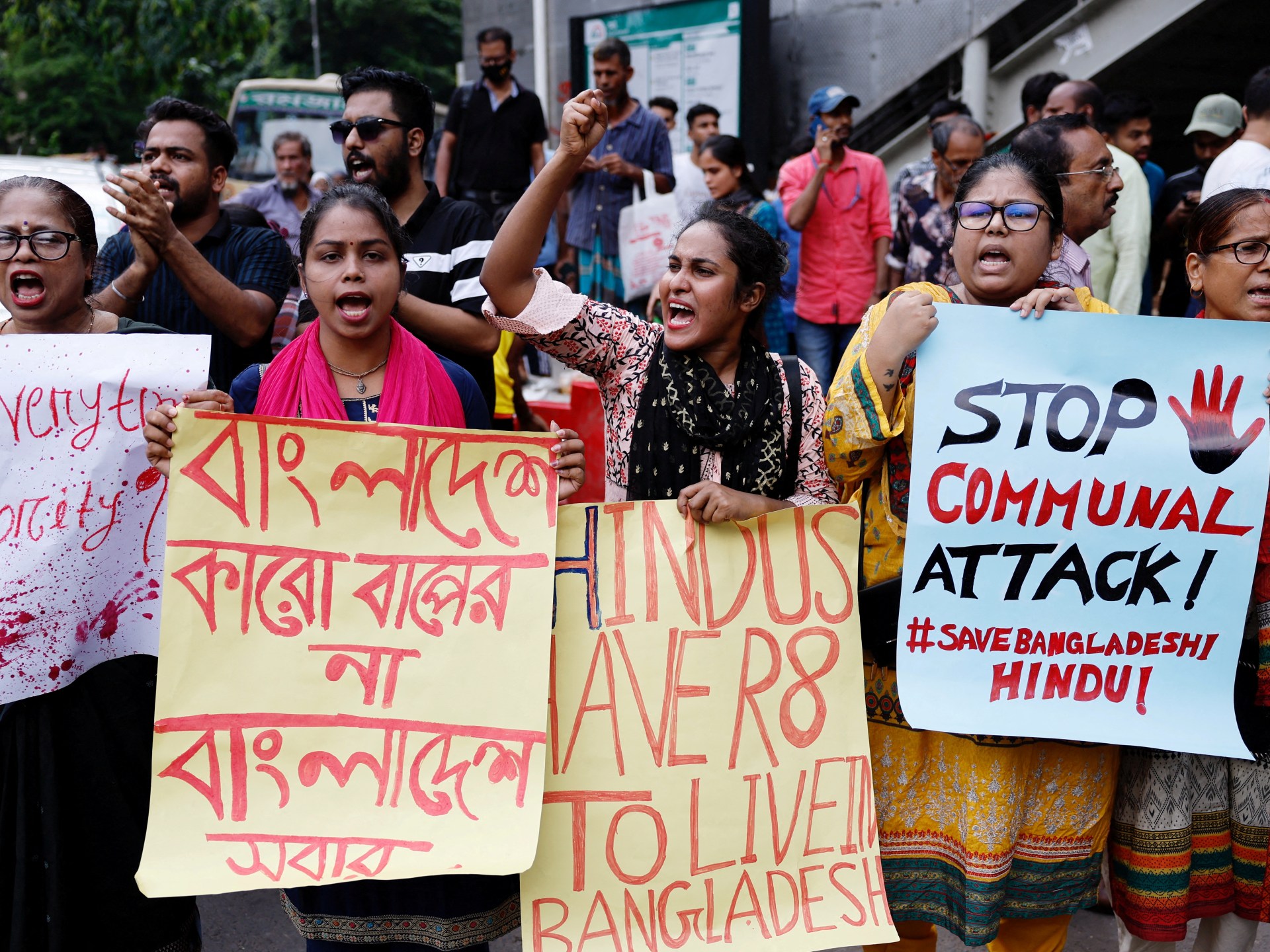
DHAKA, Bangladesh — Sukumar Pramanik, a Hindu teacher in the city of Rajshahi, about 250 kilometers (155 miles) from Bangladesh’s capital Dhaka, says the upcoming national elections could be the final test of faith in politics.
Bangladesh has seen a spike in communal and political violence during election periods throughout the country’s history, with religious minorities often bearing the brunt of intense political competition and social tensions.
Recommended stories
list of 4 itemsend of list
But since August 2024 and the end of former Prime Minister Sheikh Hasina’s rule, Bangladesh’s ethnic minorities have felt under siege, with reports of attacks, killings, and the burning of property, despite the government’s insistence that most incidents were not driven by religious hatred.
Despite efforts by major political parties to reach out to minority communities, this backdrop has led to growing anxiety ahead of the February 12 election. “Leaders of the major political parties have assured us that we will be safe before and after voting,” Pramanik said, but trust in politicians is low in his community at the moment.
After the August 2024 riots that led to Hasina’s ouster, mobs across the country targeted Hindu communities. Many of its members have historically voted for Hasina’s Awami League, which has long sought to claim a “secular” mantle — even though critics have accused the party of failing to prevent attacks on minorities and indulging in politics of terror during its years in power.
Pramanik said a mob from his village attacked a Hindu community in Rajshahi’s Bidyadharpur, beating him and breaking his hand. He required surgery and spent several days in the hospital. “I stood in front of the mob believing that they knew me and would not attack me,” he said. “They broke my hand, but more than that they broke my heart and my trust. I had never experienced anything like this before.”
“There is no proper justice.”
In Muslim-majority Bangladesh, Hindus make up about 8 percent of the population, with far smaller numbers of Christians, Buddhists and other minorities.
Throughout Bangladesh’s history, experts, ethnic minority leaders, political actors and their allies say religious identity has been exploited to intimidate voters or settle local disputes, leading to targeted attacks on minority homes, places of worship and individuals.
“If you look at past elections, even during Awami League’s tenure, the oppression and persecution of minorities never really stopped,” Manindra Kumar Nath, acting general secretary of the Bangladesh Hindu Christian Unity Council (BHBCUC), an umbrella group representing these minority communities, told Al Jazeera. “It happened before the election and after the election.” But what made matters worse, he said, was that “there was no proper justice.”
This was the case after attacks on Hindus in the years that followed after the 2001 elections won by former Prime Minister Khaleda Zia and her Bangladesh Nationalist Party (BNP).
Now, sporadic attacks in recent months leading up to the election have brought those concerns back to the fore. According to the BHBCUC, at least 522 gang attacks were recorded in 2025, of which 61 resulted in murder. The group said 2,184 cases took place in 2024 after Hasina was removed from office in August of the same year.
Nass said minorities are currently “very anxious” ahead of the election. “Everyone is scared,” he added.
The Bangladeshi government disputes claims of widespread gang violence. According to official data, in 2025 authorities recorded 645 incidents involving members of ethnic minority communities. The government said only 71 of the cases had a “communal element” and the rest were classified as general criminal acts. Officials say the figures show that most incidents involving minorities are not motivated by religious hostility, and emphasize the need to distinguish between mass violence and broader law-and-order crimes.
At the national level, Bangladesh faces persistent law and order challenges, with an average of 3,000 to 3,500 people dying from violent crime each year, according to official statistics.
The government also indicated that the issue has been politicized internationally, particularly by Indian media and officials, since the fall of Hasina’s government.
However, rights groups present different data. Ain O Salish Kendra, a prominent human rights organization, recorded 221 incidents of mass violence in 2025, including one death and 17 injuries. This figure is lower than the BHBCUC tally, but higher than government data.
And despite the disparity in numbers, interviews with minority communities point to deep anxieties shaped by recent lived experiences.
“It’s not just another psychological trauma.”
Shefali Sarkar, a housewife from Bidyadharpur in Rajshahi, saw her life change forever on the afternoon of August 5, 2024, the day Hasina fled to seek asylum in India.
As fear of the attacks spread, most of the men in the area fled, leaving the women in their homes. After Hasina’s ouster, the mob targeted mainly men.
“They started destroying our house. I thought it was the end. I thought we were going to die,” said Shefali, still visibly shaken as she recalled that day. “It left a deep scar on me and I subsequently required mental health treatment.”
Shefali said insecurity is returning as elections approach, and she worries that any new unrest could lead to her community being targeted again. “I can’t go through any more emotional trauma,” she said.
Her husband, Narayan Sarkar, said the area had remained calm since the attack and that local Muslim residents and political leaders had assured them of protection. “But fear will always remain. Peace can be snatched away at any time,” he said.
“Anxiety may spread.”
Not everyone is equally worried.
Shaimol Karmokar, a native of Faridpur district in central Bangladesh, is the secretary of the local Durga Puja celebration committee. Durga Puja is a major Hindu Bengali festival celebrated in Bangladesh and the Indian state of West Bengal.
“We have traditionally maintained strong communal harmony here over the years,” Kalmokar said. “While there were reports of attacks in many areas during the riots, nothing happened in our hometown.”
He added that political leaders have promised to actively seek minority votes and ensure minority security. “We will vote and we hope to have a peaceful election,” he said.
Indeed, BNP leader Tariq Rahman, son of former Prime Minister Khaleda Zia, has spoken of his desire to build an inclusive Bangladesh where all communities feel safe and secure, regardless of their religious beliefs.
And Jamaat-e-Islam, the BNP’s main challenger in this election, has nominated a Hindu candidate from Khulna city for the first time as part of its community outreach efforts.
Still, there are growing concerns about election violence in Gopalganj, where about a quarter of voters are Hindu.
Govinda Pramanik, general secretary of the Bangladesh Jatiya Hindu Mohajote, said that in the constituency with a large Hindu population and where Hasina was born, Bangladesh Jatiya Hindu Mohajote secretary general said: [Bangladesh National Hindu Grand Alliance] An independent candidate said he feared that “unrest may spread around this election.”
BHBCUC’s Nass said the government and election authorities could have done more to allay the concerns of minorities. “Even now, the Election Commission has never asked religious minorities what problems they face or what kind of support they need,” he said.
But Shafiqul Alam, a spokesman for Bangladesh’s interim government head Mohammad Yunus, said authorities were taking steps to protect minorities and ensure safe elections. “We have taken appropriate measures to ensure that people from all communities, minorities and majorities, adherents of all faiths and identities, can vote in a festive manner,” Alam told Al Jazeera. “For the past 15 years, under Sheikh Hasina, elections were rigged and they were not able to vote freely.”
He added: “Our priority is to ensure everyone can vote this time,” and insisted the government had consulted with ethnic minority communities and addressed their concerns.
Back in Rajshahi’s Bidyadharpur village, Sukumar Pramanik said he was considering these assurances carefully. “If we come under attack again, this will be the last time I have confidence in them,” he said.
