


With the 2018 reorganization of Petrotrine, the state oil company in Trinidad and Tobago, the new company Heritage Petroleum Company, Ltd. was established to conduct oil and gas surveys and production both onshore and offshore. It quickly became clear that the SCADA systems they inherited would require upgrades and could benefit from digitalization and IoT technology.
To develop the project, Heritage was responsible for the team at TOSL Automation and Technology Limited (TATL)¹ with general manager Keone Jackman and ICE engineer Anesa Mohammed overseeing the work. They worked closely with two Costa Rica companies, Aveva partner Incentro SA for software support, and SOATI for their system integration expertise.
The project consisted of two phases. 1) Upgrading existing SCADA systems (Aveva Intouch, historians, web clients) and 2) Integrating remote sensor monitoring. During the first phase, the TATL team quickly realized that they could save a considerable amount of time and resources using existing equipment and software.
“The original plan was to break the entire installation and start from scratch,” Jackman said. “Fortunately, as Heritage has finally made its plans, we proposed that we upgrade the SCADA system to activate assets, gain visibility into production, and supply it to the ERP system to better manage operations.”
The second phase significantly expanded the project. “Heritage was also talking about using MQTT to bring in electrical substations, compression monitoring, and remote sensors,” Jackman continued. “There was a clear need for MQTT brokers. From there, Skkynet was involved through Incentro, which was joined by DataHub software as a trusted partner that supports MQTT and works well with Aveva Suite.”
Tests have proven that the Datahub Smart MQTT broker is compatible with both Aveva Intouch and Hiberhilo devices. Typically, Lorawan-enabled sensors are connected to the cloud by MQTT and from there to the corporate office. However, Heritage wanted a way to broker MQTT data directly from Hiberhilo devices into other systems in the future.
¹At the time of previous ANSA Technologies Limited (ATL) projects

The Heritage team installed Hiberhilo sensors throughout the offshore production facility that needed monitoring, and sent data streams from each sensor to the Lorawan network server. That server was connected to a DataHub instance as an MQTT client by the TATL team. The MQTT data stream was then collected and integrated using the DataHub MQTT Smart Broker, and the results from OPC were sent to historian and web client Aveva Intouch, complementing the remaining process data.
With the basic data flow established, the team had to consider interface design and protocol conversion. “The project was unique,” Mohammed said. “It wasn’t just plug and play. I had to select the specific data point I wanted to display in Intouch, then create a tag in Intouch to create a screen from scratch. The data entered from the gateway was in a different JSON format for several different types of sensors and devices. Data hub software had to provide custut over cust to skynet in a way that handled this information and assisted Intech.
In addition to handling various JSON inputs, the system had to be redundant. The project was on track when the TATL team encountered unexpected problems. The Hiberhilo server was unable to support the expected parallel connection scenario.
“We had to change the configuration,” Jackman said. “With the help of SOATI, INCENTRO and SKKYNET, I came up with a way to monitor quality of service parameters from the data flows of each of the two MQTT servers. The DataHub script evaluates both data paths and switches, if necessary, if the server misunderstood the auxiliary paths, if necessary, if the server misunderstood the Switch, if necessary, it goes for connectivity.”
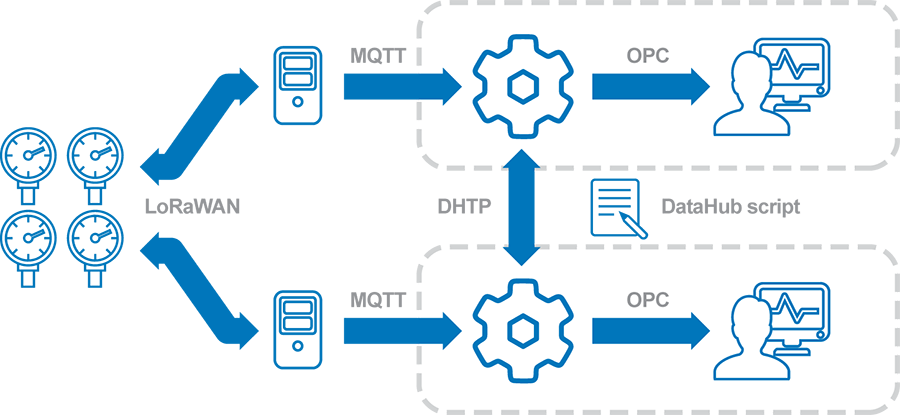
“These are two real scenarios that we had to deal with,” Jackman continued. “Fortunately, the flexibility and versatility of DataHub solutions allowed us to have room for the problem.”
“So far, what we’ve implemented has been successful,” Mohammed said. “Heritage was looking for modernized dashboards, increased availability, user friendliness, stability and security. MQTT connections improved analytics, alarm management, integration with third-party applications, and the ability to scale and add devices. All this was achieved using DataHub software.”
Many of these cost benefits came from maintaining existing hardware and software wherever possible. “Savings was important because savings were able to reuse what Heritage already had,” Jackman said. “For example, they didn’t need to rip communication infrastructure right away. For example, that alone saved them six months.”
To support the legacy of ongoing projects maintenance and development, Skkynet provided IT departments with a series of knowledge transfer training sessions. These sessions focus on DataHub scripts and how to add new devices. “The SkkyNet support team was always available for meetings, scripted and made changes,” Mohammed said. “The turnaround time to generate changes was within a day, or up to 2-3 days. There was also the time required to troubleshoot SOATI. They were always available. This project was not a success without them.”
Heritage plans to further expand its land business unit, as well as integrate additional sensors and screens into Intouch for monitoring. TATL teams are ready to assist with additional DataHub installation and scripting if necessary, and check out Standing.
About Skkynet
Skkynet is a global leader in real-time software and services, enabling businesses to securely capture, monitor, control, visualize, network and integrate live process data within the plant or cloud. DataHubtm, Azure’s DataHubtm, and Embedded Toolkit (ETK) software enable secure, real-time data connectivity for industrial automation, industrial IoT, and Industrie 4.0. Please visit skkynet.com. For more information about CogentDatahub.com, visit Cogent Datahub.
Have you enjoyed this amazing article?
To read free articles, check out our free e-newsletter.
Subscribe
