

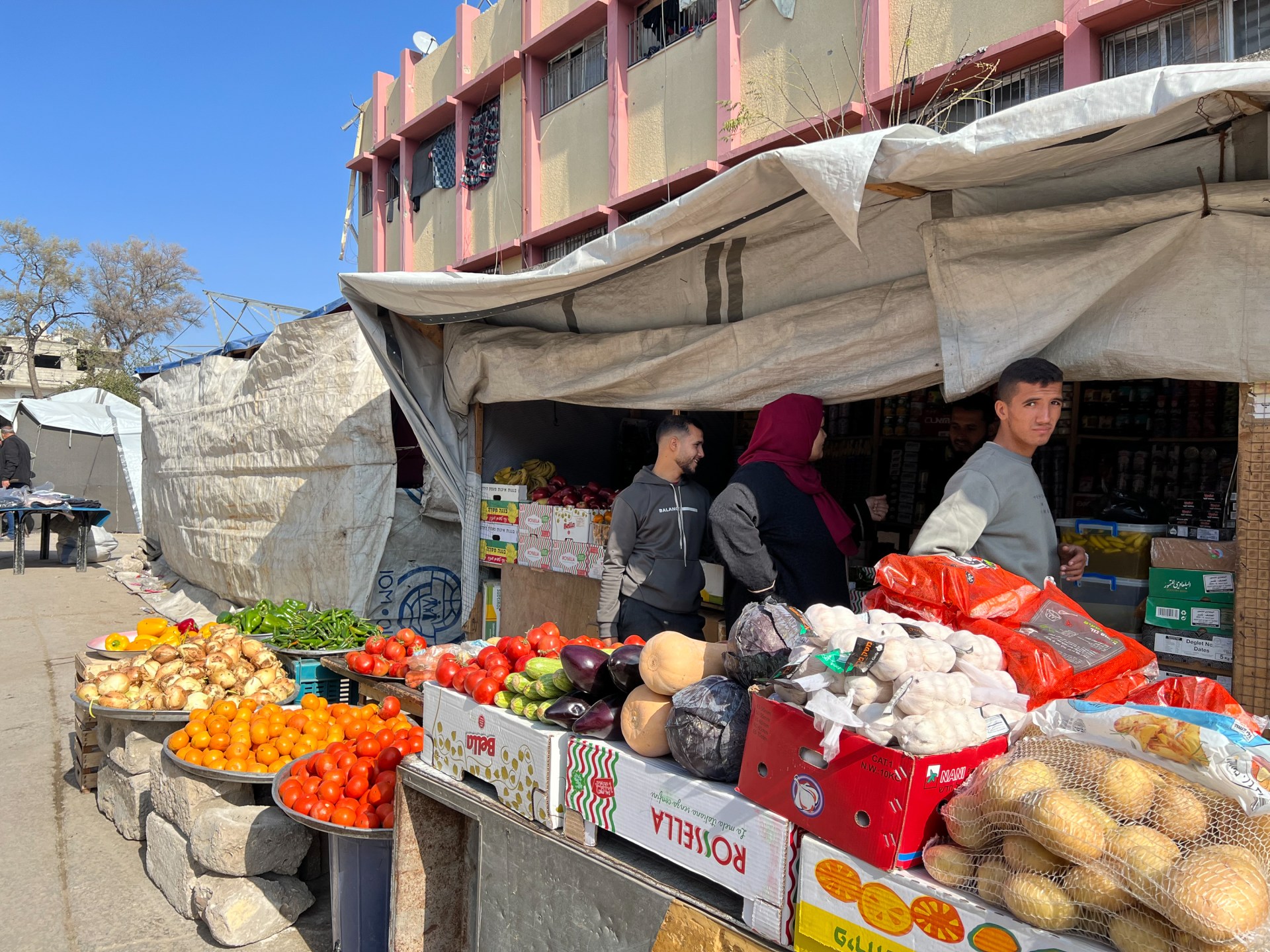
Gaza City – Amid the buzz of customers in the Remal neighbourhood in Gaza City, Samar Abu Harbied stops at a small, makeshift roadside stall to buy groceries to prepare an Iftar meal for her family, to break their fast during the Muslim holy month of Ramadan.
With no cash in her purse, the 45-year-old housewife asks the grocer if she could put the bill on credit, until her husband or son could wire the money to him.
“I have not touched a paper note for months. I don’t even have money to pay for a taxi. Now we walk a lot, for long distances,” Abu Harbied said.
Najlaa Sukkar, 48, was trying to catch her breath at the same stall, which is run by her son Abdallah, after a failed journey on foot to see a doctor for a post-surgery check-up and to buy medication.
Najlaa said she did not have enough money to pay the 30 shekel (US$9.5) check-up fees, and the only banknote she had, a 20-shekel bill, was so worn out that the pharmacist turned it down.
“I returned without receiving medical care,” she told Al Jazeera.
“At the pharmacy, they didn’t accept the banknotes as they were frayed. The taxi driver didn’t accept a banknote, only small change, which I don’t have. It is very difficult to get by. What a mess, we don’t know what to do!”
Palestinians in the Gaza Strip are struggling to conduct their daily lives amid a severe cash flow problem imposed by Israel immediately after it embarked on its genocidal war on Gaza in October 2023.
A US-brokered ceasefire that went into effect in October has brought little reprieve to Palestinians, who are still using worn-out currency they had from before the war, or must rely on a new system of electronic payments conducted through smart telephones amid limited internet coverage.
Palestinians in Gaza use the Israeli currency, the shekel, in their daily transactions, and depend on Israel to supply banks with new banknotes and coins.
![A customer pays for groceries using bank account transactions [Ola al-Asi/ Al Jazeera]](https://www.aljazeera.com/wp-content/uploads/2026/02/When-money-is-scarce-every-choice-counts-bank-cash-or-on-credit.-1772105832.jpg?w=770&resize=770%2C578&quality=80)
Electronic payments
Palestinians were forced to turn to a digital payment system as a way to get around a severe shortage of Israeli shekel banknotes, a problem that has been exacerbated by the destruction of an estimated 90 percent of bank branches and cash machines.
The Palestinian Monetary Authority, working with internet service providers, has pushed for mobile-based electronic payments, including PalPay and Jawwal Pay, to help Palestinians overcome the liquidity problem.
Abu Harbeid said her son switched to electronic payments after he faced many problems using the 50 shekels per shift he was receiving while working as a night guard.
“My son, Shady, was receiving his daily wage in cash, which was worn and torn. We could hardly break it into smaller change or buy anything, as sellers don’t accept overused paper bills,” she told Al Jazeera.
“Moreover, the seller doesn’t accept it unless I spend it all, as they don’t have change. Now, as he is paid into his bank account, we buy everything through bank apps,” she added.
But digital payments have added another layer of hardship to a large segment of the population.
Most Palestinians still do not receive bank-transferred salaries, many lack access to smartphones, and those who have phones struggle to keep them charged in an area where electricity services are in severe crisis.
To add to that, there is still the problem of finding a good internet connection for the transfer process.
Abu Harbeid said a proper trip to the market requires her to have her husband or son with her to pay for goods. But neither can leave work to join her.
“I prefer cash in my hand; I could buy anything on the go,” Abu Harbied said.
![Abdallah Sukkar, owner of a street grocery stall, writing down customers' details in a notebook [Ola al-Asi/ Al Jazeera]](https://www.aljazeera.com/wp-content/uploads/2026/02/When-money-is-scarce-every-choice-counts-bank-cash-or-on-credit-2-1772105835.jpg?resize=770%2C578&quality=80)
Not only a liquidity shortage issue
Analysts say Gaza’s current economic reality started as a liquidity crisis, but has become an issue of transition from a regulated financial system to a fragmented survival economy shaped by scarcity, informality, and political constraints.
“However, as the months passed, the crisis evolved into something far more structural,” Ahmed Abu Qamar, member of the board of directors of the Palestinian Economists Association, told Al Jazeera.
“The black market now plays a dominant role in determining liquidity conditions. A small group of traders effectively manages cash circulation through high-commission cashing operations.”
He said that when money itself becomes a traded commodity, it signals severe distortion in the monetary system. “Cash, like any commodity, becomes subject to supply and demand dynamics. When it becomes scarce, its value increases beyond its nominal worth. From an economic perspective, this represents a structural disruption of the monetary system.
“The formal banking sector and the Palestinian Monetary Authority were sidelined. What we are seeing is the neutralisation of the formal monetary system,” he said.
Abu Qamar said the deeper issue was confidence – not just in cash, but in the financial system as a whole. “Cash is inherently difficult to track, whereas electronic payments are traceable and can be frozen or restricted. Implementing such a transition abruptly produces severe economic and social distortions,” he warned.
“Widespread selling on credit is not a sign of market stability – it is an indicator of declining incomes and weakened purchasing power. When debt expands rapidly without a parallel increase in income, the result is social fragmentation. Approximately 95 percent of households in Gaza depend on aid,” he added.
![People purchasing goods at a grocery shop at Al-Zawya market [Ola al-Asi/ Al Jazeera]](https://www.aljazeera.com/wp-content/uploads/2026/02/When-money-is-scarce-every-choice-counts-bank-cash-or-on-credit.-1772105810.jpg?resize=770%2C578&quality=80)
Profiteering from Gaza’s woes
The war has paved the way for middlemen to cash in illegally on the financial woes of Gaza, residents said.
Sukkar said that when her husband or sons needed cash, they were often forced to deal with brokers who charge a hefty commission that could reach 50 percent.
“We lose our money to them for nothing; they steal from us under our full consent,” she said.
Many residents, like Abu Harbeid, also do not trust bank transfers, saying they prefer physical cash in hand.
“I ask my sons, where does that money in the account appear?” said Sukkar.
“Who holds our money in their hands? I used to see money and count it, the banknotes and the change. On some days, when there are technical problems with the bank applications, we get nervous about the possibility of losing the money in their accounts,” she added.
Abdallah Sukkar, whose family ran a well-known family store in the Shujayea area in eastern Gaza before the war, said families who receive direct deposit salaries often buy with bank transfers.
“But I don’t like this method; I prefer cash,” he said.
He said he accepts all banknotes, whether new or worn-out ones, and allows people to buy on credit, but admitted that all of that affects his ability to make improvements to the roadside stall he now runs in place of his family’s old business.
He also complained of unpaid debts, adding that debts had soared by more than 500 percent during the war, while his profits barely reach 2 percent. He said he had given out 20,000 shekels’ worth of goods to new customers, “all of [whom] have become customers during the war”.
“People don’t have money; I can’t turn them away when they come to buy food on credit. It’s already catastrophic in Gaza,” he said.
“From the beginning of Ramadan till now, I haven’t had banknotes and change, which affects the sales. I don’t have small change to give to people who have cash, so they turn to other stalls or shops.
“Yesterday, when the bank application stopped, we were terrified that we might lose our money in the bank,” he said.
