

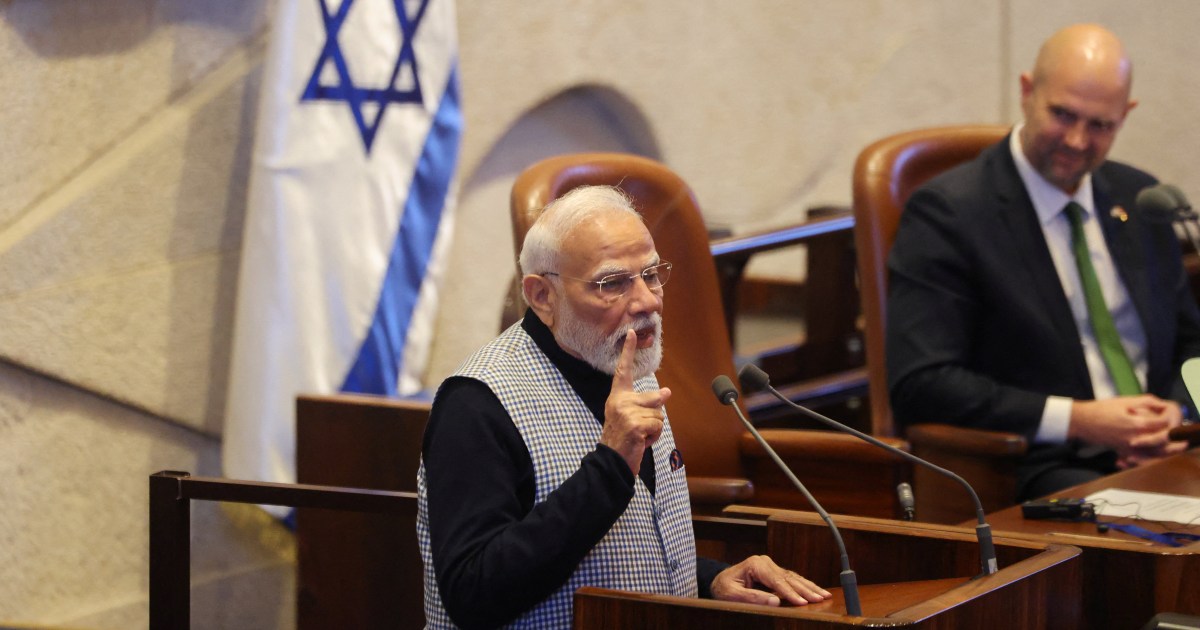
Addressing the Knesset (Israel’s parliament) in Jerusalem, Indian Prime Minister Narendra Modi delved into the history of India-Israel relations, which have improved dramatically since he took power in 2014.
In his speech on Wednesday, the first day of his two-day visit to Israel, Modi also called for closer cooperation on various projects, including the proposed India-Middle East-Europe Economic Corridor (IMEC) and I2U2.
We unravel what IMEC and I2U2 are and why PM Modi’s speech matters.
What did Prime Minister Modi say in his parliamentary speech?
Prime Minister Modi was greeted with a standing ovation in Parliament. The Indian Prime Minister responded with a namaste, and MPs chanted his name.
“The world was shattered by the barbaric terrorist attack by Hamas on October 7,” the Indian prime minister said at the start of his speech, referring to the 2023 Hamas-led attacks on villages and military outposts in southern Israel that triggered Israel’s genocidal war in Gaza, which killed more than 70,000 Palestinians.
“We feel your pain. We share your grief,” PM Modi said, adding that India stands with Israel “with full faith.” Prime Minister Modi said India and Israel are “trusted partners” that “contribute to global stability and prosperity.”
After this, the Indian leader spoke about the history of Jews in India and India-Israel relations.
“We are committed to expanding trade, strengthening investment flows and promoting joint infrastructure development.”
Prime Minister Modi added that the investment agreement signed between India and Israel last year will bring confidence and predictability to businesses in both countries.
“We will also cooperate closely in various formats including the India-Middle East-Europe Economic Corridor and the I2U2 framework between India, Israel, UAE and the US,” it added.
What is IMEC?
The IMEC project was announced during the G20 summit held in New Delhi on September 9, 2023. This is a proposed infrastructure project that would connect India, the Middle East and Europe with an integrated rail and transport corridor, according to the project website.
The corridor will pass through India, the United Arab Emirates, Saudi Arabia, Jordan, Israel and Europe and will include a network of railways, ports and highways that will facilitate the flow of goods and free trade along its route.
According to the project website, IMEC aims to promote economic cooperation and green development through sustainable infrastructure projects.

What is I2U2?
The I2U2 Group was established by India, Israel, UAE and the US at a virtual summit on July 14, 2022.
Some analysts refer to I2U2 as the “West Asia Quad” or “Middle East Quad,” after the Quadrilateral Security Dialogue, an informal forum made up of the United States, Japan, Australia, and India.
According to the U.S. Department of State, I2U2 designs projects and initiatives to address global challenges in the areas of water, energy, transportation, space, health, food security, and technology.
It added that the project aims to modernize infrastructure, promote low-carbon development pathways and improve public health.
The group’s efforts include a food security project in India, a hybrid renewable energy project in the Indian state of Gujarat, and a project that uses space-based observational data and capabilities to address environmental and climate change challenges.
Why is Prime Minister Modi’s speech in Parliament important?
Prime Minister Modi visited Israel against the backdrop of strengthened ties between Israel and India and complex and rising geopolitical tensions in and around the Middle East.
Strengthening bonds
Relations between India and Israel have improved significantly over the years. Although still under British rule in the 1920s and 1930s, India strongly identified with the Palestinian struggle for independence.
India initially opposed Israel’s creation and membership in the United Nations until it recognized Israel in 1950. Full diplomatic relations were postponed until 1992, after which economic ties between India and Israel gradually expanded over the next two decades.
Since Mr. Modi became prime minister, further changes have occurred in the relationship between the two countries. Nine years ago, Prime Minister Modi became the first Indian Prime Minister to visit Israel.
India is currently Israel’s second largest trading partner in Asia after China. According to India’s Ministry of External Affairs, trade volume has soared from $200 million in 1992 to $6.5 billion in 2024.
“Prime Minister Modi has highlighted IMEC and I2U2 as part of a broader push to deepen economic and strategic cooperation with Israel and key partners in the Middle East, positioning India at the center of emerging trade and technology corridors amid changing geopolitics in the region,” said Sanam Vakil, head of the Middle East and North Africa program at Chatham House, a London-based think tank.
Joint projects such as IMEC and I2U2 are central elements of the growing India-Israel partnership. It also connects India and Israel with Middle Eastern countries.
“For Gulf states like the UAE and Saudi Arabia, IMEC and I2U2 represent an opportunity to accelerate economic diversification beyond oil, while cementing their role as vital connectivity and logistics hubs linking Asia, the Middle East and Europe,” Baqir told Al Jazeera.
“However, the prolonged UAE-Saudi policy competition and Israel’s stance towards Palestine will inevitably complicate the political cohesion needed to fully implement a project like IMEC.”
regional tensions
Prime Minister Modi’s visit to Israel also comes amid worsening tensions in the region.
This follows India’s decision to join more than 100 states in condemning Israel’s de facto expansion in the occupied West Bank, but New Delhi delayed action by a day, suggesting hesitation due to its close ties to Israel.
Prime Minister Benjamin Netanyahu said this week that he plans to form a new regional bloc, called the “Hexagonal” alliance, to counter a “radical” Sunni-Shia Islamist “axis”.
On Sunday, Netanyahu said the alliance would include Israel, India, Greece and Cyprus, as well as other unnamed Arab, African and Asian countries. However, these governments, including India, have not formally approved the plan.
At the same time, tensions between the United States and Iran are rising. While US President Donald Trump has threatened limited strikes over Iran’s nuclear and missile programs, the US government has been building up military assets near Iran. The Iranian government has said it will prioritize diplomacy but will defend itself if attacked.
Analysts said Israel would likely be a front-line participant in any escalation that would result in a U.S. attack or Iranian retaliation.
