

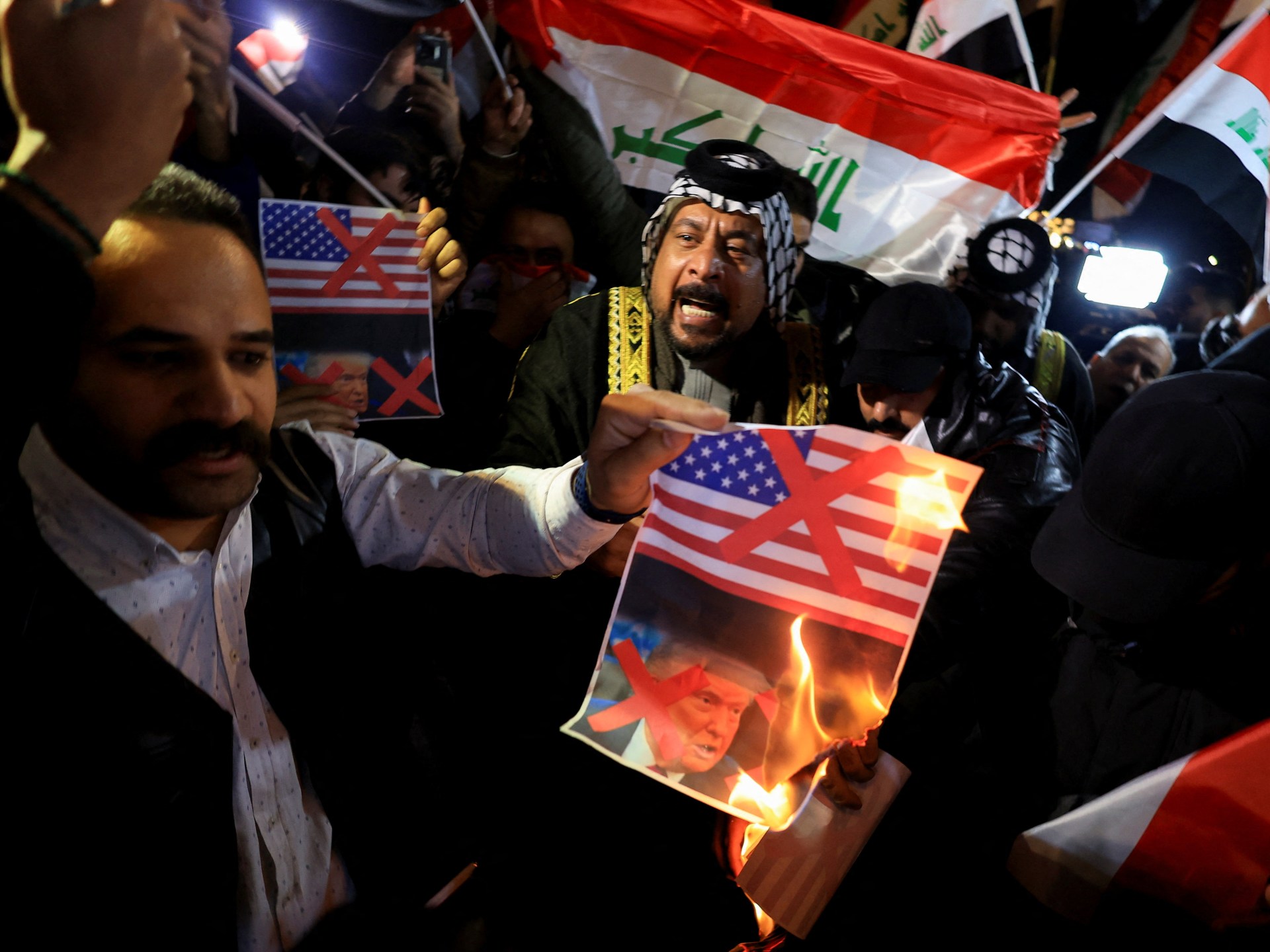
Najaf, Iraq – Leaders of the Iraq Coordination Framework, the Shiite political coalition that came to the top in November’s parliamentary elections, are adamant that Nouri al-Maliki will be their candidate for Iraq’s prime minister, despite threats from US President Donald Trump.
In late January, President Trump warned that the United States would cut off aid to Iraq if Maliki, who served as Iraq’s prime minister from 2006 to 2014, returned to the post.
Recommended stories
list of 3 itemsend of list
“If we don’t come to the rescue, Iraq has zero chance of success, prosperity and freedom,” the US president said in a post on his website Truth Social.
President Trump and the U.S. administration view al-Maliki as part of Iran’s direct network of influence in Iraq and are concerned that his return would undermine U.S. efforts to weaken Iran’s power in its western neighbor, including limiting the reach of Iranian-backed militants.
However, despite the mounting pressure, the majority of the Coordination Framework’s most influential actors appear unwilling to give up on al-Maliki and are determined to find a way to advance his candidacy.
Splitting the coordination framework
The Coordination Framework (CF) is a coalition of Shiite parties established in 2021 and represents the largest Shiite bloc in Iraq’s parliament.
The loose nature of the coalition that makes up the CF means that opinions on al-Maliki’s candidacy are diverse, with some opposed, others willing to bend to President Trump’s wishes and change their support, and others insisting they go ahead with it.
And the majority seem to be in the latter camp.
The CF issued a statement on Saturday reiterating its support for al-Maliki. The statement added: “The selection of the prime minister is an exclusively constitutional matter in Iraq and is free from foreign interference.”
The statement reflects the position of various pro-Maliki factions within the CF, including former deputy speaker of parliament Mohsen al-Mandalawi. Badr organization led by Hadi al-Amir. and the Islamic Supreme Council, led by cleric Humam Hamoudi.
The current prime minister, Mohammed Shia al-Sudani, whose party won the most votes in the election but was unable to receive the CF nomination despite being a member, has publicly supported al-Maliki’s nomination, although he has not given up on the possibility of continuing as prime minister.
Some of these factions performed well in last year’s parliamentary elections, including al-Maliki’s own Law Nation Coalition and Badr and al-Sudani’s Coalition for Reconstruction and Development.
But with support from Kurdish and Sunni parties, Shiite al-Maliki skeptics have enough seats and enough voice to block the nomination if they wish.
These include important Shiite figures such as Qais al-Khazali, leader of the Asaib al-Haq group. Ammar al-Hakim, leader of the National Armed Forces Alliance. and former Prime Minister Haider al-Abadi.
Mr al-Hakim, who holds 18 seats, warned of “economic consequences” if Mr Maliki is elected, adding: “Public interests must be prioritized over private interests.”
Meanwhile, the Victory Alliance, led by al-Abadi, issued a statement calling for the following:[the prioritisation of] Although al-Abadi’s group does not hold a seat in parliament, it maintains an important voice within the CF.
Both statements include a tacit acknowledgment of Iraq’s inability to withstand US pressure and the need for alternative candidates suited to current realities.
Other disorders
Therefore, the CF is still fighting a tough battle to approve Mr. al-Maliki as prime minister. Beyond Shiite political groups, there are also opponents of al-Maliki, a divisive figure who is remembered negatively by many Iraqis, especially Sunnis.
There are also divisions within non-Shia groups, which have also slowed the nomination process.
Under Iraq’s constitution, parliament must first elect Iraq’s president, and then the president must delegate the formation of the government to candidates from the largest parliamentary bloc. According to Iraq’s Muhasasa system, which has been in place since 2003 and divides political affairs based on sect and ethnicity, the prime minister must be a Shiite, the president must be a Kurd, and the speaker of parliament must be a Sunni.
So far, the main Kurdish factions, the Kurdistan Democratic Party (KDP) led by Masoud Barzani and the Patriotic Union of Kurdistan (PUK) led by Baffer Talabani, have not been able to agree on a consensus candidate for the presidential election.
CF is trying to broker an agreement between Kurds. Recent efforts include a delegation led by al-Sudani meeting with both parties and a personal visit by al-Maliki to Barzani. However, these efforts have not yet been successful, and without political agreement on the presidency, the process of appointing a prime minister cannot proceed.
And even if the Kurds reach an agreement and stay out of al-Maliki’s way, the CF will have to win over the former prime minister’s long list of opponents.
They include former parliament speaker and Taqadoum party leader Mohammed al-Harbousi, who issued a statement implicitly rejecting al-Maliki’s candidacy before the US veto.
Together, anti-al-Maliki forces can collect about a third of the seats in parliament, enough to prevent a presidential election from being held due to a lack of quorum.
To avoid this scenario, the CF would need to reset its internal negotiations on the next prime minister or nominate Al-Sudani for a second term.
Al-Sudani’s party issued a statement on January 28 calling for “a positive relationship with the United States,” a move that was interpreted as an indirect pitch for his reelection, drawing on his strong record of managing relations with the United States during his time in office.
US influence
The United States may no longer be the occupying power in Iraq, but it still has enormous economic influence over the country.
Revenue from oil, Iraq’s main export, is routed through the US Federal Reserve Bank in New York.
President Trump may decide not to renew an executive order originally issued by President George W. Bush after the Iraq War. The executive order gives legal protection to the oil revenue fund and prevents it from being frozen by Iraq’s creditors. The order was scheduled to be officially renewed when it expires in May.
If the US president decides against renewal, creditors could seek to claim the funds and a New York court could rule to freeze Iraqi assets. That would disrupt the flow of funds needed to pay public servants and keep the economy afloat for months or even years. As a practical matter, Iraq’s economy would grind to a halt.
This therefore explains why pro-Maliki factions within the CF are trying to persuade the US to change its position, rather than simply ignoring Trump.
A senior official with the CF’s Law-State Coalition, who requested anonymity to speak freely about the matter, told Al Jazeera that “attempts are underway to persuade the US government to lift its veto on al-Maliki.”
Ministry of Justice spokesperson Aqeel Al Fatrawi also said he was hopeful that the United States would “change its position going forward.”
Mr al-Maliki himself has sought to soften his position, blaming regional countries such as Turkiye and Syria for the US attitude towards him.
Syria has become one of the main points of difference between President al-Maliki and the United States, which has supported him even though Iraq’s former prime minister has accused him of being a former member of al-Qaeda.
In a television interview on Tuesday, al-Maliki used al-Sharah’s full name, rather than the Syrian leader’s nickname “al-Jolani,” and sought to emphasize his willingness to move on from the past. Mr al-Maliki also sought to soften his stance towards the Syrian government, criticizing the previous government of ousted President Bashar al-Assad and its role in supporting “terrorism” in Iraq.
It remains to be seen whether these efforts will be effective enough to appease the United States.
According to reports, Mark Savaya, the US special envoy to Iraq, may have been fired, but there is no official confirmation. His successor is likely to be Tom Barrack, who is currently the US ambassador to Turkiye and special envoy to Syria.
The CF supports Mr. Sabaya, who has proven more supportive of adopting a softer approach to weakening the power of Iraq’s Shiite militias, against Mr. Barrack, who is viewed more negatively by the CF for his role in weakening Hezbollah in Lebanon and his support for al-Shara in Syria.
The official announcement of the changes could indicate where President Trump’s thinking stands at a critical time in the coming weeks, and whether the president chooses not to renew U.S. guarantees to protect Iraq’s oil revenues in May.
