

Cesar Martinez, 45, works full-time at a butcher shop in Buenos Aires, but in the last year, he has had to pick up other jobs to make it to the end of the month. So, when the government of President Javier Milei publicly celebrated a new drop in the inflation rate in June as a sign of a recovering economy, something didn’t quite add up.
“The money one makes is never enough to afford everything, even the most basic things,” Martinez says.
The sentiment is a shared one on the streets of Argentina’s capital, Buenos Aires.
Little over a year and a half since taking office, Milei managed to fulfil one of his campaign promises: radically cut inflation, which had reached a record monthly rate of 25 percent in December 2023. Now at 1.6 percent, the monthly rate is among the lowest since April 2020.
Back in 2023, high inflation put a great strain on Argentina’s population, with prices of basic goods – such as food, services and rent — escalating month on month while salaries stayed stagnant.
Argentina has a history of high inflation going back to the 1940s, including several cycles of hyperinflation, the most recent in the late 1980s, pointed out Mariana Heredia, a researcher at the National Scientific and Technical Research Council (Conicet).
“Inflation is a global phenomenon, but in Argentina, it has been such a constant that people tend to think that all their problems are related to inflation. For people here, stability is very important,” Heredia told Al Jazeera.
This is one of the reasons why the promise to tackle inflation helped Milei garner significant support on his way to the presidency. He now says achieving the lower rate is evidence of the success of his economic programme, which made radical cuts to public spending, including in healthcare, education, social services and public infrastructure works, to achieve a fiscal surplus.

But his programme has also involved an early nominal devaluation, which then saw the Argentian peso appreciate, making the country more expensive in dollars. This, combined with a sharp fall in real wages, has delivered a significant blow to the purchasing power of large sections of the population.
Argentina is now among the most expensive countries in Latin America, but it also has some of the lowest salaries.
While tackling inflation was essential to start fixing Argentina’s ailing economy, it’s proving not to be enough, experts say.
“Inflation isn’t everything,” Guido Zack, economy director at Fundar, a national think tank, told Al Jazeera. “Having a low inflation rate is important, but [in Argentina] the economic recovery has been very mixed among sectors of the economy and of the population. The majority of the population still has a low purchasing power, the rate of informal work has risen, and the poverty rate is still very high. There’s still a long way to go.”
Other analysts have criticised aspects of the methodology used to calculate inflation in Argentina. They say the basket of goods and services used to measure it, developed in 2004 and updated in 2016, does not accurately reflect current consumption patterns. This includes the share of income that goes into paying for housing, which rose in the renter-dense greater Buenos Aires area by 4.5 percent in June alone. According to a September poll from Inquilinos Agrupados (Organised Renters), which surveys tenants twice a year, renters spend an average of 44.5 percent of their income on rent.
‘Economic Stress’
The mismatch between some economic indicators and what people are experiencing in their daily lives is what the Observatory of Social Debt of the Catholic University of Argentina has called “economic stress” — the increased perception, or reality, that most salaries are not enough to cover basic living expenses.

This is particularly evident in the country’s increasing rate of personal borrowing. According to a recent report by the Social and Economic Statistics and Tendencies Institute (Instituto de Estadísticas y Tendencias Sociales y Economicas – IETSE), 91 percent of homes in Argentina have some form of debt, and 58 percent of those loans were taken to buy food in 2024.
“Sales have slowed right down in recent months,” Martinez, the butcher, said. “People are always looking for discounts, buy smaller quantities, maybe for the day, and tend to pay with credit card; it’s hard to find anyone paying in cash.”
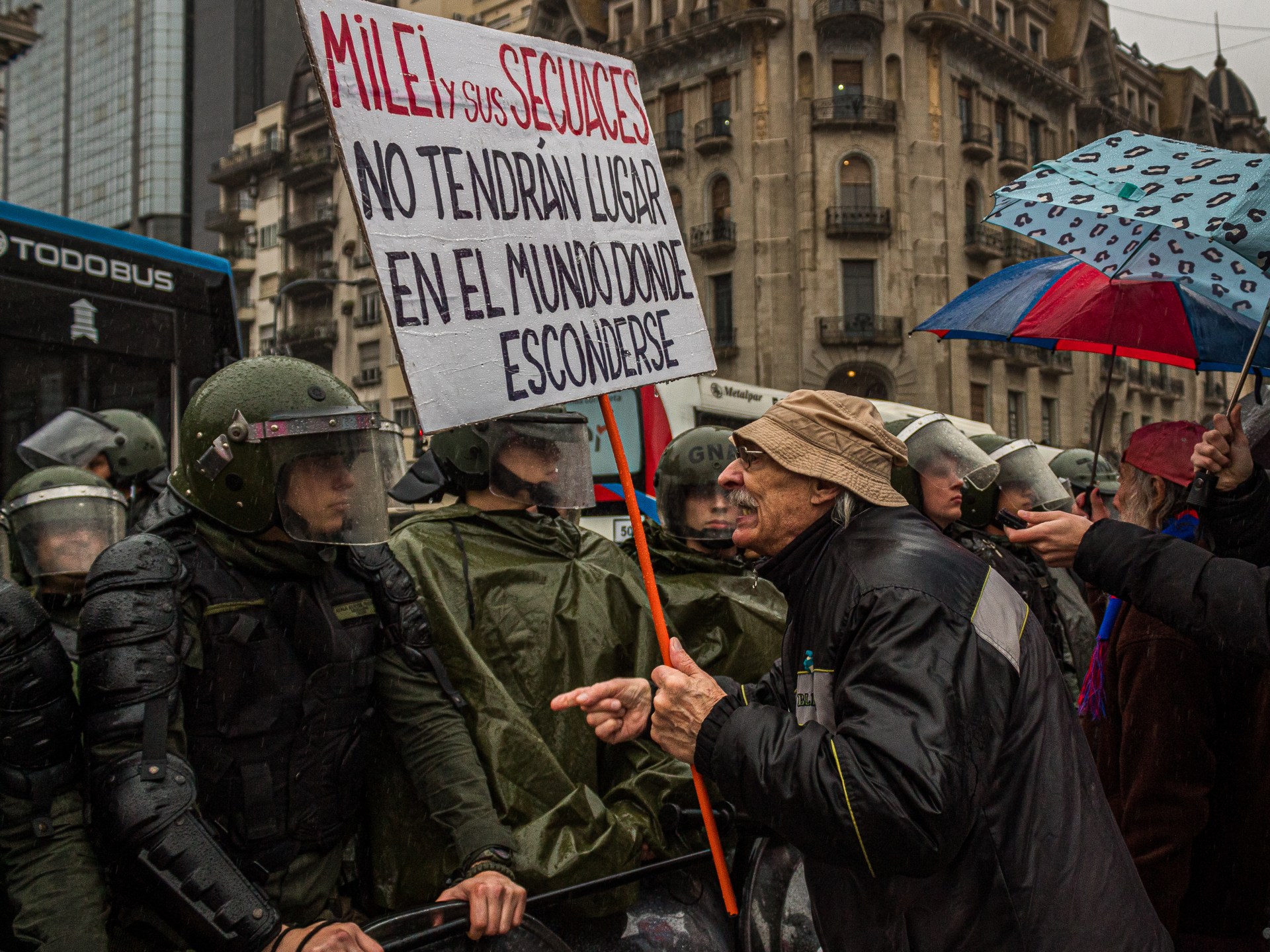
People’s frustration at the economy is also evident on the streets of Buenos Aires, where protests against inflation and cuts to public funding – mostly led by pensioners – have increased.
Every Wednesday, pensioners gather in front of Congress in Buenos Aires to demand a rise in their state pensions. The current pension for five million people stands at $300 a month, below the minimum living wage. Milei has promised to veto a bill approved by Congress for a rise in pensions.
Raul Maldonado, 68, retired in 2020 after working as a lathe operator in a factory for 35 years. He now makes just more than the minimum pension.
“The money I earn lasts 15 days. If it wasn’t for the help of my family, I would not be able to survive,” he says.

The long game
As Milei promises to continue pushing through with his current economic plan, the question is whether he can keep inflation down and adopt measures to improve other indicators.
Heredia says that the type of anti-inflationary programme, focused on cuts to public spending and an appreciated currency, is similar to others implemented in Argentina in the past, but which failed to work in the long run.
“At first, these kinds of programmes can bring people some initial relief – they generate some economic bounce back and, to a certain extent, an increased income to some high-earning sectors. But in the midterm, the costs start to show when it comes to the public spending cuts, the opening of the economy to imports that affect local production and its impact on the job market.”
For Zack, the key to the long-term economic recovery is the adoption of measures aimed at improving some of the structural challenges Argentina faces, which have a negative impact on the economy.
Among them, he lists the country’s complex tax system, high levels of bureaucracy, the current lack of investment in public infrastructure, such as roads to connect the country, as well as the low exchange rate and openness to imports.
“Even if Argentina manages to sustain low inflation, that’s a complicated cocktail” to tackle, Zack said.
