

Despite growing concerns about resistance, parasitic wasps remain an effective and resilient alternative to chemical pesticides for controlling crop pests, according to new research.
The University of Stirling research results show that biological pest control continues to work well even when pests begin to adapt, which should reassure farmers and producers who are under increasing pressure to reduce chemical inputs.
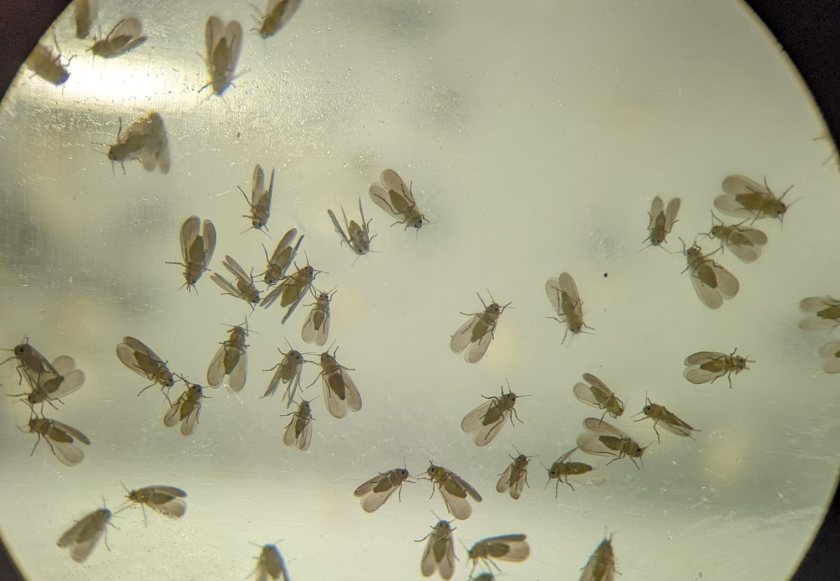
The researchers focused on the glasshouse whitefly, a sap-sucking pest that is widespread in protected crops, and Encarsia formosa, a parasitic wasp commonly used to control it.
The study, led by Dr Mia McGowan, found that while some whiteflies may develop genetic resistance to parasitism, those that survive pay a significant biological cost. The reproductive success of surviving individuals was found to be low, and the spread of resistance throughout the pest population is unlikely.
The use of predators and parasitic insects to control pests is widely considered to be safer and more environmentally sustainable than chemical pesticides, to which pests are known to rapidly adapt. In the case of Encarsia formosa, the wasps lay their eggs inside whitefly larvae, preventing them from becoming adults and naturally reducing the pest population.
Importantly, researchers have discovered that biological control agents can evolve along with the pests they target. This coevolution reduces the risk of rapid resistance development that often undermines the effectiveness of chemical insecticides.
Although reports of pests showing resistance to biological control agents have increased in recent years, this study suggests that such resistance is far less likely to be widespread.
Dr McGowan said concerns about bacterial resistance should always be kept in mind. “In recent years, there have been increasing reports of resistance to biological control agents becoming a problem,” she says.
“Our study shows that although this is possible, complex evolutionary interactions between host and parasite limit its potential and that biological control is evolutionarily resilient when compared to chemical control.”
This study included two controlled experiments conducted in a university controlled environment facility. In one, known closely related whiteflies were exposed to parasitism to assess whether survival was genetically inherited. In a second experiment, whiteflies that survived parasitism were monitored to assess lifetime reproductive success.
The results showed that whiteflies that were able to resist the parasitism laid fewer eggs and produced fewer viable offspring than unexposed insects, confirming that resistance comes at a significant adaptive cost.
Dr Rebecca Boulton, lecturer in evolutionary ecology at the University of Stirling, said the findings strengthened confidence in biological pest control as a long-term strategy.
“Our results add to a small but growing number of case studies demonstrating that resistance to biological control by parasites can evolve under certain circumstances,” she said.
“However, these findings strengthen the view that biological control is an evolutionarily stable and resilient strategy to the evolution of resistance compared to chemical pesticides.”
The researchers said the study supports the continued use of biological control as part of integrated pest management, especially as agricultural systems adapt to stricter pesticide regulations and environmental goals.
They added that biological control provides a durable, science-backed solution for managing pests while reducing reliance on chemical sprays.
