

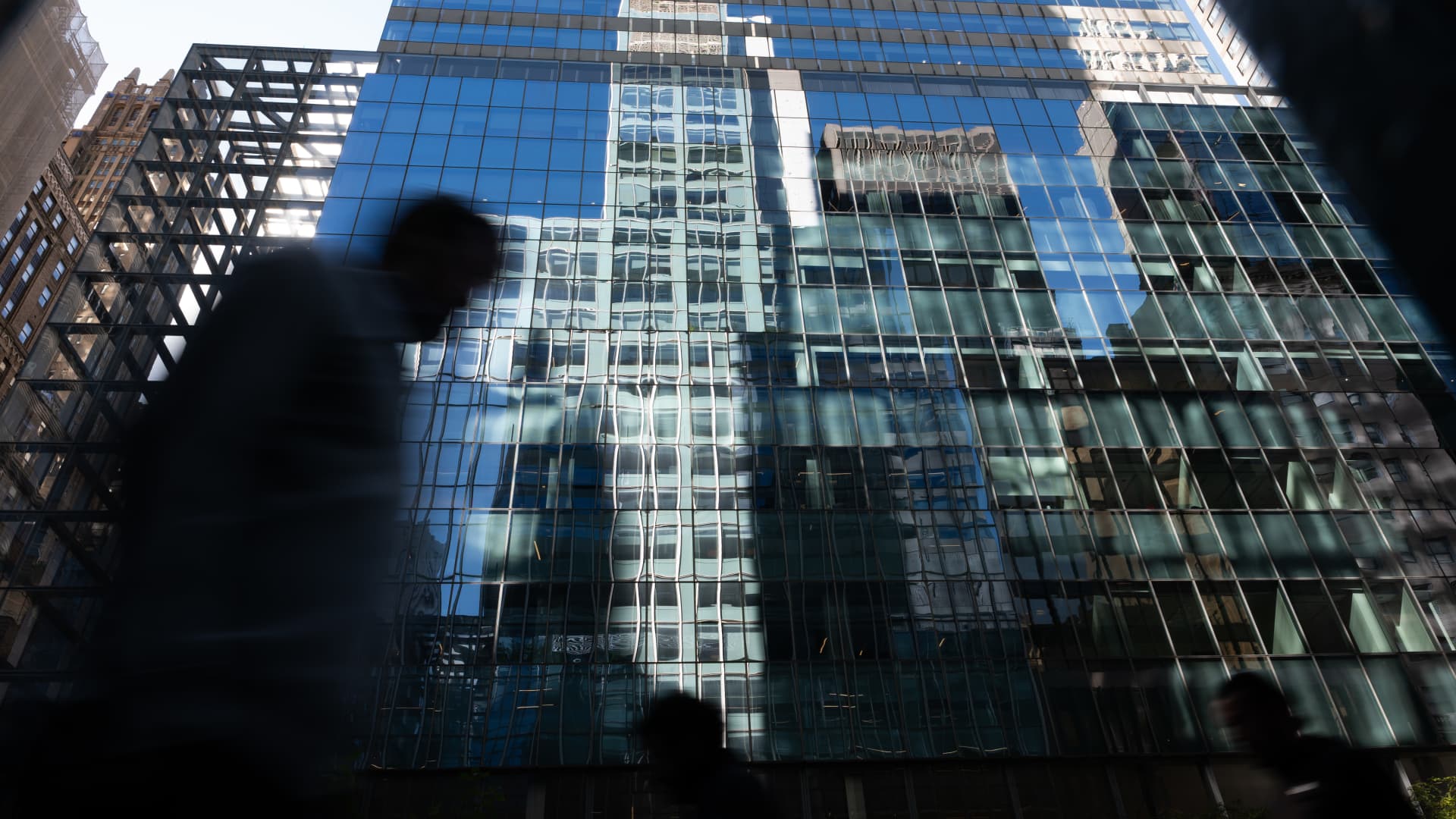
Crowds walk through Midtown Manhattan on October 16, 2025 in New York City.
Spencer Pratt | Getty Images
A version of this article first appeared in the CNBC Property Play newsletter with Diana Orrick. Property Play covers new and evolving opportunities for real estate investors, from individuals to venture capitalists, private equity funds, family offices, institutional investors and large publicly traded companies. Sign up to receive future editions directly to your inbox.
Office rentals in Manhattan increased significantly in Q4 2025 due to the continued return to offices and increased hiring of technologists, particularly for artificial intelligence.
Colliers said leasable area increased more than 25% from the third quarter to 11.87 million square feet. Demand increased 16% year-over-year, nearly 52% above the five-year quarterly average and 43.5% above the 10-year average.
According to Colliers, this was the strongest single-quarter rental performance on the island since the fourth quarter of 2019. For the full year of 2025, the number of leases was the highest since 2019 and was just 2.4% below the pre-pandemic 2019 total.
“Manhattan’s strong performance in 2025 did not come out of nowhere, but was a continuation of the recovery that began to be felt in 2024,” said Frank Wallach, executive managing director of New York research and business development at Colliers.
“Demand in 2025 was a continuation of that trend, but greatly accelerated by factors such as a flight to tenant quality to attract and retain talent, implementation of the return-to-office trend, significant expansion by major tenants such as Amazon, New York University, and BlackRock, and the emerging AI industry leasing space across Manhattan,” he said.
Wallach also noted increased demand from a variety of industries, including finance, technology, law, education, healthcare nonprofits, and government.
According to Colliers, the supply of available office space remains significantly higher than at the start of the pandemic in March 2020, up nearly 37%, but much lower than its post-pandemic peak in February 2024. Oversupply is gradually being absorbed as demand increases, and Manhattan is now at its tightest supply since November 2020.
Tight supply ultimately leads to higher rents. The average asking rent in Manhattan in the fourth quarter rose 1.5% from the previous quarter to $76 per square foot, the highest average asking rent in Manhattan since October 2020, according to Colliers research. Average asking rents for the highest tier, so-called Class A products (for new construction) rose 1.6% to $83 per square foot, Colliers said.
Class B office products are older but tend to be in better locations. Now, landlords are investing in upgrades and renovations as demand increases. This pushed rents up 1.1% in the fourth quarter to a record high of $68.61 per square foot, according to Colliers.
The flight to quality continues, with 69% of all leased space in four- and five-star buildings now up from 66% in 2024, according to another report from CoStar. The study found that all 15 of the largest office leases signed that year were in four- or five-star properties. For example, Deloitte’s 800,000-square-foot deal at Manhattan’s premier office building, 70 Hudson Yards, was the year’s largest lease.
Overall net absorption, which measures the amount of physical space actually occupied by tenants and the amount of space vacated by tenants, was positive by nearly 4 million square feet, Colliers reported. For all of 2025, there was a positive 15.56 million square feet, including 2.14 million square feet of space removed from the market for planned conversion to non-office uses.
“Importantly, the economic recovery and strong demand in 2025 was also driven by millions of square feet of buildings being converted to non-office uses, spurring a wave of leasing by tenants moving out of those buildings,” Wallach said.
Even though the market is improving, there is still far more office supply than there was before the pandemic.
“Despite increased tenant demand and tighter vacancies in 2025, the Manhattan office market has only lost half of its post-pandemic surplus supply. Therefore, the healthy demand and underutilized office asset conversion recorded in 2025 should continue in 2026 and 2027,” Wallach said.
