

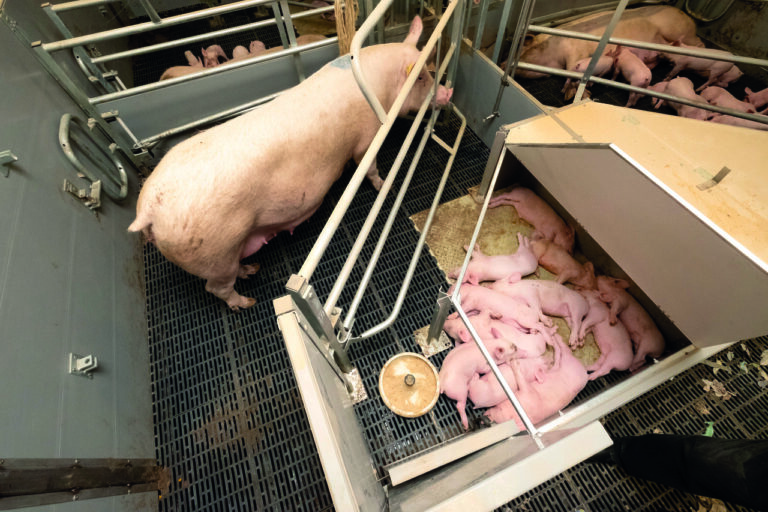
The National Pig Association has disputed BBC Farming Today’s claim that farrowing boxes for sows will be banned “within four years”.
The group contacted the program after a presenter suggested the government was setting a firm deadline to end the use of crates, raising concerns across the pig industry.
NPA said the statement was inaccurate and warned that unclear messages risked creating unnecessary uncertainty for producers.
Farrowing boxes are widely used in pig production to prevent piglets from being crushed by sows, but they remain the subject of welfare debate.
Rather than setting a ban date, the Government’s Animal Welfare Strategy says it will “work with industry to consider how to move away from the use of farrowing boxes to alternative systems”.
Tom Haynes, the NPA’s chief policy adviser, said the recently published strategy outlines England’s priorities up to 2030, but does not impose a fixed timescale for change.
He explained that although the bill could be passed by that time, that does not mean it will come into force immediately.
“It is very common to have implementation periods in legislation to give industry time to prepare and adapt,” he said.
Formal consultations with a specific date have not yet been published, and they are not expected until later this year.
In a recent House of Commons debate, Agriculture Minister Angela Eagle acknowledged that moving to a higher welfare system would be costly and time-consuming, and said the government would “work with industry” to move away from farrowing boxes.
The NPA is calling for a significant transition period and warns that many pig farms will need major capital investment in new infrastructure to adopt alternative systems.
NPA chief executive Lizzie Wilson said the organization welcomed Farming Today’s continued focus on pig welfare issues, but stressed the need to get the timing right.
“We want to set the record straight for our members and have asked Farming Today for clarification to avoid further misunderstandings,” she said.
NPA said greater clarity on future schedules is essential to enable producers to plan and adapt investments without unnecessary disruption.
