

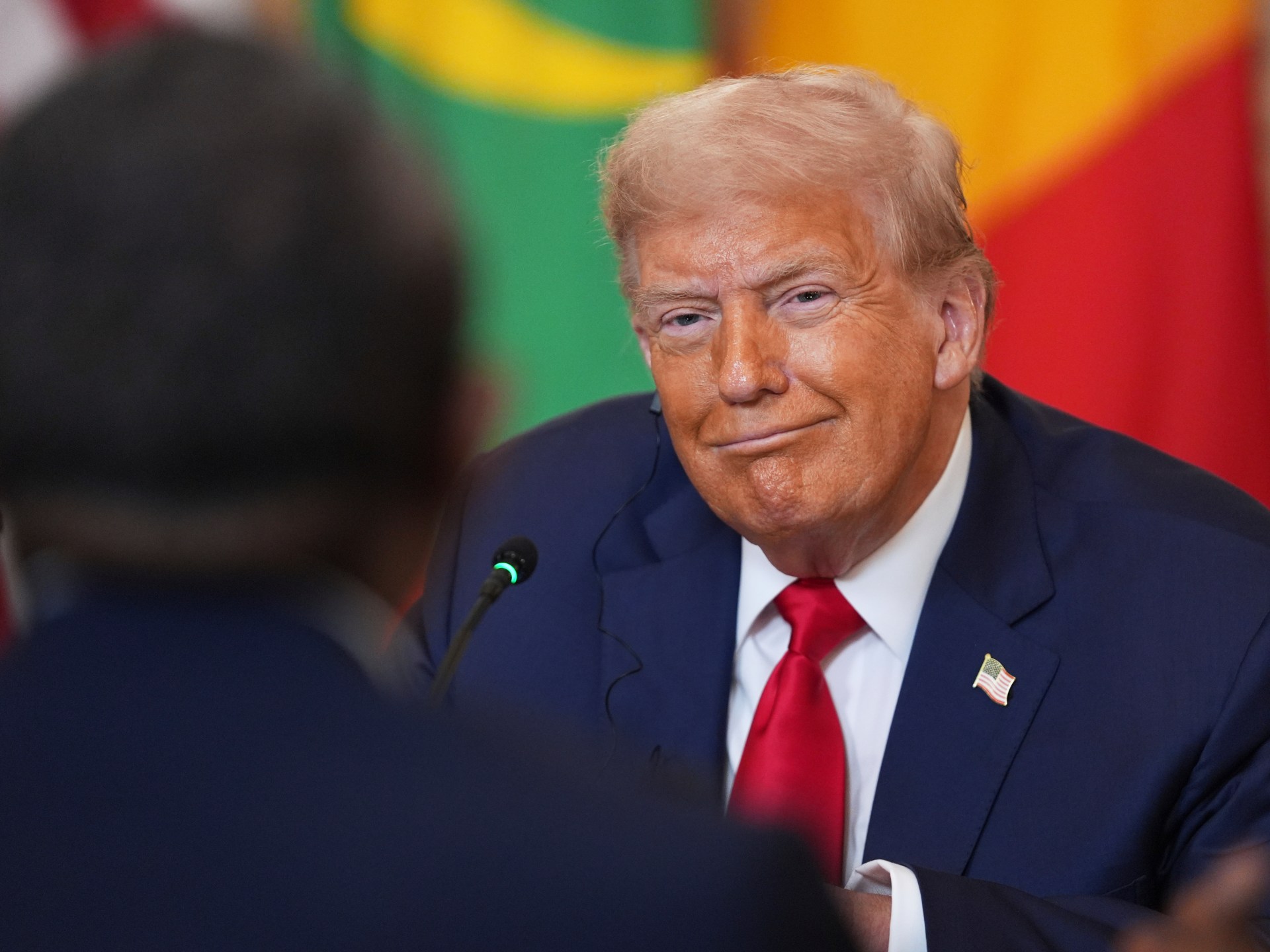
President Donald Trump is not scheduled to attend the 39th annual meeting of the African Union, where the summit opens on Friday.
But his presence will still be felt as delegations from 55 member states grapple with the new and devastating realities of the US president’s second term.
Recommended stories
list of 3 itemsend of list
President Trump’s historic foreign aid cuts, overhaul of U.S. trade policy, and sweeping changes to immigration all have a profound impact on Africa, but he mentions the continent only briefly in the broader global agenda.
Amid the chaos, the Trump administration has focused on acquiring resources and security, seeking new bilateral deals with African countries.
Carlos Lopez, a professor at the University of Cape Town in South Africa, told Al Jazeera: “Over the past year, US policy toward Africa has created a degree of uncertainty that will inevitably shape how African leaders approach this summit.”
“We are seeing a clear shift away from broad multilateral engagement and large-scale development plans to a more transactional, security and trade-oriented approach.”
Many African leaders have sought to strike a careful balance with the new American leadership.
Lopez observed that officials are simultaneously “hedging” by “strengthening relationships with China, the Gulf, Europe, and institutions within Africa to avoid over-reliance on a single partner” while engaging with the United States.
“In that sense, the defining theme of this summit is likely to be a recalibration of both sides. The United States is experimenting with a more transactional model of engagement, and African leaders are signaling that partnerships must be mutually beneficial, predictable, and respectful if they are to last,” Lopez said.
huge impact
The White House’s National Security Strategy, released in November, mentions Africa only fleetingly.
In the entire 29-page document, only three paragraphs at the bottom of the last page mention the continent.
Several of these paragraphs reiterate the United States’ long-standing goal of countering Chinese influence. This section also highlights President Trump’s recent efforts to end conflicts in the Democratic Republic of the Congo and Sudan.
But the document also refers to a broader vision for U.S.-Africa relations: a shift from a “foreign aid paradigm to an investment and growth paradigm.”
This approach would be facilitated by new bilateral relationships with countries “committed to opening their markets to U.S. products and services.” Meanwhile, the United States envisions boosting development efforts on the continent, particularly regarding access to strategic energy and rare earth mineral resources.
But the paradigm shift away from foreign aid has had a disproportionate impact on Africa and is likely to be a topic of discussion at Friday’s summit.
An estimated 26 percent of the continent’s foreign aid came from the United States. As of 2024, the country’s foreign direct investment in Africa is estimated at $47.47 billion, much of it through the United States Agency for International Development (USAID).
But President Trump has since dismantled USAID and canceled billions of dollars in aid programs. These moves have been accompanied by a broader U.S. withdrawal from the United Nations. Experts say the effects are already being felt on the ground in Africa.
Belinda Archibong, a professor at the Johns Hopkins School of Advanced International Studies (SAIS), told Al Jazeera: “We are experiencing the demise of USAID, which has had a hugely detrimental impact on global health, especially health funding for African countries, at least in the short term.”
The Center for World Development has estimated that current U.S. foreign aid cuts could result in between 500,000 and 1 million deaths per year.
The group said in a December report that evidence of President Trump’s aid cuts can be seen in increased mortality from malnutrition in northern Nigeria and Somalia, food insecurity in northeastern Kenya, and malaria deaths in northern Cameroon, among others.
Archibong also noted that HIV treatment and prevention is disrupted across the continent, a matter of concern for African Union member states.
For example, President Trump’s funding freeze disrupted services for programs funded by the President’s Emergency Plan for AIDS Relief (PEPFAR), a U.S. initiative credited with saving 25 million lives, primarily in Africa.
“So what is the impact of the U.S. withdrawal on health funding and health security around the world?” Archibon said. “That will be a very important discussion point at the summit.”
In the wake of the USAID outage, the Trump administration is pursuing at least 16 preliminary bilateral agreements on public health assistance with countries including Ethiopia, Nigeria, Mozambique and Kenya. The country calls its new aid model the “America First Global Health Strategy.”
But critics have raised concerns that these deals are tainted by “trade pressures”, creating potential for corruption and questions about their long-term sustainability.
“Strategic ambiguity?”
For Everist Beniera, a political science professor at the University of South Africa in Pretoria, Trump is likely to be the “proverbial elephant in the room” during the two-day African Union summit.
“This summit will make his presence felt even in his absence,” he told Al Jazeera.
President Trump’s tariff policies also have far-reaching effects on the continent. In April, 20 countries were slapped with tariffs ranging from 11% to 50%, and a further 29 countries faced basic tariffs of 10%.
Experts say the nature of the tariffs will increase uncertainty ahead of this year’s summit.
Individualized tariff increases disproportionately impact countries with specialized export industries that rely in part on protectionist trade policies to sustain their economies.
For example, the Kingdom of Lesotho, a country of about 2 million people surrounded by South Africa, initially faced a staggering 50 percent tariff rate, putting its garment industry at risk of being devastated. Meanwhile, Madagascar, known for its vanilla exports, was initially slapped with a 47% tariff.
The tax rate in Lesotho and Madagascar has since been reduced to 15%.
President Trump’s decision this month to temporarily extend the African Growth and Opportunity Act, a trade deal dating back to 2000, provided some reprieve.
This will allow eligible countries to export 1,800 items to the United States duty-free, including fossil fuels, auto parts, textile products, and agricultural products. However, the extension period is until the end of 2026.
Trump’s decision to suspend processing of immigrant visas from 75 countries, including 26 African countries, has also added to tensions. This represents almost half of the African Union member states.
Three African countries have come up with reciprocal policies banning travel for U.S. citizens.
Still, Beniera predicted that most leaders at this week’s summit will seek to maintain “strategic ambiguity” in order to forge a future agreement.
“Therefore, the African Union will not want to take policy lines that are inconsistent with President Trump,” he said.
“They will seek to strike a strategic balance between placating and reassuring Trump.” [Russian President Vladimir] Maintaining relations with President Putin [Chinese President] Xi Jinping. ”
“Normative Actor”
Meanwhile, López predicted the summit would include “subtle but sharp language emphasizing international law, multilateralism and coherence.”
He noted that several African countries have taken “vocal stances” against “global flashpoints” such as Israel’s genocidal war in Gaza, which is supported by the United States, and the recent U.S. military action in Venezuela.
For example, the governments of South Africa, Namibia, and Ghana have led the charge in condemning the United States’ abduction of Venezuelan President Nicolas Maduro as a blatant violation of international law.
Meanwhile, South Africa is spearheading a genocide case against Israel at the International Court of Justice (ICJ).
“We hope that the theme of international justice will continue, not necessarily as an open conflict, but as a reminder that Africa increasingly sees itself as a normative actor on the world stage,” Lopez said.
He described recent deals between the United States, South Africa and Nigeria as “illustrating” the tightrope many African Union member states face in the Trump era.
In South Africa, President Trump pushed the claim that white Afrikaner farmers were being persecuted in “white genocide,” a position rejected by President Cyril Ramaphosa’s government and several senior Afrikaner officials.
But even after an extraordinary (and false-filled) standoff in the Oval Office, the Ramaphosa government is seeking to forge a new deal with the Trump administration while strengthening ties with China, its largest trading partner.
President Trump has also promoted dubious claims about the persecution of Christians in Nigeria. In December, the United States attacked groups linked to the Islamic State (ISIS) in the country’s restive northeast, promising more bombings if the militants “continue to kill Christians.”
The Nigerian government responded cautiously to the US attack, calling it a “joint operation” while rejecting the idea that religion was the root of the violence.
It is also seeking to capitalize on President Trump’s interest in the region to increase security cooperation and intelligence sharing with the United States to counter continuing insecurity in the country’s north.
“Both countries have experienced more hostile attitudes from the U.S. government, but both have used that friction to diversify their partnerships and assert their strategic autonomy,” Lopez said.
“This reflects the broader rebalancing that is underway across the continent.”
