

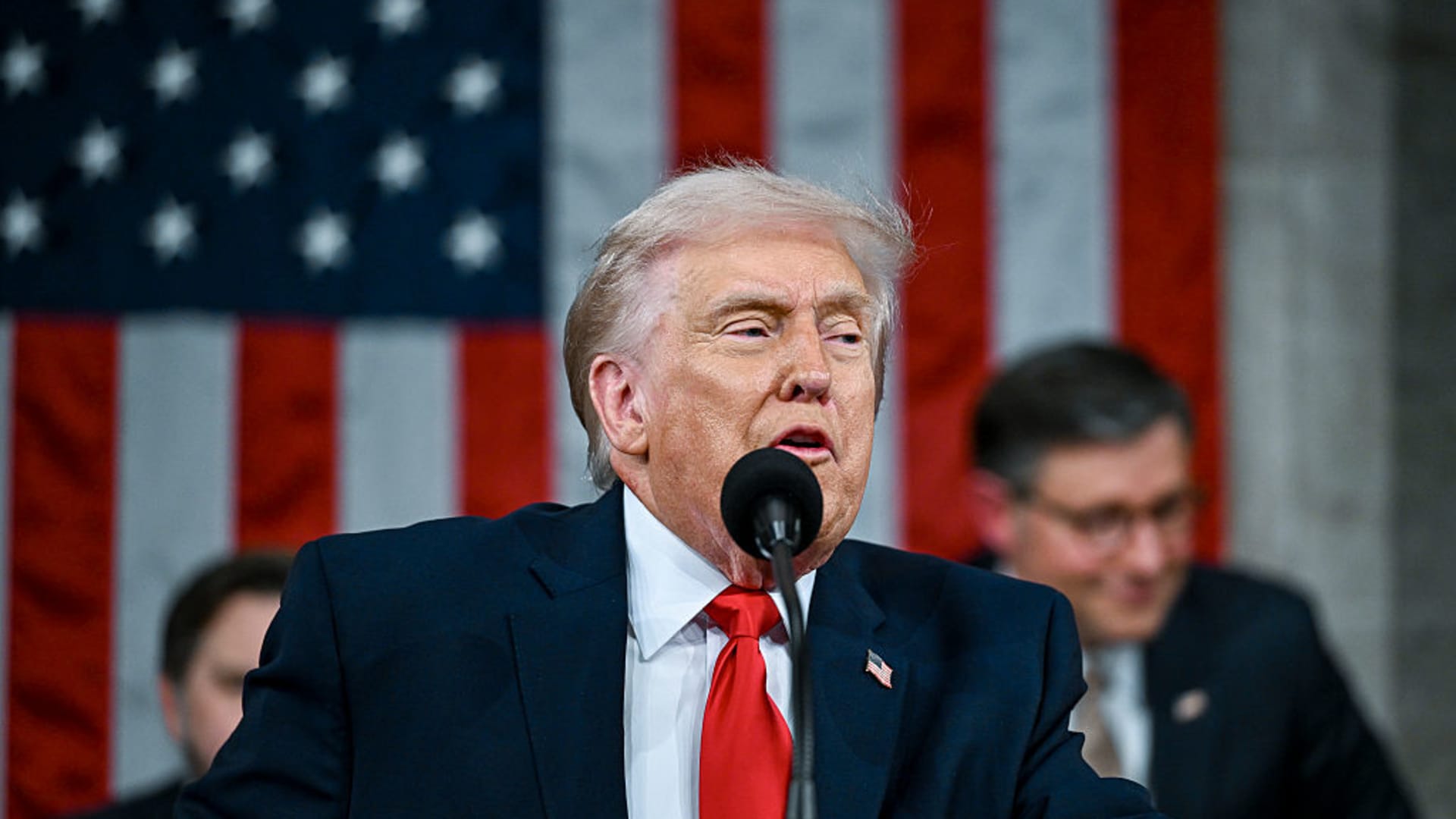
US President Donald Trump delivers the State of the Union address in Washington, DC on February 24, 2026.
Kenny Halston – Pool/Getty Images
President Donald Trump said in his State of the Union address Tuesday night that his administration’s policy is to “rapidly end” the high prices of certain protein-containing foods in the American diet, such as beef, chicken and eggs.
However, since President Trump took office in January 2025, chicken and beef prices have increased.
Agricultural economists say egg prices have indeed fallen significantly, but like beef prices, they are influenced more by supply and demand factors specific to those markets than by federal policy.
The price movement also came after the Trump administration said it would “end the protein wars” by announcing new U.S. nutritional guidelines that emphasize protein, full-fat dairy products and vegetables.
“President Trump is right: Inflation has subsided and the prices of many essential goods have fallen or are on the right track,” White House Press Secretary Khush Desai said in an emailed statement. “The entire administration remains committed to providing economic relief to the American people.”
Beef prices rise in President Trump’s second term
President Trump said in his State of the Union address that beef prices are “starting to go down significantly.”
Federal government data shows beef prices are starting to fall in some places, but remain at multi-year highs or near all-time highs.
The average price of ground beef in January was $6.75 per pound, the highest level on record, according to data from the U.S. Bureau of Labor Statistics. Prices have increased 22% in the past year from $5.55 a pound in January 2025, when President Trump began his second term. This is the highest annual inflation rate since June 2020, during President Trump’s first term.
Prices for other cuts of beef are also rising, according to federal data.
For example, raw beef steak prices averaged $12.30 per pound in January, down slightly from December’s all-time high of $12.51 per pound, according to Bureau of Labor Statistics data. Prices have increased 13% in the past year.
The average price for a uncooked beef roast in January was $8.82 per pound, down from an all-time high of $9.29 per pound in November. Average prices have increased by 14% over the past year.
Michael Swanson, chief agricultural economist at Wells Fargo Agri-Food Research Institute, said beef prices “still have risen significantly” over the past year.
Swanson said recent price declines are “not much consolation for most people.”
Why beef prices are high
Agricultural economists say beef prices are rising at high levels due to a decline in supply and increased demand from American households.
It’s a “double whammy,” said Charlie Martinez, assistant professor and chair of the Department of Agricultural and Resource Economics at the University of Tennessee.
On the supply side, U.S. cattle inventories are at their lowest in decades, according to federal data.
According to the U.S. Department of Agriculture, as of January 1, there were 27.6 million beef cattle in the United States. This is the lowest supply of cattle earmarked for the beef market since 1961, according to historical USDA data tracked by Martinez.
As of Jan. 1, the U.S. had about 86.2 million cows (including other breeds such as those used for milk production), the lowest number since 1951, according to USDA data.

Bernd Nelson, an economist with the American Farm Federation, an industry group, said in October that many factors are contributing to the significant decline in the U.S. cattle herd.
Persistent drought has created “deteriorating” pasture conditions for cattle, Nelson wrote.
Good pasture conditions lower the cost of raising cattle, he said, but poor conditions force farmers and ranchers to transport hay from other parts of the country, leading to record increases in the cost of raising and feeding cattle. As a result, many farmers sold their cows rather than keep them to give birth to calves.
“If you don’t have enough cows to produce beef, it’s hard to produce more beef,” said Amy Smith, a food economist at Advanced Economic Solutions.
She also said that breeding cattle for the beef market takes a long time, about three years.
Meanwhile, demand for beef among U.S. households is increasing, despite rising prices, economists say.
Commenting on USDA data, Martinez said the 2025 retail total raw beef demand index reached its highest level since at least 2000.
“COVID-19 and the whole pandemic has created a lot of new demand,” Martinez said. “Everyone has become a backyard grilling hero. … There has been a shift in beef tastes and preferences that we have never seen before.”
Economists said they do not expect beef prices to continue falling in the short term due to supply and demand in the beef market.
The Trump administration has sought to expand supply through policies that encourage beef imports from countries such as Argentina. Imports were already at a record high in 2025, according to Nelson of the Agriculture Department.
But such market intervention would have the “unintended consequence” of lowering prices paid to U.S. livestock farmers, Nelson wrote.
Increased imports “could add further barriers to herd growth and potentially prompt further reductions in cattle inventories,” he wrote. “This could further increase beef prices and increase U.S. reliance on imported beef to meet domestic demand.”
Why did the price of eggs fall?
President Trump said Tuesday that egg prices are down 60%.
The numbers are consistent with data from the Bureau of Labor Statistics, which shows the average price of 12 large Grade A eggs has fallen from an all-time high of $6.23 per dozen to $2.58 per dozen in January, down about 59% from March 2025.
Prices have fallen 48% from $4.95 per dozen in January 2025.
Economists say much of the decline is a return to more typical prices after a supply shock caused by a historic bird flu outbreak.
“We’re seeing a significant decrease [in price] from shockingly high prices,” said Swanson of the Wells Fargo Agriculture and Food Research Institute.

Highly pathogenic avian influenza, commonly known as avian influenza, has driven egg prices to dizzying highs from late 2024 to early 2025, economists say.
The disease is highly contagious and fatal to birds, including hens in commercial egg farms. Economists say that to prevent the spread of infection, farmers must kill entire herds when they find infected individuals.
In total, tens of millions of egg-laying chickens died. For example, more than 38 million commercial egg-laying birds died in 2024, according to USDA data tracked by the University of Arkansas. More than 20 million more people died in early 2025.

More than 140 million egg-laying hens have been lost in the U.S. since the outbreak began in 2022, according to Advanced Economic Solutions’ Smith.
“You can’t just recover from that,” she says.
While the disease is not going away, Smith said so far “we haven’t seen a huge impact” in late 2025 or 2026.
Consumer demand also likely fell as prices rose, which helped ease prices at grocery stores, he said. He said prices could rise in the coming weeks as the Easter holiday approaches, making it like the Super Bowl for the egg industry.
chicken price
President Trump also said Tuesday that chicken prices are “a lot lower now than they were when I took office.”
However, the average price of chicken meat has increased by about 1% over the past year, according to the Consumer Price Index. Consumers paid an average of $4.17 per pound of boneless chicken breast in January, up from $3.97 per pound during the same period last year, according to BLS data.
Economists say bird flu has not affected chickens raised for meat as seriously as chickens raised for egg production.
