

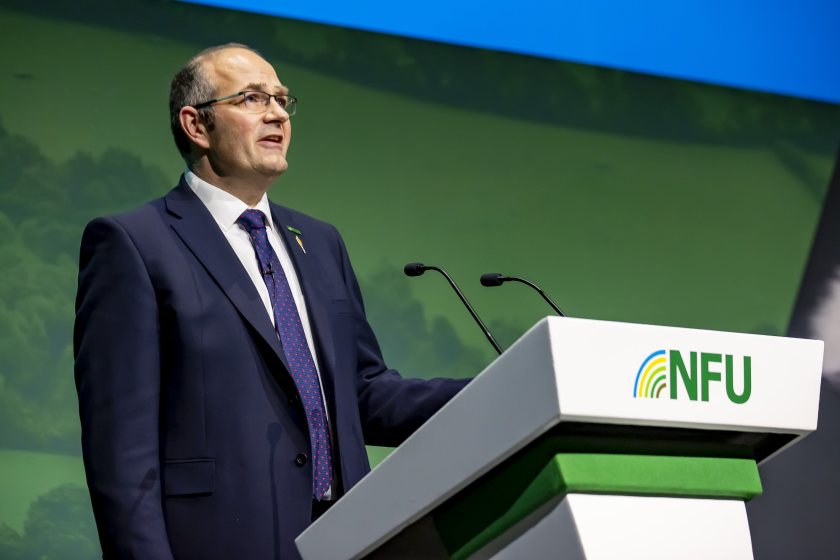
With farmer confidence at extremely negative levels and domestic production of key food items in decline, NFU chairman Tom Bradshaw will warn that building a resilient food system is essential to curb inflation and protect national security.
In his opening address to the NFU annual conference today (24 February), he will tell more than 1,000 members, politicians and industry leaders that the resilience of food production during periods of geopolitical instability is not optional, but “fundamental to national security”.
His speech came as the NFU’s latest reliability survey paints a grim picture. Short-term confidence is -33 and medium-term confidence is -30, with 64% of farmers and producers reporting that their profits have declined or that their operations may not survive.
Bradshaw is expected to argue that a return to profitability must be the starting point for growth.
“Investing in food production is critical to the future of the country,” he would say. “Everyone needs resilient food systems, young and old, rural and urban.”
He will define resilience as “the ability to anticipate shocks, withstand shocks and recover stronger than before” and will call for a clear, long-term government strategy for agriculture and food production.
Quoting recent comments from the Defra Secretary, he added: “Profit is not a dirty word. Profitability is the first step to true sustainability. It is the key to growth, resilience and controlling food inflation.”
The intervention comes amid ongoing debate over agricultural support, environmental planning and rising input costs.
Mr Bradshaw will also point to planning reforms aimed at making it easier for farmers to obtain approval for new agricultural buildings and highlight examples of integration policy.
But he will urge ministers to demonstrate similar ambition in other areas, such as delivering on a pledge to ensure half of public sector food is sourced locally.
Energy policy will be a major focus of his remarks. He will warn that changes to permanent rates this spring could add “hundreds of millions of pounds of inflation” to supermarket shelves, and will argue that energy-intensive businesses in agriculture should receive the same level of support as sectors such as cement and steel.
Water safety will also be improved. “Our ability to feed our growing population depends on a safe water supply,” he said, and will call for Britain’s river network to be treated as critical national infrastructure and properly maintained.
When it comes to environmental policy, he describes farmers as the “original environmentalists”, but warns that programs like sustainable agriculture incentives will not succeed if “goals” keep changing.
“If we get this right, British farmers will be investing in the farm infrastructure they need to provide a resilient food system for 70 million consumers,” he said, arguing that domestic investment would help maintain processing capacity, technology and research in the UK.
He is also expected to warn against over-reliance on imports, citing a report by the National Preparedness Committee that highlighted the “risk of the UK repeating the mistakes of the past by assuming that other countries will always provide for us”.
Production of staple foods such as wheat, beef, poultry and vegetables has fallen in recent years, leading him to conclude that “years of contraction in British food production must end now”.
Mr Bradshaw will conclude by warning that without decisive action to strengthen domestic food production, the UK risks becoming more exposed to global shocks and sustained food price fluctuations.
“Britain should and can be one of the best places on earth to produce food,” he would say. “For the sake of our economy, our planet, and our national security, we must not take its benefits for granted.”
