

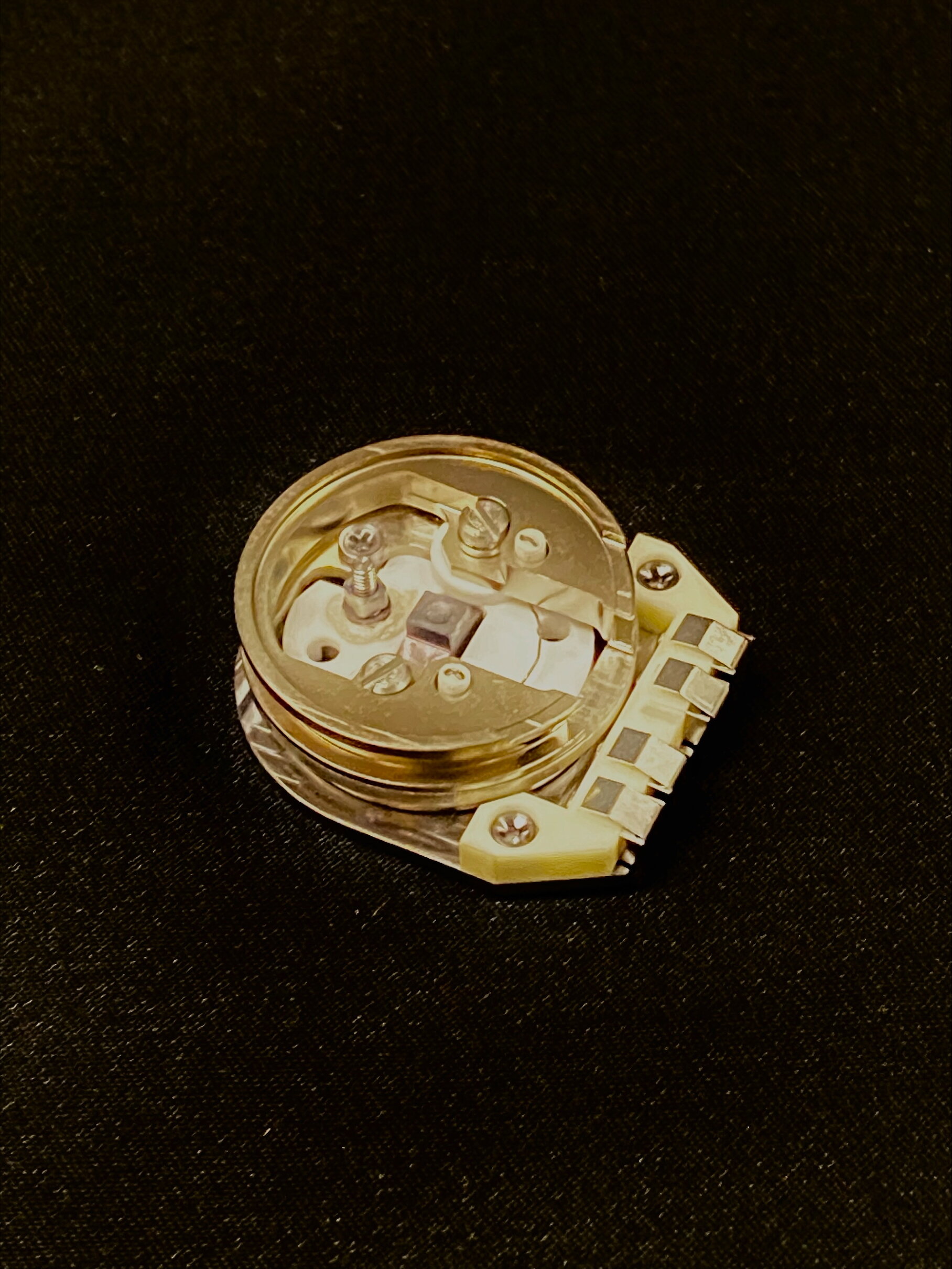

To thoroughly analyze the original protective layer of the cryogenically flash-frozen anode, Stanford researchers placed this sample holder containing the anode (approximately 1 inch in diameter, bottom view) into an X-ray photoelectron spectroscopy tool after battery operation. Credit: Ajay Ravi
In science and everyday life, the act of observing or measuring something can change what is being observed or measured. You may have experienced this “observer effect” when you measured the tire pressure and the tire pressure changed due to deflation.
To study materials involved in important chemical reactions, scientists can expose them to X-ray beams to reveal details about their composition and activity, but their measurements can trigger chemical reactions that change the material. Such changes could have significantly hindered scientists from learning how to improve rechargeable batteries, among other things.
To address this, researchers at Stanford University have developed a new twist on X-ray technology.
They applied a new approach by observing key battery chemistry reactions. As a result, the observed battery materials were not changed and no additional chemical reactions occurred. In doing so, they have advanced knowledge to develop rechargeable lithium metal batteries.
This type of battery stores a large amount of energy and can be recharged very quickly, but after a few recharges it shorts out and fails.
The new research, published in the journal Nature, could also advance our understanding of other types of batteries and many materials unrelated to batteries.
“Perhaps most importantly, we think other scientists and engineers will be able to use this new approach to solve the mysteries of many chemical reactions,” said Stacey Bent, co-senior author of the study and the Jagdeep and Roshni Singh Professor of Energy Science and Engineering in Chemical Engineering in the Stanford School of Engineering and the Stanford Doerr School of Sustainability.
protective layer
During the first few use/recharge cycles of a lithium metal battery, a protective film forms on the surface of the lithium negative electrode. This protective layer is only a billionth of a meter thick, but it is critical to the battery’s performance and durability. This membrane must block electrons at the negative electrode while allowing lithium ions to pass between the opposite electrodes.
Battery researchers have learned a lot about this important protective layer using an X-ray beam technique known as X-ray photoelectron spectroscopy (XPS).
The standard method of operating XPS devices is at room temperature and under ultra-negative pressure. This means that there are almost no extraneous atoms or molecules floating around the observation chamber.
But under these conditions, a new study shows that the chemical composition of the protective layer in lithium batteries changes, making it thinner.
Believing that these changes could obscure problems with lithium batteries, the study’s researchers tried flash-freezing the new battery cells at around minus 325 degrees Fahrenheit (minus 200 degrees Celsius) immediately after the protective layer was formed.
Although Freeze has proven useful in studies using similar equipment, its use in XPS is quite new. The researchers hoped that their “cryo-XPS” method would allow them to maintain the protective layer in its original state through XPS observations at slightly warmer temperatures, around -165°F.
It happened.
To thoroughly analyze the original protective layer of the cryogenically flash-frozen anode, Stanford researchers placed this sample holder containing the anode (approximately 1 inch in diameter, bottom view) into an X-ray photoelectron spectroscopy tool after battery operation. |Ajay Ravi
“By comparing observations using our method, we identified changes brought about by XPS observations at room temperature, which may lead to overcoming the challenges of lithium metal batteries and improving other lithium-based batteries,” said Yi Cui, another co-senior author of the study and Fortinet Founding Professor of Materials Science and Engineering in the School of Engineering, Photon Science at the National Accelerator Laboratory at SLAC, and Energy Science and Energy Sciences, as well as Bento. engineering.
“cryo-XPS also improves performance-based evaluation of different electrolyte chemistries used in lithium negative electrodes, which will be useful for researchers working on several new battery architectures,” said Cui.
new insight
The researchers used both conventional XPS and its freezing method to measure how well the batteries performed with different chemistries of electrolytes in which charged particles move between the positive and negative electrodes during use and subsequent charging. Electrolytes contain salts and solvents, and salt-based chemicals are thought to be useful in protective layers to ensure stability.
They found only a moderate correlation between charge retention in the protective layer and salt-based chemicals when using conventional XPS. However, the correlation was very strong when using cryo-XPS measurements.
“Cryo-XPS appears to provide more reliable information about which compounds actually improve battery performance,” said Sanjeeda Baig-Shoochi, a Ph.D. and lead student on the research team. Candidate in Chemical Engineering.
Among other important differences between room-temperature XPS and cryo-XPS, the research team learned that conventional XPS measurements of battery materials include increased amounts of lithium fluoride in the protective layer, a compound associated with improved battery performance.
“This may have misguided the battery design, as higher lithium fluoride content is believed to increase the number of discharge/recharge cycles the battery takes. However, standard XPS exaggerates the amount of lithium fluoride present in the protective layer,” Shuchi said.
Lithium oxide, another compound associated with improved battery performance, also showed significant differences between room temperature and cryo-XPS. Under freezing conditions, large amounts of lithium oxide were detected in the protective layer during cell operation with high performance electrolytes.
This did not occur in conventional XPS observations, and is probably due to chemical reactions induced by conventional XPS. Curiously, this result was reversed when using a lower performance electrolyte, with lithium oxide becoming more prominent in XPS measurements at room temperature.
Lithium metal outlook
The development of Cryo-XPS has important implications for better battery design. Lithium metal batteries use a metallic lithium anode instead of the graphite anode of lithium-ion batteries, and can be expected to have significantly higher energy density than today’s mainstream lithium-ion batteries. However, lithium metal batteries have safety and longevity issues, primarily related to the protective layer on the anode.
“More precise insight into the composition of the lithium anode interface will allow researchers to design electrolytes and even ultrathin coatings that create more stable interfaces,” Bent said.
“Knowing which chemicals are actually present during battery operation is better than characterizing the interface, which may not reflect real-world conditions.”
The researchers say that while the study calls into question some existing interpretations of battery interfaces, scientists and engineers can proceed with measurements with more confidence using cryo-XPS.
Further information: Stacey Bent, Cryogenic X-ray photoelectron spectroscopy for battery interfaces, Nature (2025). DOI: 10.1038/s41586-025-09618-3. www.nature.com/articles/s41586-025-09618-3
Provided by Stanford University
Citation: Rapid freeze observation improves outlook for lithium metal batteries (October 22, 2025) Retrieved October 23, 2025 from https://techxplore.com/news/2025-10-method-outlook-lithium-metal-battery.html
This document is subject to copyright. No part may be reproduced without written permission, except in fair dealing for personal study or research purposes. Content is provided for informational purposes only.
