

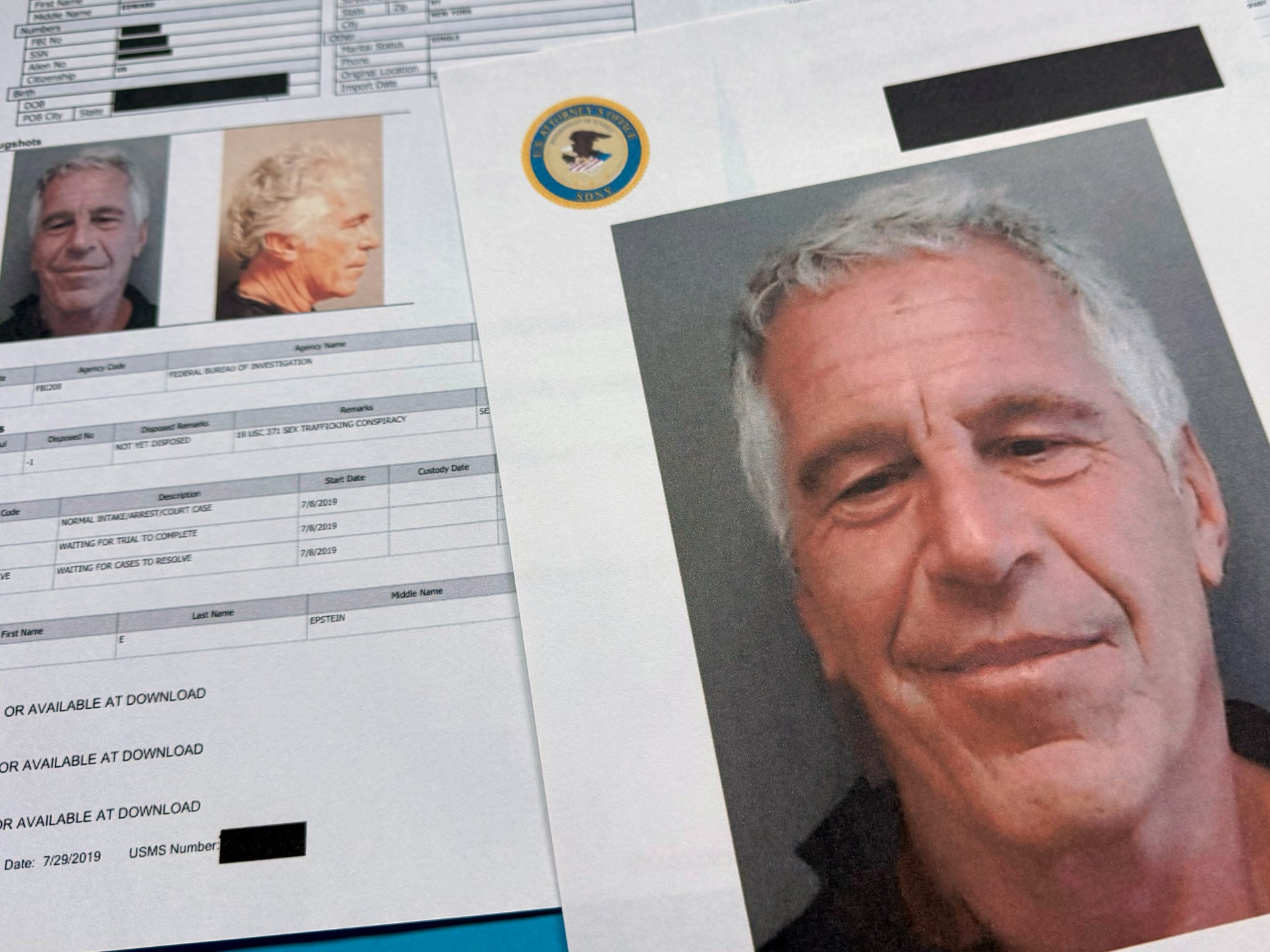
US lawmakers have revealed the names of six men included in Jeffrey Epstein’s file, including American billionaire Leslie Wexner, who was labeled a co-conspirator by the FBI in 2019.
Speaking on the House floor Tuesday, Democratic Rep. Ro Khanna said he named the men after spending two hours reviewing unredacted documents with Republican Rep. Thomas Massie during a review sponsored by the U.S. Department of Justice.
“If you found six guys hiding within two hours, imagine how many guys you’re hiding in those 3 million files,” Khanna said.
Since the bipartisan duo pushed through the Epstein File Transparency Act, signed into law by President Donald Trump in November, the U.S. government has released millions of pages of documents, including emails and photos, related to the criminal prosecution of the late sex offender Epstein and his socialite girlfriend Ghislaine Maxwell.
The inclusion of a name in the file does not imply wrongdoing by that person. But the Justice Department’s response to releasing the files has come under fire from advocacy groups and Epstein’s accusers, who say they are too redacted.
So who are the six men named by Khanna? And why are the names blacked out in the Epstein files?

What did Ro Khanna say to the US Congress?
Speaking on the House floor on Tuesday, Mr. Khanna asked, “Why did Thomas Massey and I need to go to the Department of Justice to release the identities of these six people?”
Referring to last year’s law requiring the release of files, Khanna said: “The Epstein Transparency Act requires him to unredact FBI files, but the Justice Department told me and Congressman Massey, ‘We just uploaded what the FBI sent us.'”
“This means that all survivor statements to the FBI naming wealthy and powerful individuals who went to Mr. Epstein’s island, who went to his ranch, who went to his home to rape and abuse underage girls, who witnessed underage girls being paraded around, have all been suppressed,” the lawmaker said. “They were all edited out. It’s a bit of a farce.”
The Justice Department began allowing lawmakers to view unredacted files Monday at its headquarters in Washington, D.C. They may look at files on your computer, but may not bring electronic devices with you. You are only permitted to take notes and may not make electronic copies.
The Justice Department is believed to have about 6 million pages of documents related to Epstein. These findings stem from a nearly 20-year investigation into allegations that he serially sexually abused young girls. He died by suicide in prison in 2019 while awaiting trial for sex trafficking. Maxwell was convicted of sex trafficking two years later.
All files were supposed to be released within 30 days after the Epstein File Transparency Act was signed into law on November 19th, but so far 3.5 million have been released.
The files consulted by Khanna and Massey do not appear to implicate the six men in any particular crime.
But Khanna said redacting their names was a failure by the Department of Justice. California lawmakers accused the government of hiding their names “for no apparent reason.”
Since Mr. Khanna’s speech to Congress, the Justice Department has partially unredacted some of the files he and Mr. Massey pointed to.
What do we know about the six people named?
Khanna identified one of the men in the files he examined as Wexner, a billionaire retail tycoon and former owner of Victoria’s Secret.
Mr. Wexner was a longtime friend of Mr. Epstein and hired him to manage his investments over the years.
Although Wexner’s relationship with Epstein was already known, Khanna revealed that the FBI also considered Wexner a co-conspirator with Epstein at one point during the investigation. No criminal charges have been brought against the billionaire in connection with Epstein’s crimes.
On Tuesday, after Mr. Khanna’s speech, the Justice Department unredacted portions of an internal FBI Criminal Investigation Division document dated Aug. 15, 2019, that included references to Mr. Wexner as a co-conspirator. The file is currently available for viewing in its unedited form on the Justice Department’s Epstein File website.
The other man named by Khanna was Sultan Ahmed bin Sulayem, Dubai’s most powerful and well-connected man. The chairman and CEO of logistics giant DP World exchanged messages with Epstein in the years before and after he pleaded guilty in 2008 to soliciting prostitution from a minor.
The friendly exchanges between the two sides included discussions about business deals, and noted that Mr. bin Sulayem visited Mr. Epstein’s private island while sharing business and political connections. The two men also shared lewd comments about women.
The deletion also confirmed that bin Sulayem’s email address was used to communicate with Epstein, who said Epstein “loved the torture videos.”
Khanna named four others: Salvatore Nuala, Zurab Micheladze, Leonik Leonov and Nicola Caputo. However, Al Jazeera was unable to independently confirm their identities or affiliations.
US-based broadcaster CBS News reported that a ministry spokesperson said that of the six names mentioned by Khanna, four of the lesser-known ones “are included in only one document of the entire file. Mr. Wexner is mentioned nearly 200 times in the file, and Sultan bin Sulayem appears more than 4,700 times.”

How did the Department of Justice respond?
Todd Blanche, deputy attorney general at the Justice Department, said some of the redacted names mentioned by Khanna and Massey appeared unredacted in other documents in the Epstein file.
In a post to X related to email communications between Epstein and Bin Sulayem, Blanche wrote: “You know it’s a redacted email address. The law requires the redaction of personally identifying information, even in email addresses. And you know that the Sultan’s name is available in the file unredacted.”
Blanche also mentioned another email exchange in which Bin Sulayem’s name was visible but the email was blacked out.
Blanche added in a comment directed at Massey: “Please be honest and stop grandstanding.”
However, the Epstein File Transparency Act only allows such redactions if the information identifies the victim.
In a post to Only Epstein and Maxwell’s names came up.
In response, the deputy attorney general said the list “contains the names of numerous victims” and that the department has “unredacted all names other than the victims.”
But Massey pointed out that “four of the 18 redacted names in this document are men born before 1970.”
There is no information as to what the purpose of the list mentioned by Massey was. In the updated document, only two names had been redacted when Al Jazeera reviewed it on Wednesday.
What does the law say about editing?
The Epstein File Transparency Act requires that records in the file may not be edited solely because it may embarrass or defame any government official, national, foreign national, or public figure.
Redaction of information is permitted in the following circumstances: if the information includes personally identifiable information of the victim, depicts or contains material of child sexual abuse, jeopardizes an active federal investigation, and depicts or contains images of death or physical abuse.
The law also allows documents to be redacted if they contain information specifically authorized by executive order to be kept secret in the interest of national security or foreign policy.
The law further provides that all edits must be accompanied by a written justification published in the Federal Register and submitted to Congress.

Who decides what gets redacted in the Epstein files?
Under U.S. law, laws such as the Epstein File Transparency Act designate the attorney general (currently Pam Bondi) to be in charge of its enforcement.
In the case of the Epstein files, the law requires Bondi, as head of the Department of Justice, to release in searchable and downloadable format all unclassified records, documents, communications, and investigative materials held by the department, including the FBI and the U.S. Attorney’s Office.
The Attorney General then delegates these tasks to the departments and agencies in charge, and staff members review each page.
Some emails and other documents may contain details about Epstein’s victims, but these must be redacted to ensure victims’ privacy and security.
However, US media reported that many of the files the department received from the FBI had already been redacted.
“So what? The FBI sent me a scrubbed file,” Khanna said.

Did Epstein’s files reveal the identities of his victims?
The Justice Department is under increasing pressure over its handling of the Epstein dossier.
In addition to protecting the identities of people who exchanged emails and other messages with Epstein, he is also accused of failing to redact the identities of his victims.
On February 2, the Justice Department announced it had removed thousands of documents and media items from the Epstein Files website after lawyers representing Epstein’s accusers told a New York judge that the lives of nearly 100 victims had been “upended” by sloppy editing in the release of records.
The materials released included nude photos of young-looking potential victims, names and email addresses, as well as information that was not fully redacted or completely suppressed, although it is unclear whether they were minors or not.
The ministry blamed this on “technical or human error” and said, given the enormous task of reviewing millions of documents, “the team may have mistakenly edited individuals or left unedited people who should have been edited.”
Attorney Jay Clayton said the department has now “revised its procedures for dealing with flagged documents,” adding that documents will be re-evaluated “ideally within 24 to 36 hours” before being reposted.

