

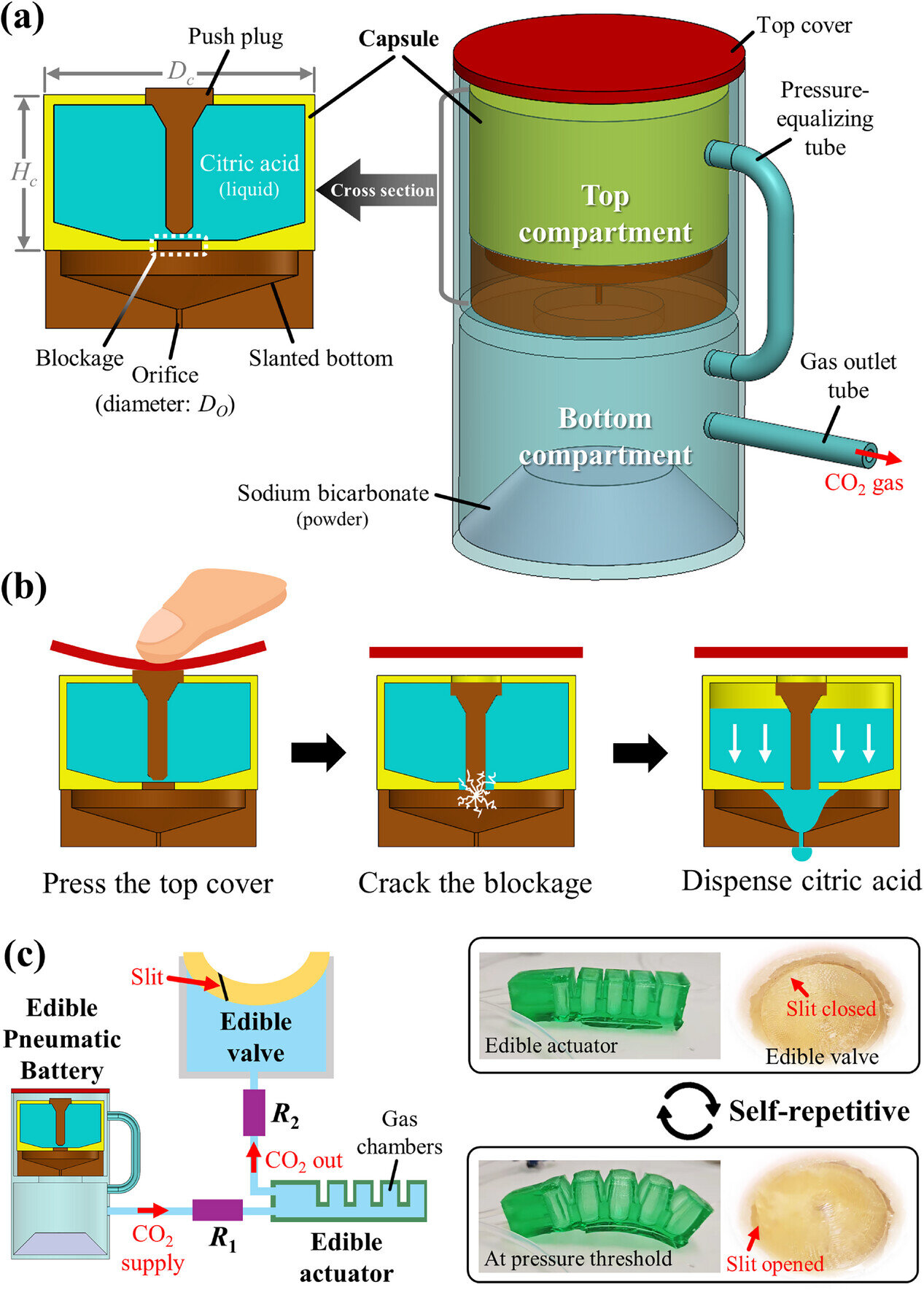

Schematic diagram of the proposed edible battery actuator system to produce rhythmic and sustained gas generation and release. Credit: Advanced Science (2025). DOI: 10.1002/advs.202509350
Using common kitchen materials such as citric acid and sodium bicarbonate, scientists created an edible pneumatic battery and valve system to power the soft robot.
Soft biodegradable robots are used in a variety of fields, such as environmental monitoring and targeted drug delivery, and are designed to completely disappear after performing a task. However, their main problem is that they rely on traditional batteries (such as lithium), which are toxic and non-biodegradable. And to date, no successful system has been developed that can provide repetitive independent exercise using only edible materials.
In a new paper published in the journal Advanced Science, researchers at Dario Floreano’s Institute for Intelligent Systems at EPFL in Switzerland describe how they developed a completely edible power source (battery), valve system (controller), and actuator (robotic muscles).
How the system works
The battery consists of two components. One contains citric acid, which is found in lemons, and the other contains powdered sodium bicarbonate (common baking soda). To generate electricity, drop acid into baking soda, safely foaming it and releasing pressurized carbon dioxide gas. This is the classic “volcano” chemical reaction seen in many college science classes.
“The edible air battery described here relies on the chemical reaction of sodium bicarbonate and citric acid to produce an energy source that is safe to eat, fast-acting, low-cost, and has zero environmental impact,” the researchers said in the study.
Carbon dioxide gas flows into an edible actuator made of soft, flexible gelatin. If gas pressure builds up inside, the actuator will bend. This bending is the robot’s movement.
If the pressure gets too high, it is released through a valve, which is a thin circular gelatin shell with slits. When the pressure drops, the valve closes automatically and pressure builds up again from the battery, starting the next cycle of rhythmic movement. This continuous cycle creates independent movement.
The system is highly programmable and scalable and can be fine-tuned for specific missions. By adjusting the size of the opening through which the acid drips, scientists can control the rate of gas evolution. This affects the robot’s movement speed.
On the other hand, the number of repetitions can be controlled by varying the resistance to gas flow between the components. Additionally, batteries can be manufactured in a variety of sizes and run from as little as 20 seconds to as long as 650 seconds.
test success
The researchers were able to demonstrate the technology in a laboratory environment that mimics real-world use. They developed a foot-activated actuator that can be buried underground and activated when a wild boar or other wild animal steps on it.
The robot then moves repeatedly (imitating live prey) to attract the wild animal closer to it. Eating a robot also consumes its payload’s nutrients and vaccines. No toxic waste is left behind.
This article, written for you by author Paul Arnold, edited by Gabby Clark, and fact-checked and reviewed by Robert Egan, is the result of careful human labor. We rely on readers like you to sustain our independent science journalism. If this reporting is important to you, please consider making a donation (especially monthly). As a thank you, we’re giving away an ad-free account.
Further information: Bokeon Kwak et al. Edible pneumatic batteries for sustained and repetitive robot actuation, Advanced Science (2025). DOI: 10.1002/advs.202509350
© 2025 Science X Network
Citation: Soft Robot Powered by Edible Pneumatic Battery and Actuator (November 17, 2025), Retrieved November 17, 2025 from https://techxplore.com/news/2025-11-soft-robot-powered-edible-pneumatic.html
This document is subject to copyright. No part may be reproduced without written permission, except in fair dealing for personal study or research purposes. Content is provided for informational purposes only.
