

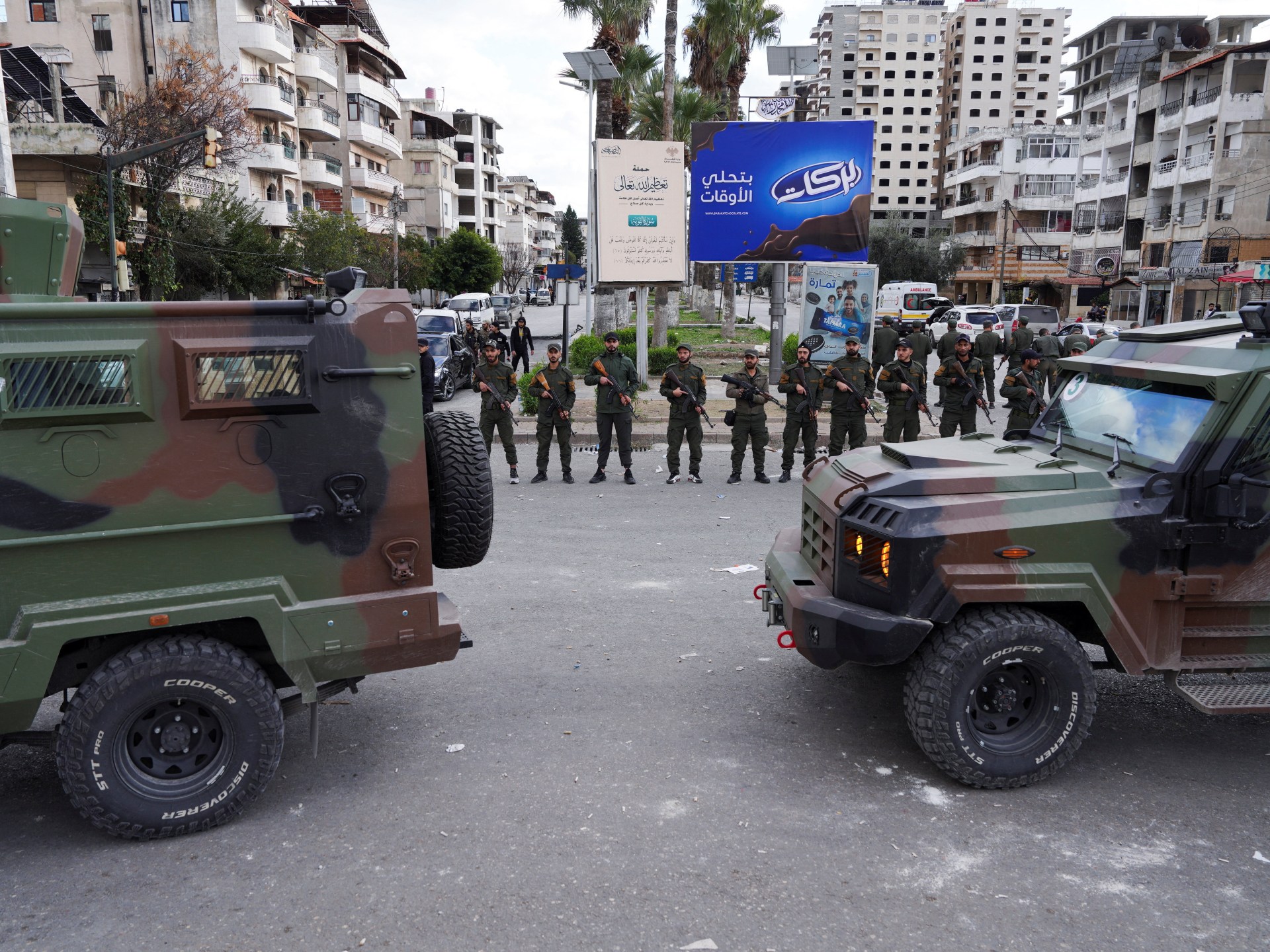
The deployment followed deadly violence during protests by the coastal city’s Alawite minority.
Syrian government forces were sent to the coastal cities of Latakia and Tartus after demonstrations sparked deadly clashes that left at least three people dead and 60 injured.
It is the latest turmoil to challenge President Ahmed al-Sharaa’s nascent government, which has been pushing to stabilize the country and reintegrate it into the international community after 14 years of devastating civil war.
Syria’s Ministry of Defense announced on Sunday that military units with tanks and armored vehicles had entered urban centers in the country’s west on a mission to counter attacks by “lawless groups” against civilians and security forces and restore stability.
Syrian state news agency SANA said the attack was carried out by “remains of the defunct regime” of former President Bashar al-Assad during protests in Latakia, citing officials.
SANA said 60 people were injured in “stabbings, stone-throwing and gunfire targeting both security personnel and civilians”.
Clashes reportedly occurred as demonstrators and pro-government demonstrators confronted each other, and masked gunmen opened fire on security personnel.
The Interior Ministry said in a statement that a police officer was among the dead. Al Jazeera’s reporting team confirmed that gunfire was fired at Syrian security forces at the Al-Azhari roundabout in Latakia, and in Tartus, unidentified assailants threw a grenade at al-Anaza police station in Baniyas, injuring two security personnel.
Alawite protests
Violence escalated Sunday as thousands of Alawite Syrians took to the streets in the religious minority’s heartland in central and coastal Syria to protest violence and discrimination.
The protests were called by Alawite spiritual leader Ghazal Ghazal, who lives abroad, to “show the world that the Alawite community will not be humiliated or marginalized” in the wake of Friday’s Homs mosque bombing.
The bombing, which killed eight people and was claimed by the Sunni group known as Saraya Ansar al-Sunna, was the latest act of violence against the religious minority, which included ousted president al-Assad and held a large position under his rule.
Demonstrators also demanded that the government introduce federalism, a system that decentralizes power from Damascus in favor of greater minority autonomy, and release Alawite prisoners.
“We don’t want civil war. We want political federalism. We don’t want your terrorism. We want to decide our own destiny,” Ghazal, head of the Islamic Alawite Council inside and outside Syria, said in a Facebook video message.

“We want federalism”
Ali Hassan, one of Sunday’s anti-government demonstrators, said demonstrators were demanding an end to the ongoing violence against the Alawite community.
“We just want to sleep in peace and work in peace and we want federalism,” he said. “If this situation continues like this, we want a federal system. Why are 10 of us being killed every day or every other day?”
Mohammad Bakkur, a counter-demonstrator, said he was found to be showing support for the government.
“We are here to support the new government, which has called for peace and amnesty for criminals from the first day of liberation,” he said, accusing anti-government protesters of trying to “obstruct a new path towards national reconstruction.”
“The whole nation wants one people and one homeland, but they don’t want one people or one homeland. They want sectarianism, chaos, problems and federalism for personal gain.”
