

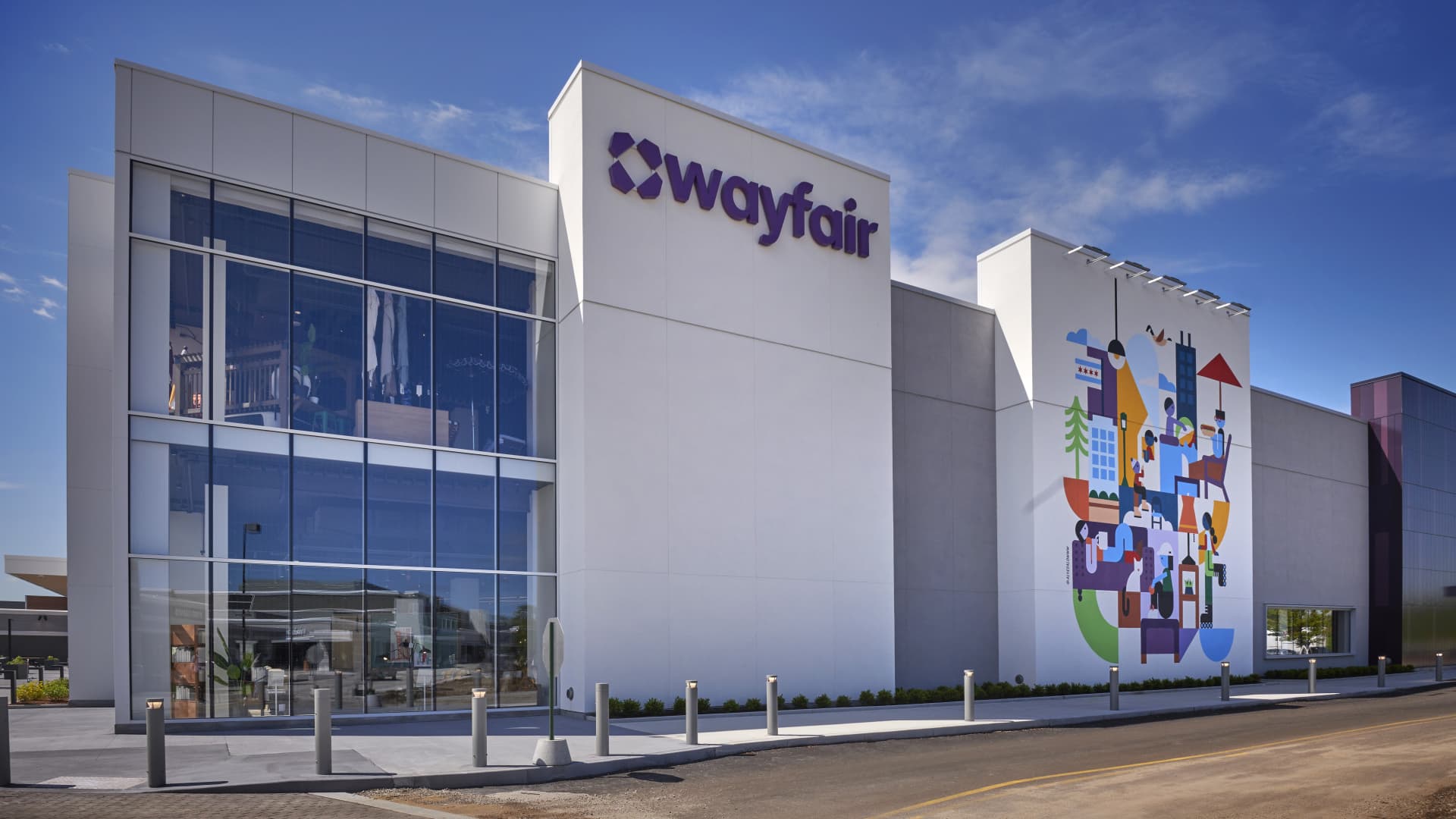
Wayfair store in Wilmette, Illinois.
Provided by: Wayfair
wayfairAnnual sales rose last year for the first time since 2020, as online furniture companies continue to attract value-seeking consumers, the retailer announced Thursday.
In 2025, Wayfair’s revenue increased 5.1% to $12.5 billion. This increase follows a year-over-year decline of more than 1% in 2024.
The e-commerce giant also beat Wall Street expectations on fourth-quarter fiscal revenue and bottom line, delivering better-than-expected adjusted earnings as strong sales flowed into the business.
“The fourth quarter capped off a great year for Wayfair,” said co-founder and CEO Niraj Shah. “…We achieved three consecutive quarters of new customer growth in addition to a healthy increase in repeat orders, all in the face of a category that contracted by low single digits in the final quarter of the year. 2025 was a year in which we returned to growth and accelerated throughout the year through a number of organic business strategies that have the potential to compound over the next few years.”
Despite sales growth and better-than-expected results, Wayfair shares fell more than 10% in premarket trading Thursday.
Here’s how Wayfair’s fourth-quarter results compare to Wall Street expectations, based on a survey of analysts by LSEG.
Earnings per share: 85 cents adjusted, 66 cents expected; Revenue: $3.34 billion, $3.3 billion expected.
For the three months ended Dec. 31, Wayfair reported a loss of $116 million, or 89 cents per share, compared with a loss of $128 million, or $1.02 per share, in the year-ago period. Excluding one-time items related to stock-based compensation and other one-time charges, Wayfair’s earnings per share were 85 cents.
Wayfair has had two consecutive quarters of strong revenue growth. Revenue for the same period was $3.34 billion, an increase of approximately 7% from $3.12 billion in the same period last year.
Wayfair hasn’t reported annual net income since 2020, but its adjusted earnings before interest, taxes, depreciation and amortization have increased. During the quarter, Wayfair posted adjusted EBITDA of $224 million, beating expectations by $200 million, according to StreetAccount.
“Ultimately, this is the culmination of our efforts throughout 2025. I think it’s been a very important year for us in proving both our share price appreciation and our earnings story,” Finance Director Kate Gulliver said in an interview with CNBC. “As a result, we had a very strong sales quarter, continued to gain share despite challenging macros, and then delivered very impressive flow-through and strong growth in our adjusted EBITDA line.”
The company’s profitability has improved as sales have increased over the past two quarters. If sales trends continue, the company expects earnings to improve further.
Wayfair’s growth comes at a difficult time for the furniture industry, where tariffs, high interest rates and weak home sales are weighing on demand for new sofas and kitchen tables. Consumers are still spending money on these products, but they are instead prioritizing value and low prices, and Wayfair is well-positioned to provide that through its extensive network of manufacturers.
Average order value for the quarter increased to $301 from $290 a year ago, and the number of orders delivered increased at a similar pace. While prices are rising across the home goods sector, Wayfair’s volume trends are consistent with order values.
Over the past year, Wayfair has focused on improving the customer experience through initiatives such as its rewards program and Wayfair verify, which stamps products with the quality the company recommends. Gulliver said the website has also been improved.
“I think the combination of these customer-facing efforts has allowed us to gain share in a category that still seems quite challenged,” Gulliver said.
