

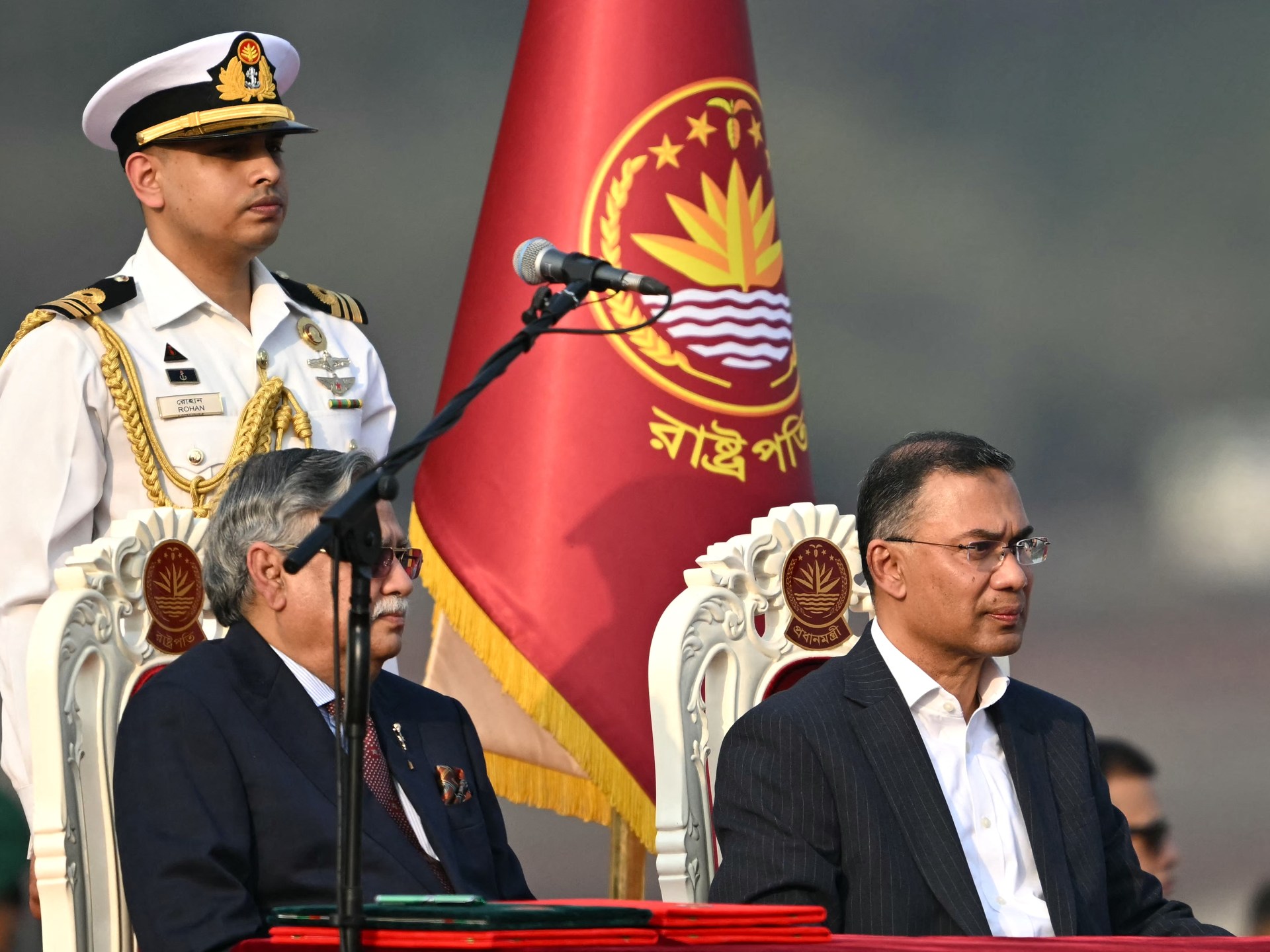
Following a landslide victory in last week’s parliamentary elections, Bangladesh Nationalist Party (BNP) leader Tariq Rahman has become the country’s first elected prime minister since the 2024 mass protests that led to the ouster of the previous government and Prime Minister Sheikh Hasina.
The Rahman Party-led political alliance won 212 seats in Bangladesh’s parliament, Jatiya Sangsad, in Thursday’s election, while its main rival, the Jamaat-e-Islam-led alliance, won 77 seats.
On Tuesday, Mr. Rahman took the oath of office and the newly elected members swore allegiance to the country after being sworn in by AMM Chief Election Commissioner Nasir Uddin in the oath room of Parliament House.
Foreign officials, including Pakistan’s foreign minister and the Indian speaker of parliament, were also present.
Here’s what we know about the people running Bangladesh’s new government.
Who are the new ministers?
The 25 full-time ministers of the new cabinet were sworn in at a separate ceremony in Dhaka on Tuesday afternoon. The vast majority of the 25 were drawn from the BNP and its close allies.
Among the state ministers appointed by Rahman’s government were first-time parliamentarians Nurul Haq and Zonaid Saki, who became prominent voices in the 2024 protests.
The cabinet members have been announced, but the ministries and agencies in charge have not yet been decided. Now let’s take a look at who some of them are.
Mirza Fakhrul Islam Alamgir
Alamgir, who has been BNP’s general secretary since 2016, was elected to parliament from the Thakurgaon 1 constituency in northwestern Bangladesh.
Mr Alamgir, 78, was a member of parliament from 2001 to 2006 under the former BNP government led by Mr Rahman’s late mother Khaleda Zia, during which time he also served as minister of state for agriculture and later minister for civil aviation and tourism.
After the term of that government ended, an interim government was established until elections in 2008, but Alamgir ran for office but did not win. He remained a senior member of the BNP outside parliament.
In October 2023, when Hasina’s Awami League was in power, Alamgir was detained by police the day after large-scale anti-government protests erupted in Dhaka. Police said he was detained for questioning in connection with the violence that occurred during the demonstrations.
When the BNP’s victory was announced last week, Alamgir praised the victory and called it the “people’s party”.
Amir Qasr Mahmoud Chaudhry
Chaudhary was elected from Chattogram-11 constituency, which covers Bandar and Patenga districts of Chattogram city in southeastern Bangladesh.
From 2001 to 2004, Chaudhary served as Minister of Commerce under the previous BNP government. He is a member of the Standing Committee of the BNP.
Before last week’s vote, Chaudhry said if elected, the BNP would govern by investing in human resources in “health, education and upskilling” and by supporting access to international markets through credit support and branding support for “artisans, weavers” and small-scale industries.
Iqbal Hasan Mahmood Tuk
Mr. Tuku, 75, was elected as the Member of Parliament from Sirajganj 2 constituency in North Bengal.
Mr Thuku is a member of the BNP Standing Committee, the party’s highest policy-making body.
He is a veteran of the BNP, having been elected to parliament many times and holding important roles in the party. From 2001 to 2006, he served as Deputy Minister of Power. He also briefly served as Deputy Minister of Agriculture in 2006.
In 2007, during the military-backed caretaker government, the Special Anti-Corruption Court in Dhaka handed down a nine-year prison sentence in a case brought against Tuk by the Anti-Corruption Commission (ACC). The ACC accused Mr. Tuku of concealing information about assets worth 49.6 million taka (approximately $400,000).
The High Court upheld his conviction and prison sentence in 2023 after a lengthy appeals process. However, in September 2025, a year after the overthrow of the Awami League government, the Appellate Division of the Supreme Court acquitted Tuku.
Khalil Rahman
Khalil Rahman was a technocrat, appointed for his expertise and not as a political party politician. He is not a member of Congress.
He served as national security adviser to the interim government led by Muhammad Yunus, which oversaw the transition after Hasina’s ouster.
During Yunus’ tenure, he also served as the government’s representative on the Rohingya issue. More than a million Rohingya refugees are sheltered in refugee camps in Cox’s Bazar in southern Bangladesh, the majority of whom fled Myanmar in 2017 to escape military crackdowns.
Afroza Kanum Rita
Rita, the only female cabinet minister, is a first-time member of parliament, but comes from a family of politicians whose late father was a four-time member of parliament. Rita is also the Chairman of Monno Group of Industries, a conglomerate that produces ceramics, textiles and agricultural machinery, primarily for export.
Asaduzzaman
Asaduzzaman was elected from Jhenaidah-1 (Shailkupa) constituency, which covers Shailkupa upazila in Jhenaidah district in southwestern Bangladesh.
Depen Dewan
Mr. Dewan, 62, a Chakma Buddhist leader, will be appointed as the minister in charge of the Chittagong Hill Tracts. Mr. Dewan won from Rangamati constituency.
Chakma Buddhists are an ethnic group of Tibeto-Burmese speaking people. They live in the Chittagong Hill Tracts of Bangladesh and parts of northeastern India.
Nitai Roy Chowdhury
Chaudhary, a Hindu leader, is widely expected to become culture minister.
Chaudhry, 77, has served as a senior advisor and strategist to top BNP leaders.
How important are these appointments?
During the election campaign, the BNP vowed to respond to the people’s demand for an elected government with true legitimacy. Ministers and ministers are therefore expected to be subject to considerable scrutiny, experts say.
Khandakar Tahamid Rejwan, lecturer in global studies and governance at Bangladesh Independent University, told Al Jazeera: “The appointees in their respective fields will face invisible but significant pressure to prove themselves more competent and distinctive than the interim government and, of course, the previous Awami League-led regimes led by Sheikh Hasina.”
He added: “It will be particularly interesting to observe whether the core of executive power will be handed over to the old guard after the youth-led uprisings, or whether it will be taken over by new faces reflecting a diversity of age, gender, ethnicity and religion.”
Two prominent figures of the 2024 student uprising, Nurul Haq and Zonaid Saqi, were nominated as state ministers, but Rejwan added that the leadership of the student-led National Civic Party, which was founded after the 2024 uprising, had made a “strategic mistake” by allying with Jamaat rather than the BNP.
“They had the option of allying with the BNP, but later abandoned it in favor of Jamaat. Given these political dynamics, student leaders are unlikely to win ministerial posts.”
Who attended the swearing-in ceremony of the new cabinet?
Several foreign delegations had visited Bangladesh to attend the ceremony.
Among them were Maldives President Mohamed Muiz and Bhutan’s Prime Minister Tshering Tobgay.
India was represented by Speaker Om Birla. Pakistan’s Federal Minister for Planning Ahsan Iqbal was also present.
Leaders and representatives from Nepal, the United Kingdom, China, Saudi Arabia, Turkiye, United Arab Emirates, Qatar, and Brunei were invited to attend.
