

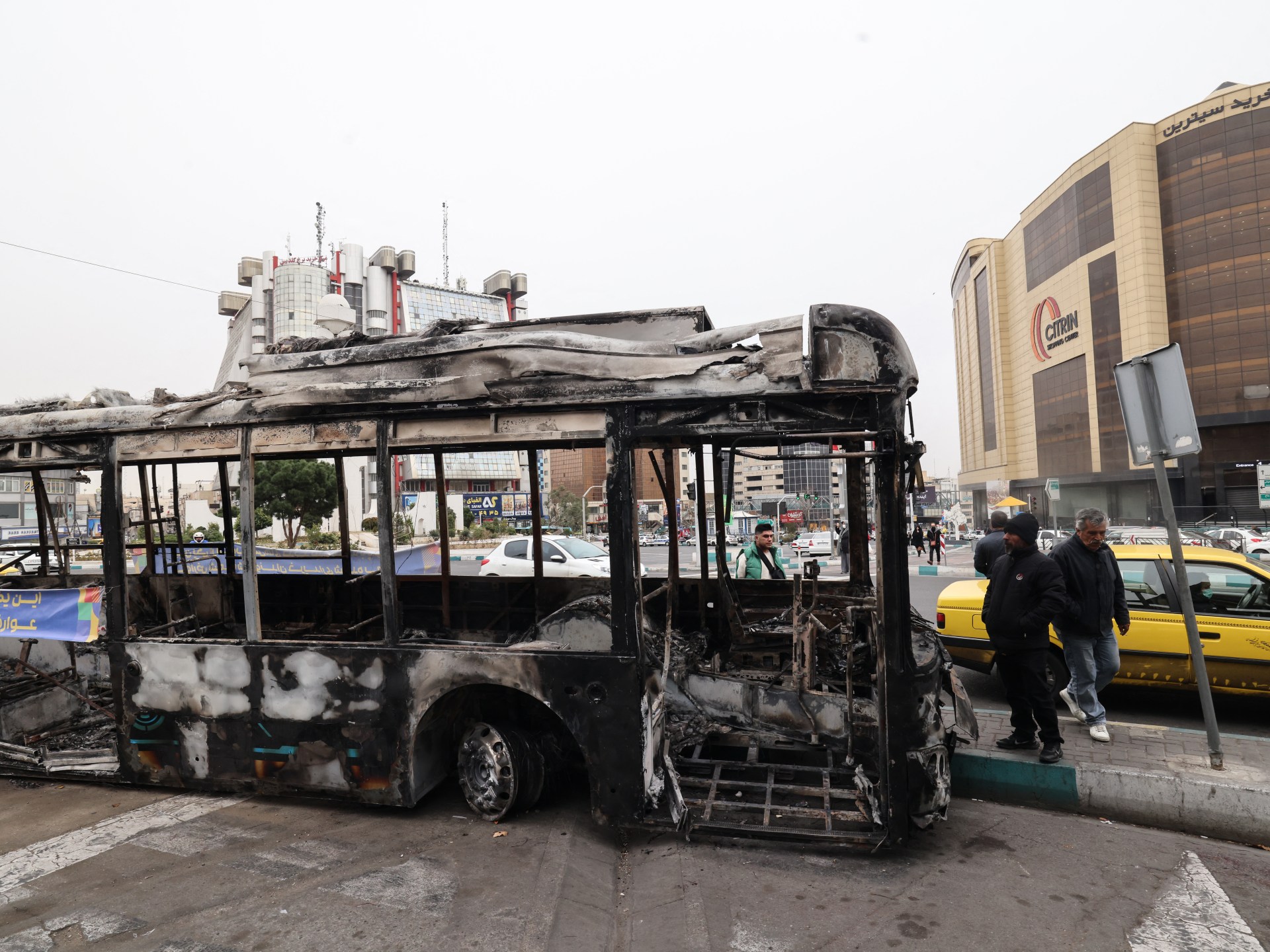
Four weeks after shopkeepers in Tehran’s Grand Bazaar closed their shops in protest of the tanking economy, much of the country is experiencing an internet blackout as protests that escalated into mass demonstrations against Iran’s clerical rule have subsided.
Hundreds of thousands of people who took to the streets in response to protests by shop owners are now reportedly staying at home after many protesters died and were detained.
The Iranian government has not released an official death toll, and estimates of the number of people killed in the protests vary. However, the widely quoted US-based Human Rights Activists News Agency (HRANA) put the death toll this Wednesday at 2,615. The Iranian government claims the numbers are greatly exaggerated.
Tensions with the United States soared this week when President Donald Trump threatened to take action if the killings continued, but appeared to backtrack on Wednesday night, saying he had received assurances from the Iranian government that the killings would stop and that detained protesters would not be executed.
But while the protesters may be silent for now, their concerns remain unaddressed. The threat of US intervention remains very real and, importantly, the dire economic situation that first sparked the protests at the end of 2025 will only worsen.
Why did economic protests erupt?
“The recent unrest is definitely rooted in economic hardship,” Hassan Hakimian, professor emeritus of economics at SOAS, told Al Jazeera. “Decades of chronic corruption and widespread economic mismanagement, further accentuated by international economic sanctions, have further increased the misery of widespread ordinary people.”
In addition to this, Hakimian said that Iran has been suffering from severe environmental problems in recent months, including “severe water shortages, power outages, and catastrophic air pollution, creating a perfect economic storm.”
The value of the Iranian rial, which fell to an all-time low against the dollar on December 28 and nearly crashed, sparking the initial protests, remains at an all-time low.
Bank ATMs are offline, flights and currency transactions remain restricted, and there have been casualties from the shutdown of Iran’s state-controlled domestic intranet, the National Information Network, which is essentially the country’s internet.
“Given that the shutdown lasted about a month, we can pretty much say that the Iranian economy has been operating at about 50% capacity during this period,” said Javad Salehi Isfahani, an economics professor at Virginia Tech. “Assuming that’s true, if that goes on for a month, you’ll lose about a tenth of the country’s GDP. How much that amounts to in dollars depends on the currency conversion you use. It always fluctuates, but over the course of a year it’s probably somewhere between $20 billion and $90 billion.”
How have sanctions affected Iran’s economy?
War, sanctions and shifting economic priorities have slowed Iran’s economy to a much slower rate today than it did during the Islamic revolution in 1979, experts say.
One of the main reasons is that Iran is one of the most heavily sanctioned countries in the world.
Economic sanctions against Iran, beginning with those imposed by the United States shortly after the revolution and followed by further sanctions imposed by the United Nations in 2006 over its nuclear program, have played a central role in tipping Iran’s economy to the brink of collapse. Trust was further eroded by an Israeli attack last June that sparked a 12-day war between the two countries.
The United States first imposed sanctions on Iran in 1979, when an Islamic revolution overthrew the Shah, or monarch, Mohammad Reza Pahlavi. At the time, the country’s military was notorious for using repression and torture to maintain power without a democratic mandate.
In 1979, the US government also suspended oil imports from Iran and froze $12 billion in Iranian assets.
In 1995, then-President Bill Clinton issued an executive order banning U.S. companies from investing in Iranian oil and gas and doing business with Iran. A year later, the US Congress passed a law requiring the US government to impose sanctions on foreign companies that invest more than $20 million annually in Iran’s energy sector.
In December 2006, the United Nations Security Council imposed its own sanctions on Iran’s trade in nuclear energy materials and technology and froze the assets of individuals and companies involved in related activities.
In the years that followed, the United Nations tightened sanctions, and the European Union followed suit.
In 2015, Iran signed a nuclear agreement, the Joint Comprehensive Plan of Action (JCPOA), with the US, UK, China, France, Germany, Russia, and the EU. Under the agreement, Iran agreed to refrain from enriching uranium and research for 15 years.
However, in 2018, during his first term as president, Trump unilaterally withdrew the United States from the nuclear treaty and reimposed all sanctions on Iran.
In 2019, the Trump administration designated Iran’s Islamic Revolutionary Guards Corps (IRGC) as a “foreign terrorist organization.” Additionally, President Trump imposed sanctions targeting petrochemicals, metals (steel, aluminum, copper), and Iranian officials.
On January 3, 2020, the United States also imposed additional sanctions on Iran after a drone strike in Baghdad, Iraq, assassinated Qasem Soleimani, commander of the Revolutionary Guard’s elite Quds Force.
In September 2025, the Security Council voted against permanently lifting economic sanctions against Iran, and UN sanctions were reimposed on Iran over its nuclear program.
Currently, nearly all of Iran’s oil revenues remain frozen under U.S. and other international sanctions. In addition, assets held overseas are frozen, trade is restricted, and banks are targeted.
Financial networks and companies involved in the development of Iran’s nuclear and ballistic missile networks, as well as organizations such as the Islamic Revolutionary Guard Corps, which much of the international community holds responsible for the domestic crackdown, are also subject to sanctions and are not allowed to do business with the United States or other countries that have imposed sanctions.
China currently buys more than 80% of the crude oil shipped to Iran, according to 2025 data from analytics firm Kpler. Much of it is transported by “shadow fleets” of oil tankers that fly false flags or switch off tracking devices to evade sanctions.
How did this affect the Iranian people?
Even before last year’s conflict with Israel, many economists considered Iran’s economy to be locked in a period of “stagflation.” Slower growth, estimated at just 0.6% a year, according to the International Monetary Fund, combined with soaring prices have robbed many Iranians of their last hope for a stable future for themselves and their families.
Economists generally believe that an economic growth rate of 2 to 3 percent per year is ideal.
Over the past eight years, Iranians’ purchasing power, or the value of the money they have to spend, compared to the price of goods, has fallen by more than 90 percent. According to official statistics, food prices have soared by an average of 72% compared to last year as the rial depreciated against the dollar.
In December 2025, 1 US dollar = approximately 1.36 million rials on the open market, the worst real rate in history.
Then, in early January, when protests were in full swing, the Iranian rial further depreciated against the US dollar to 1.42 million rials. This is a 56 percent drop in value in just six months, and a significant drop from around R700,000 in January 2025.
Meanwhile, nearly one in five young people is unemployed.
Why is the real exchange rate important?
“One of the economic indicators that really matters to people is the exchange rate,” explained Iranian-American economist Nader Habibi. “People are paying close attention to where the dollar stands relative to the rial, and as uncertainty increases, so does the amount of foreign currencies such as dollars and gold.”
Habibi said a shortage of foreign currency after last June’s attack on Israel and competition for funding from a government rushing to rebuild and maintain its defense after a 12-day war undermined confidence in Iran’s economy and accelerated the rial’s collapse.
“The rapid devaluation of the rial was more than even the conservatives in a society like the Bazaar could cope with,” Habibi said, referring to the common name of shopkeepers working in the Grand Bazaar.
“Think of you want to sell a TV, and if you sell it, you need to buy another TV to replenish your inventory the next day,” he explained. “It all depends on being able to buy a new TV for less than the price you sold your last one for. But after the real collapse, the bazaars felt they couldn’t do that, so they closed their shops and took to the streets.”
What will happen next?
“The protests have subsided in the last two or three days because a huge number of people were killed. That’s why people didn’t go out,” one Tehran resident, who did not wish to be named, told Al Jazeera.
But experts say people remain angry about the current state of the economy. “The reality is that the regime does not have a quick fix to alleviate the dire situation it is facing. Even if it succeeds in suppressing the protests by force, it will not solve the fundamental problem,” economics professor Hakimian said.
External intervention, such as by the United States, is unlikely to help, he added.
“Those who support dynamic action overlook its poor track record in the region and its potential to further complicate an already difficult situation through collateral damage in Iran and broader regional conflict.”
