

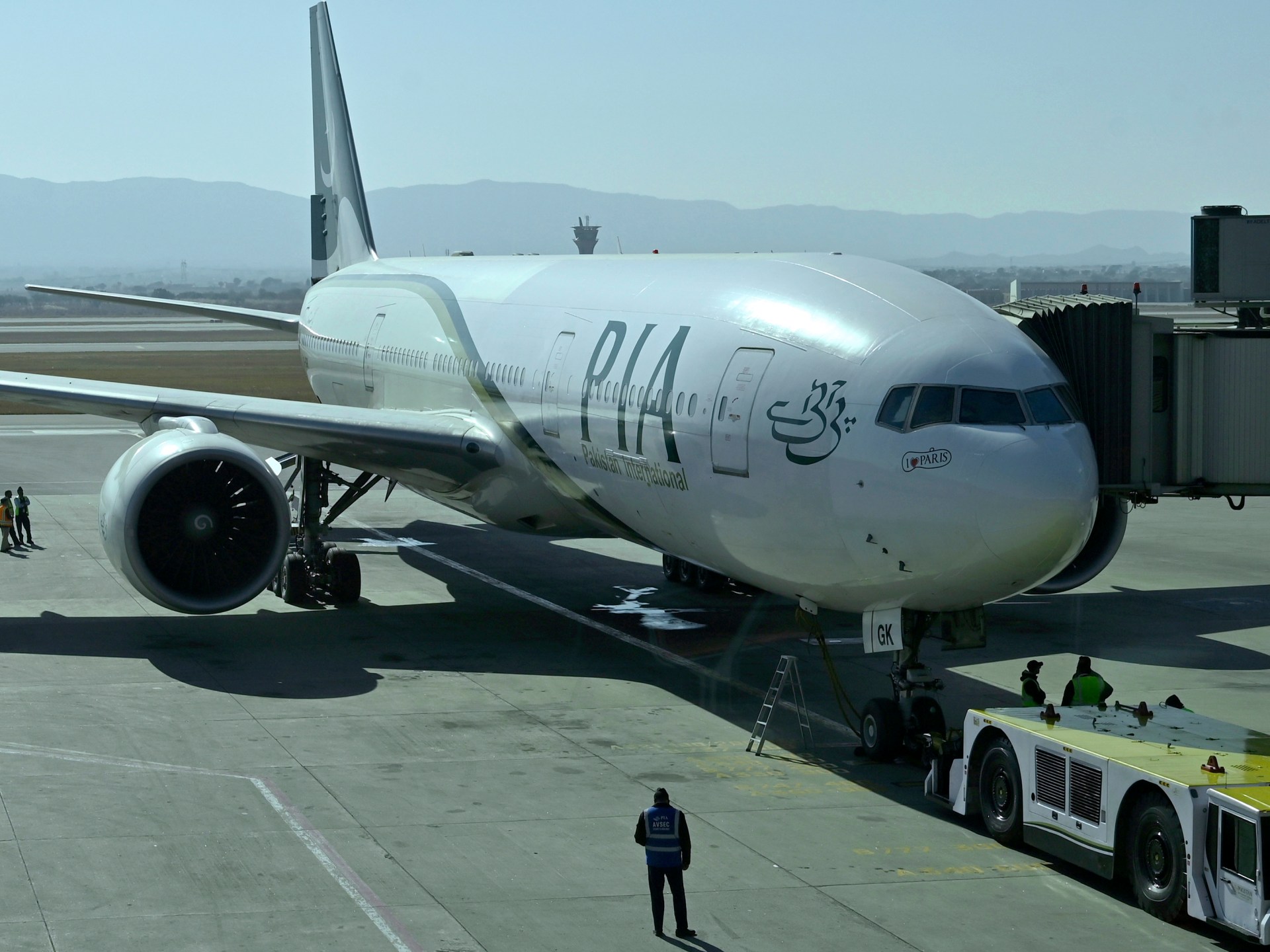
ISLAMABAD, Pakistan – After 70 years as Pakistan’s national airline, the government sold a majority stake in Pakistan International Airlines (PIA) for $482 million in a public television auction earlier this week, ending years of failed privatization attempts.
Karachi-based brokerage firm Arif Habib Limited (AHL) led the winning consortium, which included AKD Group Holdings Limited, fertilizer manufacturer Fatima Fertilizer, private school network City Schools and real estate company Lake City Holdings Limited.
Recommended stories
list of 4 itemsend of list
Following the successful bid, Fudge Fertilizer Company Limited (FFC), a military-owned listed company, also joined the consortium. The group faced competition from a rival consortium led by Lucky Cement and private airline Air Blue.
The auction was widely publicized and broadcast live by the government, and was the second formal attempt to privatize PIA. A previous effort in October 2024 was thwarted when a single bid of $36 million from a private real estate company fell well below the government’s $305 million floor price.
The privatization of PIA followed pressure from the International Monetary Fund (IMF), which urged Islamabad to sell loss-making state-owned enterprises. Pakistan is currently under a $7 billion IMF loan program and had promised to complete the privatization of the airline by the end of this year.
Here’s what we know so far about the sale, the winning consortium, and why the deal has drawn criticism from opposition parties and other quarters.
What do we know about the winning bid price?
The bidding took place on Tuesday at a packed five-star hotel in Islamabad and lasted about 90 minutes with several breaks. Three parties have made initial bids for a 75% stake in the national airline.
To attract investors, the government restructured PIA last year by spinning off more than $2.3 billion worth of long-term debt into a separate entity. It also provided policy continuity guarantees and tax breaks approved by the IMF.
Air Blue was disqualified from public bidding in the first round after offering $94.59 million, well below the government’s minimum price of $356.9 million.
Once the remaining two consortiums cleared the reserve price, open bidding began. The AHL-led group won with a final offer of $482 million for a 75 percent stake.
At a press conference the next day, the government’s advisor on privatization, Muhammad Ali, said 92.5% of the winning bid (about $446 million) would be reinvested into PIA itself. The remaining $36 million will be donated to the government, which will also retain a 25% stake worth about $160.6 million.
Arif Habib later told a private television channel that the consortium also intended to buy the remaining 25% stake, with the aim of restarting the airline by April next year.
Under the terms of the deal, the consortium must pay two-thirds of the purchase price within three months and the remaining third within one year. A decision on the acquisition of the remaining 25% of the shares must be made within three months.
Why was there a need to privatize PIA?
Once considered Pakistan’s most famous brand, PIA operated flights all over the world and boasted uniforms designed by Pierre Cardin. Founded in 1955 with a fleet of 13 aircraft, the airline quickly expanded its footprint.
PIA operated its first international flight to London via Cairo and Rome and has since achieved several milestones. It was the first Asian airline to acquire the Boeing 707 jet, opened new international routes and is credited with helping launch Dubai-based airline Emirates in the 1980s.
But more than two decades later, the airline is widely seen as a burden to the debt-ridden nation. Successive governments have tried to ease the burden on PIA, but failed due to resistance from opposition parties and protests from employee unions.
Ali said PIA accumulated more than $1.7 billion in debt between 2015 and 2024, with long-term debt exceeding $2.3 billion.
“This process builds on the lessons of the past and was completed with extensive preparation and accountability,” he said at a press conference on Wednesday.
PIA once operated about 50 aircraft and served about 40 international destinations, Ali said. Currently, only 18 of the 33 aircraft are operational.
The airline currently flies to about 30 destinations and operates about 240 round-trip flights a week, accounting for more than 30 percent of the domestic market, it added. With the rise of private carriers, that share has fallen sharply from at least 60 percent in previous decades.

PIA also holds landing rights to at least 78 destinations and has access to more than 170 airport slots.
In 2014, the company employed more than 19,000 people, including at least 16,000 full-time staff. Over the years, its workforce gradually declined to less than 7,000 people.
PIA was also banned from flying to the UK and Europe in June 2020, a month after one of its planes crashed into Karachi, killing 97 people. The disaster was blamed on human error by the pilots and air traffic control, followed by allegations that nearly a third of the pilots’ licenses were fake or questionable.
However, a four-year ban on entry from Europe was lifted by the European Union Aviation Safety Agency in December 2024, and Pakistan’s state-owned airline resumed flights to the continent in January. The UK subsequently lifted its ban in July.
What are the criticisms of the auction? How do analysts view this auction?
The government hailed the deal as the “best possible outcome” with “great symbolic value”, but the opposition condemned it.
The opposition coalition Tehreek-e-Tahafuz Aye-i-Pakistan (TTAP), led by former Prime Minister Imran Khan’s Pakistan Tehreek-e-Insaf (PTI), rejected privatization and warned that it is unacceptable to dispose of state assets without a people’s mandate, parliamentary oversight, transparency and constitutional legitimacy.
Other commentators questioned the bidding process, saying it was an act of “obfuscation” that raised more questions than answers. Some accused the government of effectively selling off 75% of its stake for just $36 million. The rest will be reinvested into the airline and the new private owners will benefit from it.
Ali dismissed those claims.
“Our structure was such that we would get 10 billion rupees ($36 million) in cash and the equity value would be 45 billion rupees ($160 million). So the government would get a total value of 55 billion rupees ($196 million) and 125 billion rupees ($446 million) would flow back to the airline,” he said.
Several economists and aviation analysts have argued that the result was the best possible agreement regardless of which government was in power.
Fahad Ali, economist and assistant professor at Lahore University of Management Sciences (LUMS), said the agreement is complete.
“Critics also talk about the lucrative landing rights and shipping lanes that PIA holds and how the new owners will sell these to recover costs. But people don’t understand that PIA’s destination is the goose that lays the golden egg,” he told Al Jazeera.
He said airlines were unable to take advantage of these routes because they required additional investment that the state could not provide, adding that selling these routes would have a negative impact on future revenues.
“Given these constraints, this agreement seems OK,” he said.
Karachi-based economic commentator Khurram Hussain said the deal was an anomaly, driven more by the need to stem losses than profits.
“There are two ways to cut losses: shut everything down, take the company private and delist it so PIA no longer exists, or the other way is to hand it over to the private sector and let them run it,” he told Al Jazeera.
Hussain, a former fellow at the Woodrow Wilson Center, said PIA’s $2.3 billion in long-term debt would have continued to grow if the government had not taken action.
“At what point do you stop? That was the government’s calculation. They were not looking to cut losses, they were looking to contain losses,” he said.
Who are the members of the consortium and why does the military’s participation raise questions?
The consortium is led by Arif Habib, whose business interests include brokerage services, fertilizers, steel and real estate. He has previously served on the Privatization Commission.
Other partners include Fatima Fertilizer, part of the Fatima Group and Arif Habib Group, City Schools, which was founded in the late 1970s and currently operates more than 500 campuses and has at least 150,000 students, and Lahore-based real estate development company Lake City Pakistan. AKD Holdings, headed by businessman Akeel Karim Dedi, is also part of the group.
However, Fauji Fertilizer Company (FFC)’s decision to join the consortium after the sale sparked controversy. FFC, which is listed on the Pakistan Stock Exchange, is a subsidiary of the military-run Fauji Foundation, which owns more than 40 percent of the company’s shares.
The move by FFC, Pakistan’s largest fertilizer producer with interests in energy, food and finance, is seen by some as an expansion of the military’s footprint into aviation.
Pakistan’s military remains the country’s most powerful institution, having ruled directly for more than three decades and retaining deep influence over political, social, and economic affairs.
Critics point to the Special Investment Facilitation Council (SIFC) as an example of the military’s growing role in economic decision-making. Established in June 2023 during Prime Minister Shehbaz Sharif’s first term, SIFC is a powerful body of civilian and military leaders tasked with breaking through bureaucracy and promoting investment. It has faced sustained criticism over its transparency.
Hussain said FFC’s presence in the consortium could prove to be “very important” in the long run.
“What is actually happening under this agreement could be that the PIA has been moved from one state department to another,” he said.
Ali Khizar, a Karachi-based economic analyst, said FFC’s participation could provide long-term security to retail investors.
“Historically, we have seen policies change 180 degrees in Pakistan with a change of government, so perhaps there was a need to ensure a military presence to provide security for investors. But if FFC ends up owning more shares than AHL, that could change its influence and decision-making,” he told Al Jazeera.
Fahad Ali said military-run companies tend to operate differently than other state-owned enterprises (SoEs).
“They remain shielded from the political interference that plagues other SoEs. But anyone who thinks the country can walk away from PIA in the future may be mistaken,” he said.
Kizar added that while the deal would be a milestone after two decades of failed attempts to privatize airlines, concerns would remain if airlines, currently backed by large amounts of private capital and military influence, were to dominate the aviation market.
“There are concerns for other domestic airlines as well,” he acknowledged. “But there is a lot of potential there. PIA’s main opportunity is the international market and we have to compete there,” he said.
