

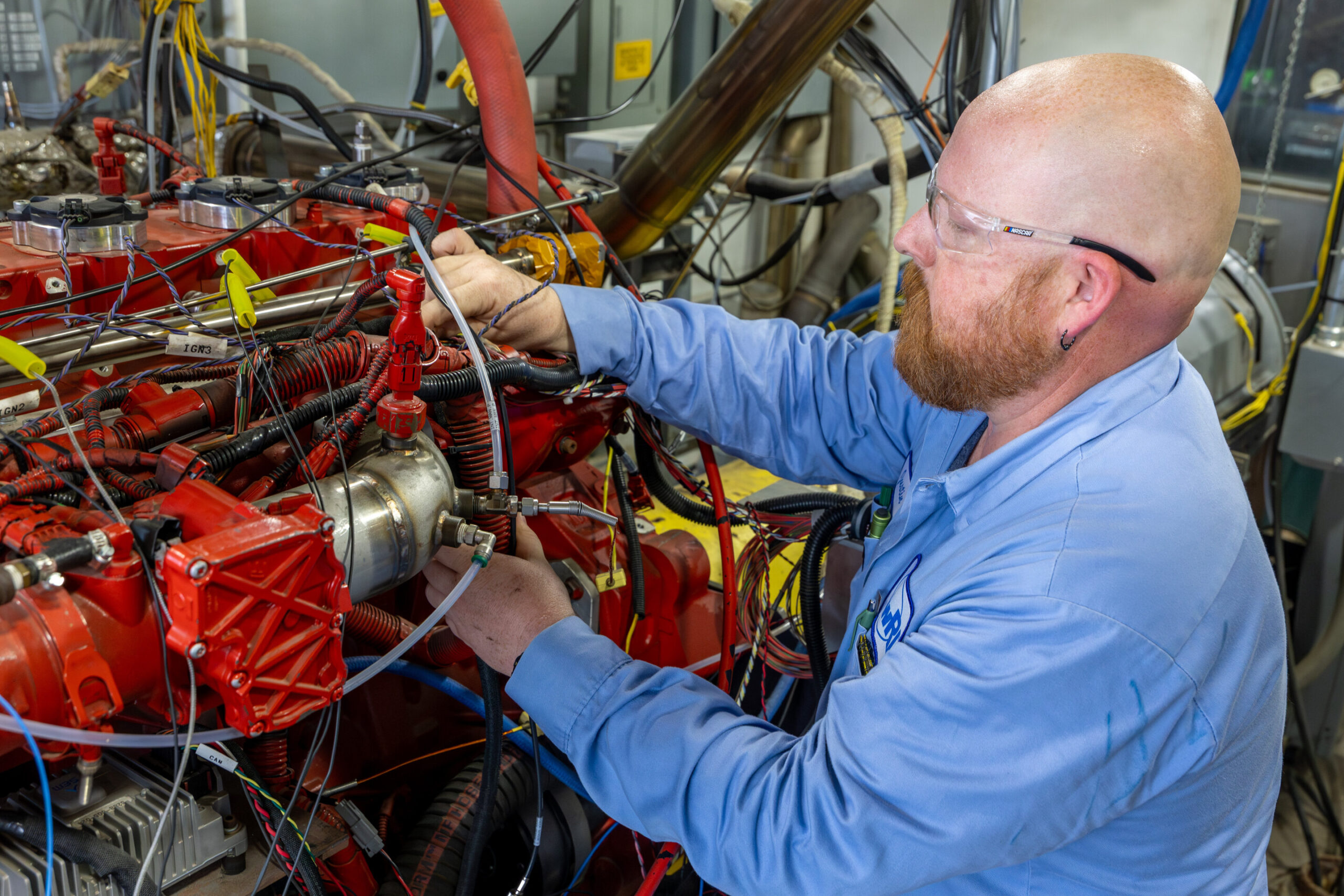

SwRI has a multidisciplinary team dedicated to hydrogen energy research initiatives to deploy decarbonization technologies across a wide range of industries. In 2022, SwRI began modifying a large natural gas-fueled engine to run on 100% hydrogen fuel, with successful demonstration in 2024. SwRI continues to research, design, and innovate H2-ICE technology. Credit: Southwest Research Institute
Southwest Research Institute (SwRI) has upgraded its hydrogen-powered large internal combustion engine (H2-ICE) with an advanced turbocharger. This upgrade significantly improves overall performance, making it more competitive with today’s fuel-efficient long-range diesel engines while maintaining near-zero tailpipe emissions.
In 2023, SwRI converted a traditional natural gas-fueled internal combustion engine to run solely on hydrogen fuel with minimal modification. It was integrated into a Class 8 truck as part of the institute’s H2-ICE project, demonstrating a cost-effective hydrogen-fueled engine as a heavy-duty transportation option with zero tailpipe carbon dioxide.
The new turbocharger unit improves the truck’s already solid performance by increasing peak torque from 1,494 to 1,760 foot-pounds (lb-ft) and peak power from 370 to 440 horsepower (hp). Modern long-range heavy-duty engines have power outputs of 1,450 to 1,850 lb-ft, with outputs ranging from 400 to 500 horsepower.
“Upgrading this drive turbocharger gives us the airflow we need to continue improving engine performance,” said Chris Bitsis, assistant director of SwRI Powertrain Systems Engineering, who oversees the combustion research program.
“For example, in addition to increased torque and horsepower, we also increased the engine’s peak efficiency to 44.0 percent, which is best in class for a spark-ignition engine. Torque and power ratings are comparable to fuel-efficient diesel trucks on the road today, with the added bonus of near-zero tailpipe emissions.”
Hydrogen engines often struggle to maintain the necessary airflow during high-speed acceleration to eliminate pre-ignition and minimize NOX emissions. SwRI met this challenge by working with a commercial supplier who designed a new turbocharger to SwRI’s specifications. The turbocharger’s shaft is mechanically connected to the crankshaft via a variable drive, allowing it to provide the required boost pressure on demand.
“This is an important milestone in the history of SwRI’s hydrogen combustion engine program and is further evidence that this technology is ready,” Bitsis said. “We are excited to continue advancing this technology towards a sustainable future.”
The Class 8 demonstration vehicle was developed as part of SwRI’s Hydrogen Internal Combustion Engine (H2-ICE) consortium. SwRI continues to help the automotive and transportation industries understand and address the technical challenges in developing clean and efficient hydrogen vehicles. The consortium’s completed Class 8 H2-ICE demonstration vehicle provides another zero-greenhouse gas option for the long-haul trucking market.
“We are proud of the SwRI team for demonstrating that we have a highly efficient, zero-emissions transportation solution that helps reduce CO2 and criteria pollutants,” said Daniel Stewart, vice president of powertrain engineering at SwRI. “The United States has the engine factories and supply chain needed to produce this technology today.”
Provided by Southwest Research Institute
Citation: Turbocharging Hydrogen-Fueled Internal Combustion Engines (November 17, 2025), Retrieved November 17, 2025 from https://techxplore.com/news/2025-11-turbocharging-hydrogen-fueled-internal-combustion.html
This document is subject to copyright. No part may be reproduced without written permission, except in fair dealing for personal study or research purposes. Content is provided for informational purposes only.
