

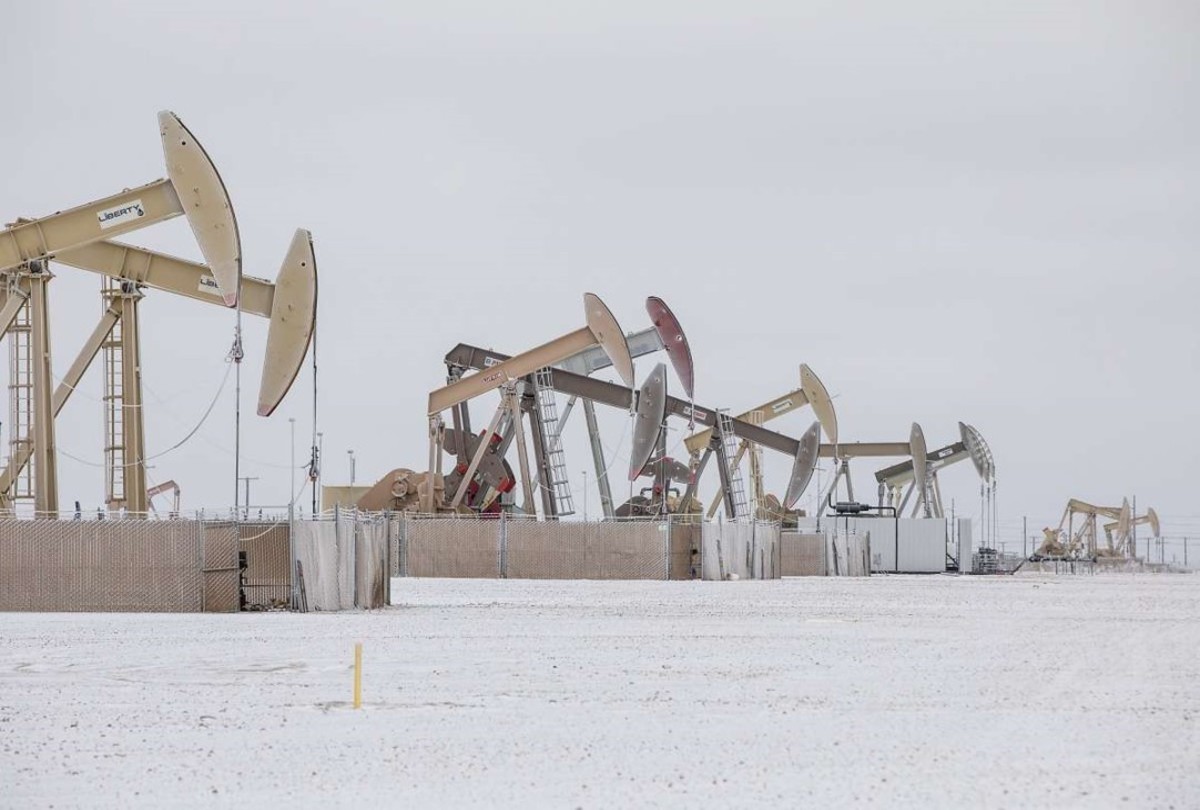
(Reuters) – U.S. oil producers lost up to 2 million barrels a day, or about 15% of national output, over the weekend, analysts and traders estimated, as winter storms swept across the country and strained energy infrastructure and power grids.
Oil production outages peaked on Saturday, with the Permian Basin likely experiencing the largest portion of the decline at about 1.5 million barrels per day, according to estimates from consultancy Energy Aspects. Production losses eased on Monday, with Permian’s outage estimated at about 700,000 barrels per day, with production expected to fully recover by Jan. 30.
U.S. oil and gas producer ConocoPhillips’ Permian crude output was down 175,000 barrels a day as of Sunday as a result of the frigid cold, the people said, not authorized to speak on the record.
ConocoPhillips typically does not comment on day-to-day operations, a company spokeswoman said.
Output in North Dakota, the third-largest oil producing state, was estimated to be down by about 80,000 to 110,000 barrels a day as of Monday morning, said Justin Kringstad, director of the North Dakota Pipeline Authority. Associated wellhead natural gas production is estimated to be reduced by 24 to 330 million cubic feet per day.
U.S. crude oil futures were trading around $60.60 a barrel as of 2 p.m. EDT, down about 50 cents on the day.
Chevron reported hatches that froze open during Sunday’s storm in Midland, Texas, while several refineries along the U.S. Gulf Coast reported problems related to the freezing weather, according to regulatory filings. ExxonMobil has closed operations at a petrochemical complex in Baytown, Texas, on Houston’s east side.
There were about 20 anomaly reports at natural gas processing plants and compressor stations in Texas over the weekend, according to regulatory filings, but that pales in comparison to the more than 200 anomalies reported during the first five days of 2021’s severe winter storm, TACenergy analysts said in a note Monday.


Average gas production in the lower 48 states fell to 106.9 bcfd so far in January, down from a monthly high of 109.7 bcfd in December, as producers halted production, according to LSEG.
Last month’s gas futures closed at $6.075 per million British thermal units, rising 80 cents, or 15.2%, to the highest since December 2022.
The power sector is under stress
About 810,000 customers across the U.S. remained without power Monday after the weekend’s arctic blast brought heavy snow, sleet and freezing rain from the Ohio Valley and the South Central region to New England. Cold weather is expected to continue in parts of the country over the next few days.
A weekend snow and ice storm knocked out power to more than 1 million homes and businesses across the U.S. Gulf Coast and Southeast, including Texas.
PJM, the nation’s largest power grid, expected generation outages to increase to 22.4 million kW, or about 16% of total committed capacity, on Monday. Most of those outages are expected to occur in Dominion Energy’s Mid-Atlantic region, according to PJM data.
PJM’s demand on Monday morning was 124 GW, higher than the expected 123.3 GW, but PJM continues to meet demand, according to PJM’s operational data.
Spot wholesale power prices are around $200 per MWh, recovering from a spike that briefly exceeded $3,000 per MWh over the weekend.
The next day, New England prices rose about 82% to $313 per megawatt hour, and PJM West prices in Pennsylvania and Maryland rose about 360% to about $413, the highest since January 2014.
Georgina McCartney and Aracey Somasekhar report from Houston, Scott DiSavino from New York and Tim McLaughlin from Boston. Editing: Liz Hampton and Nia Williams
Share this:
